Starting Monday with a Blonde Joke
An old, blind cowboy
wanders into an all-girl biker bar by
mistake.
He finds his way to a bar stool and orders
some coffee.
After sitting there for a while, he yells to
the waiter: “Hey, you wanna’ hear a
blonde joke?”
The bar immediately falls absolutely silent.
In a very deep husky voice, the woman next to
him says: “Before you tell that joke, Cowboy, I
think it is only fair, given that you are blind,
that you should know five things:
1. The bartender is a blonde girl with a
baseball bat.
2. The bouncer is a blonde girl.
3. I’m a 6 foot tall, 175 pound blonde woman
with a black belt in karate.
4. The woman sitting next to me is blonde and
a professional weightlifter.
5. The lady to your right is blonde and a
professional wrestler.
Now, think about it seriously, Mister…., do you
still want to tell that joke?”
The blind cowboy thinks for a second, shakes his
head, and mutters,
“No, not if
I’m gonna have to explain it five
times.”
Exporting Trash to Poorer Countries
From The New York Times, where you can read the entire article on exporting trash by clicking here
By ELISABETH ROSENTHAL
Published: September 26, 2009
ROTTERDAM, the Netherlands — When two inspectors swung open the doors of a battered red shipping container here, they confronted a graveyard of Europe’s electronic waste — old wires, electricity meters, circuit boards — mixed with remnants of cardboard and plastic.
“This is supposed to be going to China, but it isn’t going anywhere,” said Arno Vink, an inspector from the Dutch environment ministry who impounded the container because of Europe’s strict new laws that place restrictions on all types of waste exports, from dirty pipes to broken computers to household trash.
Exporting waste illegally to poor countries has become a vast and growing international business, as companies try to minimize the costs of new environmental laws, like those here, that tax waste or require that it be recycled or otherwise disposed of in an environmentally responsible way.
Rotterdam, the busiest port in Europe, has unwittingly become Europe’s main external garbage chute, a gateway for trash bound for places like China, Indonesia, India and Africa. There, electronic waste and construction debris containing toxic chemicals are often dismantled by children at great cost to their health. Other garbage that is supposed to be recycled according to European law may be simply burned or left to rot, polluting air and water and releasing the heat-trapping gases linked to global warming.
While much of the international waste trade is legal, sent to qualified overseas recyclers, a big chunk is not. For a price, underground traders make Europe’s waste disappear overseas.
After Europe first mandated recycling electronics like televisions and computers, two to three tons of electronic waste was turned in last year, far less than the seven tons anticipated. Much of the rest was probably exported illegally, according to the European Environment Agency.
Paper, plastic and metal trash exported from Europe rose tenfold from 1995 to 2007, the agency says, with 20 million containers of waste now shipped each year either legally or illegally. Half of that passes through this huge port, where trucks and ships exchange goods around the clock.
When we were blogging about pirates in Somalia, a Somali wrote in that part of the problem was that rich western countries were dumping toxic trash off the coast of Somalia and damaging the traditional fishing wealth of the country. Once trash is exported, there is no telling where it will be dumped, or what problems we are causing for our descendants down the road. I can’t help but think that we reap what we sow – and that we need to be paying attention to what we are dumping and where we are dumping it.
Expose Violators to Protect Consumers?
This article is from the Qatar Peninsula but it applies equally in Kuwait, in Seattle, in Pensacola . . . when a restaurant violates a health code, shouldn’t those results be made public? They are serving the public, they take our money, shouldn’t we know the state of hygiene and the safe-practices they observe – or don’t observe?
We still remember a time in Monterey, California when we walked into one of the most popular Chinese restaurants in town and found a table, without having to wait. It was astonishing. There were few customers that night. The next day in the paper we found it had been closed for health-code violations. We took comfort in knowing that when it re-opened, it had to pass a re-check, and it was probably the cleanest it had ever been, or would be for a time to come. 🙂
Restaurateurs want names of eateries violating rules to be made public
Web posted at: 9/27/2009 23:45:38
Source ::: THE PENINSULA
DOHA: The identity of the eateries punished for flouting health and safety rules should be disclosed by the authorities concerned, feel a number of restaurateurs in the city.
Not disclosing the name of an erring eating outlet is unadvisable since it can make all the eateries of a locality suspect in the eyes of patrons, say restaurateurs.
This happens especially as the authorities do mention the area an erring eatery is located in but fight shy of publishing its name in local newspapers.
Al Sharq Arabic newspaper in its weekly online survey took up this issue this time and an overwhelming 94 percent of the respondents said they were in favor of disclosing the identity of an erring eateries.
Only five percent said they did not back the idea, while one percent said they were undecided.
Kuwait Censors ‘Terror’ Blogs, Websites
Teeny Teeny Tiny Article in today’s Gulf Times:
Kuwait censors ‘terror’blogs, websites: report
Kuwait has blocked a number of Internet blogs and websites with links to “terror” cells and groups, a top official said in comments published yesterday. “The ministry has blocked blogs … used by some to communicate with terror cells and extremist groups,” communications ministry undersecretary Abdulmohsen al-Mazeedi told Kuwait’s An-Nahar newspaper. He said the ministry had also blocked sites deemed offensive to God and the emir and which undermined what he called national unity, in addition to sites promoting pornography. Mazeedi said the ministry was applying the law and “aims to preserve Islamic values.”
More information, from Al Watan:
Kuwait blocks terrorـlinked Web sites
KUWAIT: Kuwait has blocked a number of Internet blogs and Web sites with links to “terror” cells and groups, a top official said in comments published on Friday.
“The ministry has blocked blogs …used by some to communicate with terror cells and extremist groups,”Communications Ministry undersecretary Abdulmohsen AlـMazeedi told Kuwait”s AnـNahar newspaper.
He said the ministry has also blocked “sites deemed offensive to Almighty God and to His Highness the Amir Sheikh Sabah AlـAhmad AlـSabah and which undermined national unity,” in addition to sites promoting pornography. Mazeedi said the ministry was applying the law and “aims to preserve Islamic values.” However before blocking any site, the ministry takes permission from the Public Prosecution.
A number of MPs have described the ministry”s monitoring of blogs as a breach of the Constitution and threatened to question the communications minister in Parliament.
Last year, the Public Prosecution questioned Mohammed Abdulqader AlـJassem for writing an article on his Web site that was deemed offensive to the country”s crown prince.
In 2007, blogger and journalist Bashar AlـSayegh was detained for two days after comments deemed offensive to the Gulf state”s ruler were posted on his Web site.
The man, who posted the comments, a Kuwaiti citizen, was jailed for two years.ـAFP
Last updated on Saturday 26/9/2009
BitJockeys Suggestions: Fishermen and Skyline
OK, I made it more panorama by cropping out the excess sky, and I bumped up the saturation a little, and that is about all I can do, other than sepia, which doesn’t look right at all, and some other general effects that don’t enhance.
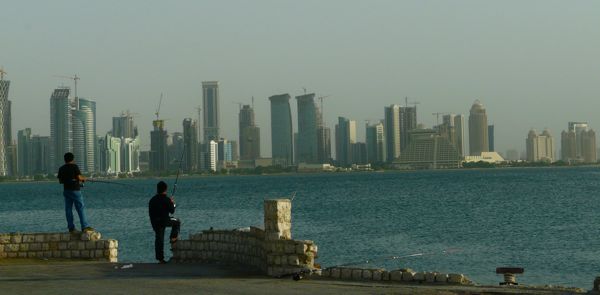
BTW, do you notice that the Sheraton – that pyramid shape at about 2/3 way across skyline – has just disappeared? It used to be the most striking building on the skyline and now, it disappears.
Slow Saturday; Yousef’s Take in Fisherman Skyline Photo
I LOVE what Yousef did. It’s a slow Saturday, nothing much going on. If you want a crack at this photo, take it. Play with it. Send it back to me, show us what you’ve done. Keep it clean. 🙂
Yousef:

is that a WOW or what?
So . . . I don’t have all these tools. Go for it. The shot is in the Eid morning photos you will find here so have some fun with it.

Wikipedia Today
I found this story in Time Magazine where you can read the rest of the story by clicking on the blue type. Wikipedia has been a great source of information for me, and I am fascinated to know Wikipedia’s growth is slowing – and why . .
Is Wikipedia a Victim of Its Own Success?
By FARHAD MANJOO
Looking back, it was naive to expect Wikipedia’s joyride to last forever. Since its inception in 2001, the user-written online encyclopedia has expanded just as everything else online has: exponentially. Up until about two years ago, Wikipedians were adding, on average, some 2,200 new articles to the project every day. The English version hit the 2 million — article mark in September 2007 and then the 3 million mark in August 2009 — surpassing the 600-year-old Chinese Yongle Encyclopedia as the largest collection of general knowledge ever compiled (well, at least according to Wikipedia’s entry on itself).
But early in 2007, something strange happened: Wikipedia’s growth line flattened. People suddenly became reluctant to create new articles or fix errors or add their kernels of wisdom to existing pages. “When we first noticed it, we thought it was a blip,” says Ed Chi, a computer scientist at California’s Palo Alto Research Center whose lab has studied Wikipedia extensively. But Wikipedia peaked in March 2007 at about 820,000 contributors; the site hasn’t seen as many editors since. “By the middle of 2009, we realized that this was a real phenomenon,” says Chi. “It’s no longer growing exponentially. Something very different is happening now.”
What stunted Wikipedia’s growth? And what does the slump tell us about the long-term viability of such strange and invaluable online experiments? Perhaps that the Web has limits after all, particularly when it comes to the phenomenon known as crowdsourcing. Wikipedians — the volunteers who run the site, especially the approximately 1,000 editors who wield the most power over what you see — have been in a self-reflective mood. Not only is Wikipedia slowing, but also new stats suggest that hard-core participants are a pretty homogeneous set — the opposite of the ecumenical wiki ideal. Women, for instance, make up only 13% of contributors. The project’s annual conference in Buenos Aires this summer bustled with discussions about the numbers and how the movement can attract a wider class of participants.
At the same time, volunteers have been trying to improve Wikipedia’s trustworthiness, which has been sullied by a few defamatory hoaxes — most notably, one involving the journalist John Seigenthaler, whose Wikipedia entry falsely stated that he’d been a suspect in the John F. Kennedy and Robert F. Kennedy assassinations. They recently instituted a major change, imposing a layer of editorial control on entries about living people. In the past, only articles on high-profile subjects like Barack Obama were protected from anonymous revisions. Under the new plan, people can freely alter Wikipedia articles on, say, their local officials or company head — but those changes will become live only once they’ve been vetted by a Wikipedia administrator. “Few articles on Wikipedia are more important than those that are about people who are actually walking the earth,” says Jay Walsh, a spokesman for the Wikimedia Foundation, the nonprofit that oversees the encyclopedia. “What we want to do is find ways to be more fair, accurate, and to do better — to be nicer — to those people.”
Yet that gets to Wikipedia’s central dilemma. Chi’s research suggests that the encyclopedia thrives on chaos — that the more freewheeling it is, the better it can attract committed volunteers who keep adding to its corpus. But over the years, as Wikipedia has added layers of control to bolster accuracy and fairness, it has developed a kind of bureaucracy. “It may be that the bureaucracy is inevitable when a project like this becomes sufficiently important,” Chi says. But who wants to participate in a project lousy with bureaucrats?
There is a benign explanation for Wikipedia’s slackening pace: the site has simply hit the natural limit of knowledge expansion. In its early days, it was easy to add stuff. But once others had entered historical sketches of every American city, taxonomies of all the world’s species, bios of every character on The Sopranos and essentially everything else — well, what more could they expect you to add? So the only stuff left is esoteric, and it attracts fewer participants because the only editing jobs left are “janitorial” — making sure that articles are well formatted and readable.
Read the rest of the article Here
Amateur Finds Treasure Trove In English Field
I love stories like this one, which I found on National Public Radio where you can read more on this fabulous story. I remember hearing once of a person who thought everything had already been dug-up. . . . wrong! so wrong! There are so many things out there, just waiting to be discovered!
September 24, 2009

A member of a British metal detecting club is being credited with finding the biggest cache of Anglo-Saxon relics ever discovered, experts in England revealed Thursday.
Terry Herbert, 55, stumbled upon more than 1,345 gold and silver artifacts as he walked across a freshly plowed field with his metal detector in Staffordshire in early July. Experts said the number of items could rise to 1,500 when more relics are extracted from 56 mounds of dirt that were also removed from the site.
Herbert told the British newspaper The Independent that finding the historic artifacts was more fun than winning the lottery.
“My mates at the [metal detecting] club always say if there is a gold coin in a field, I will be the one to find it. I dread to think what they’ll say when they hear about this,” he said.
Referred to as the “Staffordshire Hoard,” the find consists mostly of items used in warfare, including 84 pommel caps and 71 sword hilt collars removed from swords and daggers, according to the Birmingham Museums and Art Gallery. No sword or dagger blades were found. One expert said the treasures appear to have been a collection of war trophies.
At least two Christian crosses and parts of a helmet were also discovered. The gold items weighed about 11 pounds, and many were engraved with Bible verses or decorated with garnet stones.
Michelle Brown, a professor of medieval manuscript studies, said the style of lettering on many of the relics dates back to the 7th or 8th century, and they are likely to be valued in millions of dollars.
Future Airline Seating Plan
When I first saw this, I was horrified. As I read the article on AOL News and discovered that it is for short-length commuter planes, it made sense. No overhead bins, seating like on the metro or a bus . . . is this the wave of the future?
I don’t see any seat belts – I am guessing that seat belts would be a must – and I can’t imagine sitting for an hour in the middle, with no seat back.
Can the seating arrangement in an airplane lead to more affordable fares? Apparently, the answer is yes. A new aircraft seating design is being developed in the UK for just that reason.

According to a September 22 report by the Telegraph, the new arrangement has been developed specifically for budget airlines offering short flights. The article states that the design “could lead to a 50 per cent increase in the number of passengers on board with a saving of up to a third per seat,” according to the UK-based developer, Design Q.
The design features flip-up benches and face-to-face seating that call to mind the inside of a train car.
Design Q said that the configuration is “loosely based on the way some soldiers travel to battle zones,” according to the Telegraph. In the article, the company also pointed out the design is aimed for short-term flights where passengers are not as concerned about comfort.
The director of Design Q, Howard Guy, told the Telegraph that one advantage of the design is that passengers will be able to exit quickly once the plane lands. Furthermore, the exclusion of bulky seats makes the plane lighter and as a result more fuel efficient.
On September 22, The Daily Express quoted Guy as saying, “[i]t is like taking the idea of traditional transport like a train or bus and asking: ‘Why can’t we do this on a plane?'”
The article also notes that the planes would be able to carry up to 10 per cent more passengers, so long as safety approval is granted.
Recent Comments
intlxpatr on A Lawless, Authoritarian … Kuwait Someday on A Lawless, Authoritarian … intlxpatr on Oh Thank You, Amazon! Rivergirl on Oh Thank You, Amazon! intlxpatr on Give to Those Who Ask Wikipedia Donate Button

Amazina


Early Voting in Florida


 Here There and Everywhere