Karabaa in Transition
This post is for my friends not here, friends who often accompanied me on trips to Karabaa and all the funky magical shops we would find there. I dropped off the towels at the Mumtaz Tailor to be embroidered, English on one end, Arabic on the other, and while the devastation is no longer so gut-wrenchingly stunning as it was – I guess I am becoming desensitized – I can also see changes.
A lot of the rubble has been carted away. So it makes me wonder, is this what The Pearl is being built on? Is rubble from the old Suq al Waqif and these old buildings along Musherib and Karabaa going to the sea to become reclaimed land? If so, isn’t this going to boggle the minds of archaeologists a couple thousand years from now who are going to find all this stuff jumbled together and try to figure it out?
Yes, yes, it’s true, my mind does wander into trivial areas . . .
From the old parking lot, looking towards Karabaa where the honey man used to be:

To help you know what you are looking at – remember the sign that shows people how to park? It’s still standing – so far 🙂

I wanted you to be able to see just how high the pile of rubble is:

All the rubble that was The Garden is now gone, as if it never was:

OK, now, in the midst of all this noise and demolition, the rubble and the trucks and bulldozers, there is this oasis of serenity. I often see old men sitting outside on those old fashioned built-in-plaster seating areas, or on the bench. Inside, it looks like it might even be a home for old indigents, but sort of palatial, very green, and well kept up. Is there anyone who can tell me what this is?


Chicken Avocado Enchiladas
These were a lot of fun. I always try to work with healthy foods. In Kuwait, I had one friend, and every week, when we all brought food to a gathering, hers always went in a heartbeat. Her secret – bottled cheese sauce, and lots of it.
I know, I know, it’s processed. There probably isn’t any real cheese in the sauce at all. But it tastes SO GOOD!
You can put anything in an enchilada. For these, I had chicken breasts, which I cut into 3/4″ chunks and marinated for two days in a big carton of yoghurt, (I would guess four cups yoghurt), about 1/4 cup lemon juice, 2 Tablespoons chili powder, 1 Tablespoon garlic powder and 1 teaspoon cumin powder. The yoghurt makes the chicken really tender and juicy.
I drained about half the yoghurt – not all.
Chop and fry two onions in olive oil to the almost crisp stage, with one chopped red pepper and one chopped yellow pepper. When cooked, add in the chicken, and cook until just cooked, but still juicy.

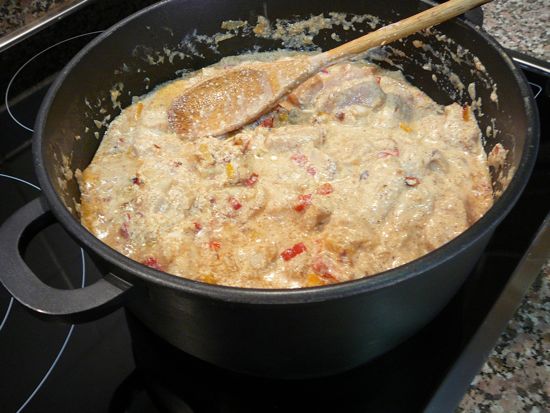
Meanwhile, mash two cans of pinto beans.
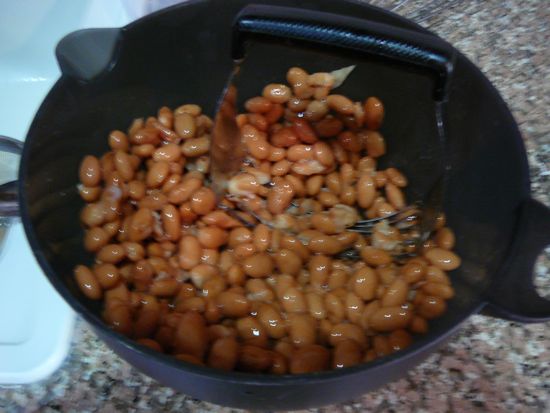
Chop an avocado – chunks about 3/4 inch. Add in the cooked chicken, onions, peppers, and mix.

Spoon into center of burrito wrapper. Roll up and place in pan.
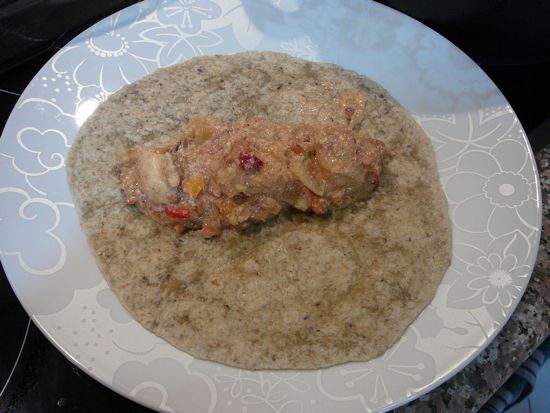
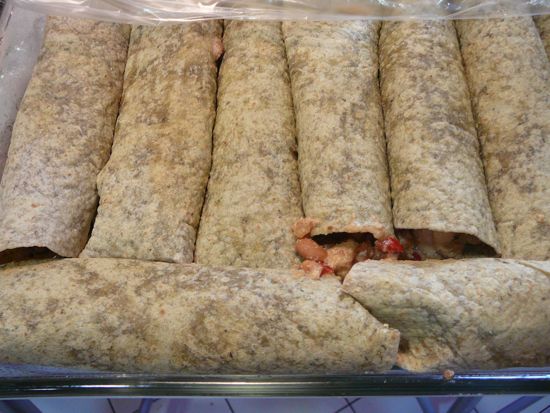
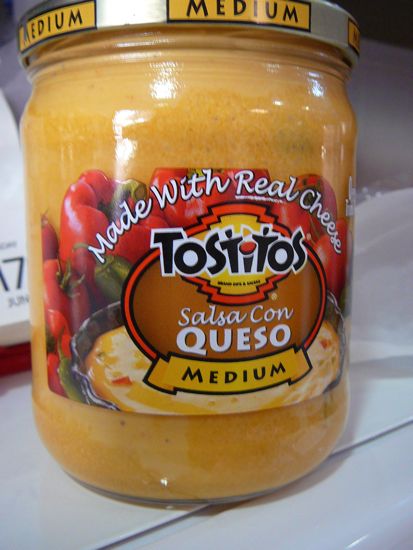
The secret ingredient – two jars of Chili Con Queso, cover enchiladas and bake 30 minutes at 350°F/180°C.
Mexican Rouladen, Recipe and Photos
I had my menu all set, and then, when I went to the butcher, he said “No madam, we never do this. You will not find this in all of Doha.
If I had the time, I would go to “all of Doha” and prove him wrong. And oh-by-the-way, what is wrong with saying “we can do this for you and have it ready for you tomorrow morning at 0900?” something like that?? No, just “you will never see this in Doha.”
So I can spend my time grinding my teeth in anger, or running all over Doha to see if I can find what I need (flank steak) or . . . I can see what is available and do what I can with what is available. Fortunately, I see a familiar cut of meat, and I can work with it.
When I get around a group of people, I can’t concentrate. I am so focused on the conversation and the people, that if I have houseguests, for example, which I did this weekend, I can’t talk and get dinner on the table at the same time (even with help!)
My solution is to do everything possible ahead of time, and make lists, including what dishes I plan to use for serving, what times this needs to happen, and then that, and sequences. That way, the fact that my thinking process goes on hold means I am not facing total disaster.
I needed to have a lot of variety, so that if someone didn’t like something, there would be something else they might like.
I took an old faithful recipe, Rouladen, and reworked it for a Mexican theme dinner. The secret to successful rouladen is long, slow pre-cooking. It can be entirely cooked the day before and then re-warmed to serve when you need it. It takes what might be a tough cut of beef and renders it fork-friendly. You don’t even need a knife; it cuts easily with a fork and melts in your mouth.

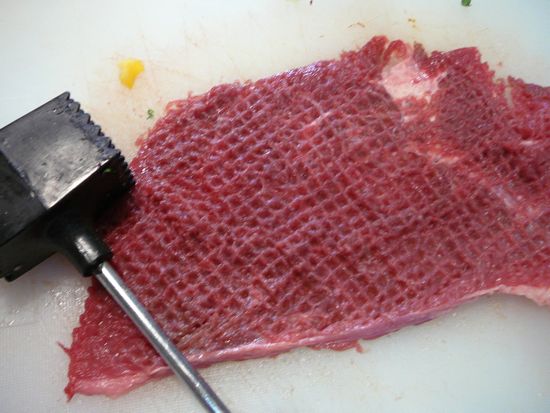
You pound the meat, especially on the edges, to flatten it and to tenderize it.
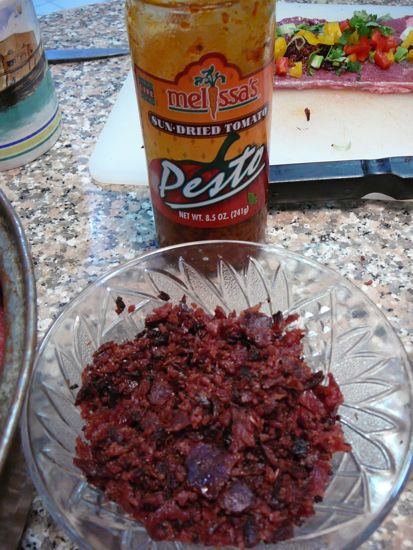
You have the filler ingredients ready to go:

Actually, I forgot to put the jalepenos inside, so I chopped up a few very finely and added them to the sauce – it turned out to be just the right thing. I like to start with just a teaspoon of Pesto, just to give it a little pop, and some already-cooked and crumbled bacon (this is turkey bacon, but any bacon will do.)
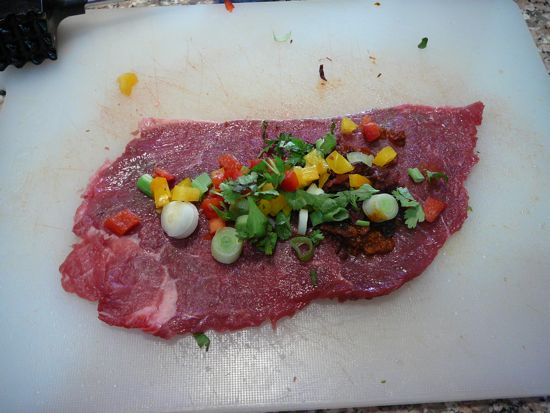
You sprinkle the other ingredients lightly over the length of the roll, leaving about an inch all around for rolling and folding:
When they are rolled, you put them closely together in a pot:

This is key – you make up an acidic sauce – tomatoes, for example, are acidic. I use tomato paste, and tomatoes, and then you can add broth, or wine, or lemon juice – something to make it more liquid. You also add spices, in this case, chili and cumin for the Mexican flavor, plus, as I mentioned above, some very finely chopped jalepenos.
Then, you pop it into a slow oven – 350°F/180°C – and slow cook it three or four hours. That’s why you want it very liquid-y, so that the sauce won’t disappear during the long cooking, it will concentrate. Yummm!
No, I don’t have any photos of the finished dish. I was pretty busy. 🙂 The roulades shrink, and brown over the top, but remain fork-tender for eating when you heat them up (30 minutes at 350°F/180°C, until hot!)

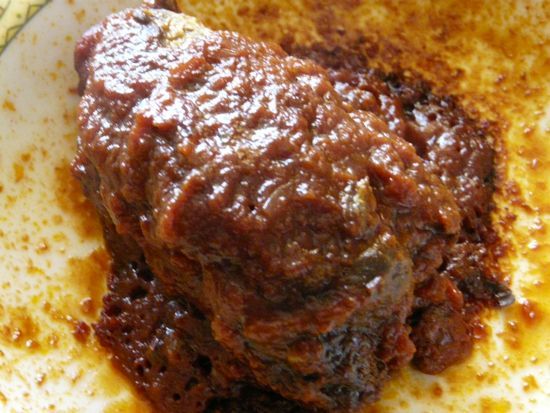
This is what one roulade on a plate looks like. They are much prettier when a bunch are all cooked up in the pan together, and I serve them right out of one of my Damascus copper cooking pots:
Scam of the Day: Short and Sweet
LLOOLL @ 100% legitimate and risk free!
Dear sir,
I am Mr.Kumalo Donald a transfer supervisor on investment in HSBC Bank,United Arab Emirates , I have a transaction of 50/50% mutual benefit worth $9.5 million dollars, If interested please respond to my personal e-mail ( kumalodonald@aol.com ) for more detail and processing. is 100% legitimate and risk free.
Best Regards !
Kumalo Donald
United Arab Emirates
The Help by Kathryn Stockett

In my book club last year, one of the themes that continued to arise as we read books from many cultures was how we are perceived by the people we hire to help us in our homes. In The White Tiger, a Man Booker Award Winner, the main character lucks into a job working for a family as a driver. We see the people for whom he works from the inside, their sweet acts and all their flaws. We see how callous they can be, and, ultimately, how the driver takes his revenge and becomes his own boss. (Not one of my favorite books, but then again, I’m still thinking about it a year later, so there is something to be said for it.)
In Half of a Yellow Sun we saw an entirely different relationship (in a book I totally loved, BTW) between employer and employee, but it shared with White Tiger the aspect of employer as seen from the eyes of an employee inside the house who sees the family and all its interactions intimately.
The Help, a surprise best seller, does the same to 1960’s era Mississippi. A recent graduate from Ole Miss (University of Mississippi) starts interviewing the maids from local households, any maid that will talk to her. At first, no one will talk with her, but after traumatizing racial clashes, one by one, they share their stories. Just interviewing the maids, just the maids sharing their stories, is enough to bring on serious consequences.
First, the book is riveting. I have a million things I really REALLY need to be doing, and I can’t stop reading. There is something about peeking into your neighbors house, seeing how they behave when they think no one is looking, that appeals to the voyeur in each of us.
Second, these women are taking serious risks. I am on the edge of my chair with each reading, hoping nothing bad happens to them.
Third, there is something that makes you squirm, it is the old “wee giftie” that shows us the worst in ourselves as others might see us; our own hypocrisies, our condescensions, our patronizing acts, how cruel our charitable acts can appear through the eyes of others, and how callous we are in the end towards those who take care of us every day.
It has rocketed onto the best seller list, now the #6 best selling book on Amazon.
If your book club is looking for a book to read that will get you talking and keep you talking for a long time, this is one of the best.
If you have hired help in the house, I double-dog-dare-you to read this book. (OOps, sometimes the little Alaska girl in me pops back out!) Fair warning, though, once you start, you won’t want to put it down.
LOL Cats Really Made Me Laugh
I was such a bad mother. Here’s the problem. Life doesn’t come with instructions. You get faced with new situations, you just have to do the best you can. You might think your parents know a lot, but we are just like you – sometimes we are over our heads.
The first time we moved to Florida, our cats got fleas. The whole house got fleas! We had to give the cats flea-shampoos and we had to flea-proof the house.
Here’s where I was a bad mother. I made our son shampoo the cats. We did it as a team, but he was the one who had to stand in the shower and do the actual shampooing. I was the one who caught the second cat and held her while he shampooed the first cat (it was a walk-in shower with a door that shut, so once inside, the cat couldn’t get out) and then I towel-dried the totally-freaked-out cat while my son shampooed the second cat, etc.
My son – my hero. There is a part of me that still feels guilty for making him to the shampooing. It’s because we didn’t have the chain mail:

see more Lolcats and funny pictures
10 Riskiest Foods to Eat
Found this on AOL Wallet Pop where you can find amazing research and ideas on how to make your money go a little further. Although this study was conducted in the US, it seems to me that these would be the hardest foods to manage anywhere in the world.
Aimee Picchi
Think you’re safe eating foods regulated by the Food and Drug Administration? Think again, according to the Center for Science in the Public Interest, a non-profit health advocacy group.
What many consumers consider healthy foods — including eggs and leafy greens — are implicated in 40% of food-related outbreaks linked to FDA-regulated food, the Washington, D.C.-based CSPI says in a new study.
The watchdog group, which based its findings on outbreak data collected by the Centers for Disease Control and Prevention between 1990 to 2006, says the list of the 10 foods should sound an alarm to consumers and legislators because of the presence of so many healthy foods, ranging from tomatoes to sprouts.
“Many of the foods that made the list are a part of a healthy and balanced diet,” said CSPI staff attorney Sarah Klein on a conference call to discuss the findings. “Leafy greens are unfortunately no stranger to food-borne illness. The most common path are Norovirus, E. coli and Salmonella.”
The report from the CSPI, known for bringing the public’s attention to food issues such as the health dangers of trans fats, comes days after the New York Times highlighted the dangers of hamburger meat and the flaws in beef inspection. Some readers decided to swear off hamburgers for good after seeing the piece, writes WalletPop sister publication Daily Finance.
More than 1,500 separate outbreaks were linked to the foods on the CSPI’s list, which has led to almost 50,000 reported illnesses. The top 10 riskiest foods regulated by the FDA are, in order of the most outbreaks:
• leafy greens
• eggs
• tuna
• oysters
• potatoes
• cheese
• ice cream
• tomatoes
• sprouts
• berries
The report doesn’t differentiate between organic and non-organic foods, although the CSPI believes the risks are fairly similar, said Caroline Smith DeWaal, the director of the group’s food safety program, on the call. It also didn’t include meat, because the FDA doesn’t regulate the meat industry, she said.
So what should consumers do? Proper food handling and safety measures are important in home kitchens, ranging from cooking eggs thoroughly to taking care potatoes aren’t contaminated by other food. Because potatoes are always cooked, which would eliminate any pathogen, the reason why potatoes are linked to food-borne illnesses is likely from cross-contamination, DeWaal said.
And the report underscores the need for the passage of the Food Safety Enhancement Act, the CSPI said. The Senate should take the lead of the House and pass the legislation, which would give the FDA authority to require food processors to implement food safety plans and increase frequency of inspections.
Despite the call for change, food system in the U.S. remains relatively safe, said Dr. Craig Hedberg, a professor of environmental and occupational health at the University of Minnesota School of Public Health, on the call. Still, food-borne illness is “a major health concern,” he added.
Suq al Waqif Coffee Shops closed
You gotta read the small items in the newspapers – that’s where a lot of the real news is. Today, in the Gulf Times is this tiny little article about shops being closed in the Souq al Waqif for serving shisha to underage people. Who knew? There is a legal age for smoking shisha?
Coffee shops closed
A number of coffee shops at the Souq Waqif were closed by the Doha Municipality for not complying with the health regulations, according to a report in a local Arabic newspaper.
The report said closure notices were put up by the municipality inspectors on the doors of the non-complying coffee shops.
Among the recently detected violations was the offering of Shish to teens under 18, which the report said, was in breach of the contracts signed by the Old Souq department and tenants of the coffee shops.
However, coffee shop managers at the Souq pointed out that asking customers their age could cause anger, particularly with female customers, who just opt to move to another outlet.
Mediterranean Diet Can Help Fight the Blues
From BBC Health News comes a study that says not only is the Mediterranean diet good for your heart healt – it is also good for your mental health. If you are fighting the seasonal blues, fight back with olives, olive oil and a diet high in veggies and legumes.
The Mediterranean diet, already thought to protect against heart disease and cancer, may also help to prevent depression, Spanish researchers say.
They found depression was more than 30% less likely to develop in people who followed a diet high in vegetables, fruit and cereals, and low in red meat.
They studied 10,094 healthy adults over four years, the Journal of the American Medical Association reports.
However, the team stressed additional, larger-scale studies were required.
Researchers at the Universities of Las Palmas and Navarra recruited university graduates to take part.
Dietary patterns
They completed questionnaires and the researchers calculated their adherence to the Mediterranean dietary pattern (MDP) for an average of four-and-a-half years.
MEDITERRANEAN DIET FEATURES
• A high intake of monounsaturated fatty acids like olive oil
• A moderate intake of alcohol and dairy products
• A low intake of meat
• A high intake of legumes, fruit and nuts, cereals, vegetables and fish
Participants who had a strong adherence to the MDP tended to be male, ex-smokers, married and older individuals.
They were more active physically and showed a higher total energy intake.
The researchers identified 480 new cases of depression during the follow-up period – 156 in men and 324 in women.
They found that those with the highest adherence to the MDP were more than 30% less likely to develop depression.
They took into account marital status, the number of children and factors associated with a healthy lifestyle and found the relationship did not change.
Even taking account of personality traits, such as competitiveness and anxiety, had no effect on the results.
‘More research needed’
Professor Miguel Martinez-Gonzalez, of the University of Navarra, said the results would have to be confirmed in longer trials with more participants but they had found a strong inverse association between the Mediterranean diet and depression.
“Thirty per cent is a large reduction in the risk and this could be very important considering the large burden of disease represented by depression.
“We know how important the Mediterranean diet is in reducing cardiovascular risk factors and the same inflammatory proteins are also raised in patients with depression.”
He said it was likely that the overall dietary pattern was more important than the effect of single components and “may exert a fair degree of protection against depression”.
Dr Cecilia D’Felice, a clinical psychologist, said there was mounting evidence for the importance of diet in treating depression.
She said: “What we do know is that a diet high in olive oil will enhance the amount of serotonin or brain transmitter available to you.
“Most anti-depression drugs work to keep more serotonin available in the brain.”
Recent Comments
intlxpatr on Shampoo Ginger tigerbutterya0c5ff1d… on Shampoo Ginger intlxpatr on British Soldier Kidnapped, Esc… John on British Soldier Kidnapped, Esc… intlxpatr on British Soldier Kidnapped, Esc… Wikipedia Donate Button

Amazina


Early Voting in Florida


