Old Fashioned Piracy Goes High Tech
Thanks to blogger BitJockey, and news service Reuters for this update on the Somali pirates:
MADRID (Reuters) – Somali pirates are planning attacks on shipping using detailed information telephoned through by contacts in London, according to an intelligence report cited by Spanish radio on Monday.
The pirates have built up a network of informants in London with access to sensitive data from shipping companies about vessels, routes and cargoes, according to a European military intelligence report that Cadena Ser radio said it had seen.
The pirates receive their information by satellite phone and use sophisticated equipment to locate their targets, Cadena Ser said.
The intelligence report also said that the pirates seem to avoid attacks on ships of some nationalities, including British ships.
It listed several attacks in which the pirates had surprised crew with detailed information of their prey, including the nationalities of those on board.
Cadena Ser did not provide any more details about where the report originated, identifying it only as “European.”
Western nations have sent warships to try to stop the pirates, who have made millions of dollars from ransoming ships and their crews in strategic shipping lanes off the Horn of Africa that connect Europe to Asia.
They are currently holding about 20 vessels with nearly 300 hostages, according to monitoring groups.
Efforts to fight the pirates have been hindered by the gaps in international maritime law, which have sometimes left it unclear who, if anyone, can put them on trial.
Spanish authorities have disagreed among themselves over what to do with 14 Somalis caught last week by a Spanish warship. A judge tried to bring some of them to Spain while the government argued they should be sent to a court in Kenya.
(Reporting by Jason Webb; Editing by Kevin Liffey)
Somali Pirate Code of Conduct
Ever since I was a kid, I found pirates interesting and exotic and adventurous. The truth is probably that those olden day pirates had bad teeth, scurvey – they had lived hard and fast and they probably aged quickly.
Of course, today we have Johnie Depp and the Pirates of the Caribbean series, which makes pirating look mostly like a lot of fun.
So a year or so ago, I wrote a post on the Somali pirates, and got an interesting response. It got me started looking more deeply into what is going on with the pirates there.
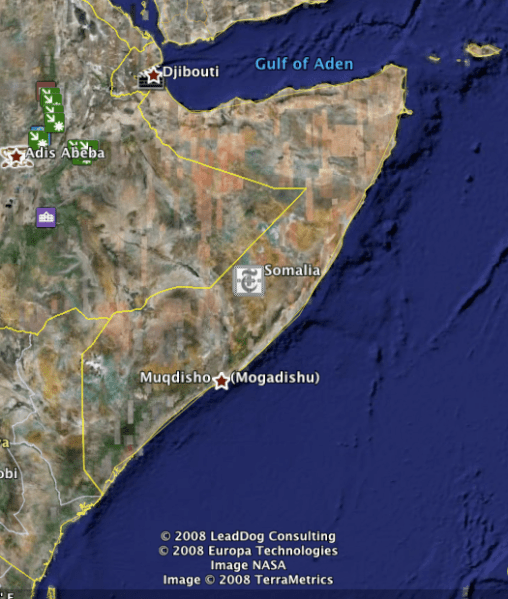
Yesterday, in the paper was an article about the Somali pirate code of conduct – with fines and punishments for infractions. I found a complete article in Newsweek, April 27.
What is bothering me now is that the one pirate captured by the US when it retook the captured US freighter (in the report filed by one BBC reporter) said he was just a frail teenager, a kid, and that the pirates had already agreed to surrender when they were blown out of the water. You could hear her attempting to control her rage.
I know it is a thorn in the side for all shippers and freighters and passenger ships who travel through waters anywhere near to Somalia. And yet . . . I kind of ask myself what the options are? Somalia is a for sure failed-nation. They haven’t been able to cobble together a government for over twenty years. Deadly, long lasting poisons have been dumped along their shoreline – and major industrial nations paid Somalis a pittance to dump their wastes there. Their coastline has been overfished. Families are starving, live is – or was – dismal.
I think it is pretty cool that they developed an enforceable – and enforced – code of conduct.
Here is the article from Newsweek:
It was a hit with the U.S. public, but president Obama’s decision to authorize the Pentagon to kill three Somali pirates who took an American sea captain hostage sent shudders through the world’s shipping and insurance industries. Because the pirates are motivated chiefly by money, maritime experts say, they have—at least until now—taken good care of the crews they hold captive. A document retrieved from a ship hijacked last year contained a “list of written rules” of conduct pirates had to follow, according to a maritime security expert who requested anonymity when discussing sensitive material. The document included a series of “punishments” to be imposed on any hijacker who struck a hostage.
Shipping companies and insurers are far more likely to fork over large ransoms if they have confidence that their personnel and cargo will be released unharmed, and while the scourge of piracy has been disruptive, so far there have been virtually no casualties among innocent people. According to estimates, there were 111 pirate attacks off the Somali coast in 2008; 42 were successful, resulting in the capture of 815 seamen. As of last week, according to one estimate, all but 37 had been released, and two had died—one reportedly of illness. Experts say the rate of attacks has increased sharply this year, and “the more [authorities] shoot, the more the pirates will shoot back,” says Tom Wilson, a Somalia analyst for the British consulting firm Control Risks.
Protecting the 23,000 merchant vessels sailing annually near the Horn of Africa would require a naval fleet of at least 60 ships, according to U.S. government and private experts; the existing international antipiracy task force has about 20. And attacking the Somali coastal villages where the pirates are based could potentially radicalize generations of Somalis. “That would be a 19th-century solution,” says Neil Roberts, a marine insurance expert with Lloyd’s Market Association in London. Industry experts say the only solution to piracy is the creation of a viable Somali government back on dry land.
According to industry officials, ransom demands have ranged as high as $25 million—but in most cases they are negotiated down to about $2 million to $3 million, and insurers then pay out claims to the shipping companies. As hijackings have increased in frequency, pirates have become fussier about how their money gets delivered. Initially, said a shipping-industry source who also asked for anonymity, ransoms were often handed off to shady Somali expats in places like Kenya. After Kenyan authorities cracked down, the pirates began insisting on airdrops via parachute into the ocean near Somali coastal villages, where they have cash-counting machines ready. Until the U.S. opened fire, one of the pirates’ biggest headaches had been dealing with the sheer volume of money they’ve collected. Last year, according to an insurance-industry official, one pirate’s boat capsized because he had overloaded it with cash.
I found this on National Post dated April 30, 2009; it is a copy of what I had read in the newspaper:
MOGADISHU — A mobile tribunal, a system of fines and a code of conduct: the success of Somali pirates’ seajacking business relies on a structure that makes them one of the country’s best-organised armed forces.
A far cry from the image conveyed in films and novels of pirates as unruly swashbucklers, Somalia’s modern-day buccaneers form a paramilitary brotherhood in which a strict and complex system of rules and punishments is enforced.
They are organized in a multitude of small cells dotting the Indian Ocean and Gulf of Aden coastline. The two main land bases are the towns of Eyl, in the breakaway state of Puntland, and Harardhere, further south in Somalia.
“There are hundreds of small cells, linked to each other,” Hasan Shukri, a pirate based in Haradhere, told AFP in a phone interview.
“We talk every morning, exchange information on what is happening at sea and if there has been a hijacking, we make onshore preparations to send out reinforcement and escort the captured ship closer to the coast,” he explained.
Somali piracy started off two decades ago with a more noble goal of deterring illegal fishing, protecting the people’s resources and the nation’s sovereignty at a time when the state was collapsing.
While today’s pirates have morphed into a sophisticated criminal ring with international ramifications, they have been careful to retain as much popular prestige as possible and refrain from the violent methods of the warlords who made Somalia a by-word for lawlessness in the 1990s.
“I have never seen gangs that have rules like these. They avoid many of the things that are all too common with other militias,” said Mohamed Sheikh Issa, an elder in the Eyl region.
“They don’t rape, and they don’t rob the hostages and they don’t kill them. They just wait for the ransom and always try to do it peacefully,” he said.
Somalia’s complex system of clan justice is often rendered obsolete by the armed chaos that has prevailed in the country for two decades, but the pirates have adapted it effectively.
Abdi Garad, an Eyl-based commander who was involved in recent attacks on U.S. ships, explained that the pirates have a mountain hide-out where leaders can confer and where internal differences can be solved.
“We have an impregnable stronghold and when there is a disagreement among us, all the pirate bosses gather there,” he told AFP.
The secretive pirate retreat is a place called Bedey, a few miles from Eyl.
“We have a kind of mobile court that is based in Bedey. Any pirate who commits a crime is charged and punished quickly because we have no jails to detain them,” Mr. Garad said.
Some groups representing different clans farther south in the villages of Hobyo and Haradhere would disagree with Mr. Garad’s claim that Somalia’s pirates all answer to a single authority.
But while differences remain among various groups, the pirates’ first set of rules is precisely aimed at neutralizing rivalries, Mohamed Hidig Dhegey, a pirate from Puntland, explained.
“If any one of us shoots and kills another, he will automatically be executed and his body thrown to the sharks,” he said from the town of Garowe.
“If a pirate injures another, he is immediately discharged and the network is instructed to isolate him. If one aims a gun at another, he loses 5% of his share of the ransom,” Mr. Dhegey said.
Perhaps the most striking disciplinary feature of Somali “piratehood” is the alleged code of conduct pertaining to the treatment of captured crews.
“Anybody who is caught engaging in robbery on the ship will be punished and banished for weeks. Anyone shooting a hostage will immediately be shot,” said Ahmed Ilkacase.
“I was once caught taking a wallet from a hostage. I had to give it back and then 25,000 dollars were removed from my share of the ransom,” he said.
Following the release of the French yacht Le Ponant in April 2008, investigators found a copy of a “good conduct guide” on the deck which forbade sexual assault on women hostages.
As Ilkacase found out for himself, pirates breaking internal rules are punished. Conversely, those displaying the most bravery are rewarded with a bigger share of the ransom, called “saami sare” in Somali.
“The first pirate to board a hijacked ship is entitled to a luxurious car, or a house or a wife. He can also decide to take his bonus share in cash,” he explained.
Foreign military commanders leading the growing fleet of anti-piracy naval missions plying the region in a bid to protect one of the world’s busiest trade routes acknowledge that pirates are very organised.
“They are very well organized, have good communication systems and rules of engagement,” said Vice Admiral Gerard Valin, commander of the French joint forces in the Indian Ocean.
So far, nothing suggests that pirates are motivated by anything other than money and it is unclear whether the only hostage to have died during a hijacking was killed by pirates or the French commandos who freed his ship.
Some acts of mistreatment have been reported during the more than 60 hijackings recorded since the start of 2008, but pirates have generally spared their hostages to focus on speedy ransom negotiations.
With the Robin Hood element of piracy already largely obsolete, observers say the “gentleman kidnapper” spirit could also fast taper off as pirates start to prioritize riskier, high-value targets and face increasingly robust action from navies with enhanced legal elbow room.
They have warned that the much-bandied heroics of a U.S. crew who wrested back control of their ship and had their captain rescued by navy snipers who picked off three pirates could go down as the day pirates decided to leave their manners at home.
I used to read science fiction novels about a diplomat named Retief, I think they were by Keith Laumer. He would find himself in an alien environment with a horrible unsolvable problem and he would find a great solution, where everyone walked away OK. I wish there were a Retief who could negotiate a win/win out of this situation.
My Lucky Day
Woo Hooo on ME! Although I have never been in Nigeria, somehow someone there neglected to pay me my TEN MILLION FIVE HUNDRED THOUSAND DOLLARS! Yes! Yes! This is “online” with my dearest dreams! Someone wants to give me a lot of free money! Wooo HOOOO!
From: “Barrister Afred Mark”
Subject: FOREIGN PAYMENT INVESTIGATING UNIT.
Date: April 28, 2009 3:25:28 PM GMT+03:00
FEDERAL REPUBLIC OF NIGERIA
CENTRAL BANK OF NIGERIA
TINUBU SQUARE LAGOS
FROM THE DESK OF:
AFRED MARK & ASSOCIATE’S
LEGAL ADVISER TO THE
CENTRAL BANK OF NIGERIA (CBN).
ATTENTION:
PAYMENT INVESTIGATING UNIT.
From the records of outstanding payment with the Federal Government of Nigeria, your name was discovered as next on the list of The outstanding beneficiaries who have not received their payments.
I wish to inform you that your payment is being processed and will be released to you as soon as you respond to this letter. Also note that from my record in my file your outstanding payment is US$10.5, (Ten Million Five Hundred Thousand United States Dollars only)
Please re-confirm to me if this is Online with what you have in your record and also re-confirm to me the followings.
(1) Your full name.
(2) Phone, fax and mobile #.
3) company’s name,position and address.
4) profession, age and marital status.
5) Copy of int’l passport or any scanned identity to prove yourself.
As soon as this information are received, your payment will be made to
you in a certified bank draft from central bank of Nigeria and a copy
will be given to you for you to take to your bank and confirm it.
YOURS SINCERELY,
AFRED MARK.
LEGAL ADVISER TO THE
CENTRAL BANK OF NIGERIA (CBN).
What? What? It’s a scam? Oh! Oh, say it isn’t so!
An Interview with Chimamanda Ngozi Adichie
This interview is with a woman I admire very much, Chimamanda Ngozi Adichie, who has a new book out, a collection of stories, called The Thing Around Your Neck. Her most recent prior book, Half of a Yellow Sun, which tells of the three year struggle of the Igbo people to secede from Nigeria to create the independent nation of Biafra, and won the Orange Prize for Literature in 2007. The book is a total WOW.
Brilliant Sunrise, 5 Apr 09
Goooooooooooood Morning, Kuwait! 🙂
It is going to be another gorgeous day in Kuwait. Don’t let this “heavy fog” deter you. When I got up, the sunrise was so bright, I couldn’t see the sun, it was refracted all over the sky. I was only able to get the shot by focusing on the reflection of the sun on the water.

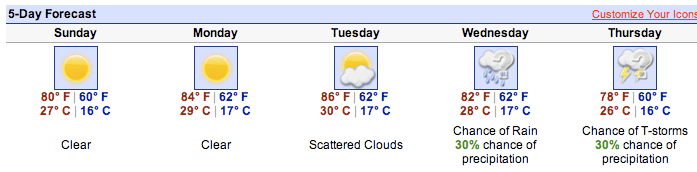
It is going to be a fantastic week – sweet warm days and cooling off evenings, perfect for sitting outside and drinking coffee, visiting with friends – and a little later in the week, a chance of more rain:
AdventureMan and I saw Journey to Mecca yesterday, along with about 500 others living in Kuwait. The movie is still packing people in! The audience was about 3/4 full with children, and I thought “oh this is going to be great, crying children and people talking on their cell phones.” I was SO wrong. Although the movie theater was full, I did not hear a single phone, I did not hear a single crying child – the movie held us all spellbound. We loved the movie, and we loved seeing it in the IMAX theatre.
(There are special headsets for non-Arabic speakers, with the dialogue in English. We didn’t know; they just spotted us as probably-non-Arabic and handed us the headsets.)
Sometimes, I am just slow. My niece, Little Diamond, had recommended a book called Travels with a Tangerine: From Morocco to Turkey in the Footsteps of Islam’s Greatest Traveller, but it was not until yesterday that I got it – that Ibn Batuta was from Tangiers! Sometimes, I am just slow . . . sometimes I can grasp subtleties but the obvious escapes me totally.

You can buy this book from Amazon.com for a mere $10.17 plus shipping. Yes, I own stock in amazon.com.
You can also probably find it at the Kuwait Bookstore, that amazing store in the bottom of the Al Muthanna Mall, near the Sheraton Circle downtown.
Seattle-like Sunrise
Good morning, Kuwait!

(How many different blues can you count in this photo? This is a RICH photo in the blue-grey spectrum, one of my favorites.)
When I saw the skies this morning, all cloudy and gloomy, I thought for a minute I was back in Seattle. If I were in Seattle, the temperatures would be much much lower – it is already getting hot in Kuwait, and this Friday we will hit a huge high:
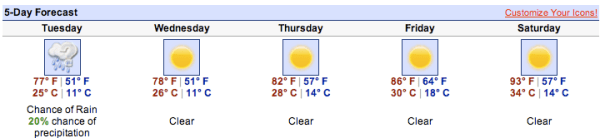
But something is goofy with Zanzibar, on my WeatherUnderground favorites:

How can that be right? Highs almost in the 90’s, lows almost freezing?
It just might rain a little out there, my Kuwait friends. Be careful on the roads and remember:
Don’t Call Until You Reach Your Destination!
Kuwait to Provide Assistance in Dharfur
From today’s Arab Times:
Kuwait Red Crescent ready to fill aid agencies gap in Darfur
KUWAIT CITY, March 7, (KUNA): Kuwait Red Crescent Society (KRCS) said Saturday it was ready to fill the aid agencies gap caused by the withdrawal of a number of humanitarian organizations from Darfur.
KRCS Chairman Barjas Al-Barjas said in a letter he sent to Secretary-General of the International Federation of Red Cross and Red Crescent Societies (IFRC) Bekele Geleta, that KRCS believed the federation should cover the needs caused by the withdrawal of 16 non-governmental organizations from Darfur due to bad security conditions. He called IFRC to urge all humanitarian and charitable bodies, national societies, and the International Committee of the Red Cross (ICRC) to contribute to ending the deterioration of the humanitarian situation in Darfur. Al-Barjas said KRCS was ready to provide aid, as it always did to the needy around the world.
Meanwhile, the Arab League Council has decided to send an Arab-Afro delegation to the UN Security Council (UNSC) to defer the International Criminal Court’s (ICC) arrest warrant against Sudanese President Omar Al-Bashir. The council, meeting urgently at the foreign ministers’ level to discuss ICC arrest warrant, expressed dismay for the ICC decision and said it did not consider justice, stability and peace in Sudan. The council voiced solidarity with Sudan against any plans undermining the sovereignty, unity and independence of Sudan.
The foreign ministers underlined in a statement importance of the independence of the Sudanese judiciary. They refused any attempt to politicize the principles of the international justice which would jeopardize the unity, sovereignty and independence of countries around the world. They regretted the fact that article 16 of the Rome statute of the ICC was not provoked thus delay the arrest warrant for 12 months. They asserted that heads of state enjoy immunity in accordance with the 1961 Vienna agreement.
The arrest warrant does not consider the implementation of the peace agreement in Southern Sudan and preparation for the general elections in the second half of this year, said the ministers. The Arab foreign ministers urged the UN Security Council (UNSC) to live up its responsibility to preserving peace and stability in Sudan. They called on regional and international parties to provide suitable atmosphere for the political settlement between the Sudanese government and rebel groups in Darfur.
May God bless the work of their hands and their hearts.
Warning from My New Best Friend
It really sounds like she knows me! And she warns me against those nasty Nigerian scammers, so she must be on the up-and-up, right? And oh my, they have a file for me with all that money? Even though I have never worked in Nigeria, never had a contract? And oh yeh, it’s a blind-copy. . . . hmmmm.
Dearest,
My name is Mrs. Susan Walter, I live at 3775 Oleander Dr Highland, Ca 92346,
United States.
I am one of those that executed a contract in Nigeria years ago and they refused
to pay me, I had paid over $70,000USD trying to get my payment all to no avail.
Somebody directed me to travel down to Nigeria with all my contract documents
to meet Barrister Mat Oto who is the member of CONTRACT PAYMENT COMMITTEE and
LEGAL ADVISER to the COMMITTEE, and I contacted him and he explained everythi
ng to me on telephone and advised me to come down to Nigeria which I did.
He said that those contacting us through emails are fake. Then he took me to the
paying bank, which is Central Bank of Nigeria, and I am the happiest woman
on this earth because I have received my contract funds of $8.2Million USD.
On the process of searching for my file,I saw your information on awaiting pay
ment list in the office of Barrister Mat Oto.Though I did not capture all your
information lest your fax number.
Am sorry contacting you late as I planed doing it as soon as I arrive back USA.
I have been so busy because we are trying to set up a factory here with the mo
ney we received.
So if you care,do contact Barrister Mat Oto with the information below and just
explain yourself to him as I know he is honest and humble person.
Alternatively mention my name to him he will attend to you.
Name: Barrister Mat Oto
Email: barr.mato@urln.name
phone number +234-1-432490123
Address: 123,Palm Avenue Palm Grove,
Lagos Nigeria.
You really have to stop your dealing with those contacting you okay because they will dry you up until you have nothing to eat.
The only money I paid was just $8,200 for Federal Inland Revenue Services
(F.I.R.S).
So you have to take note of that. You can reach me on this telefax number:1-20
8-248-3647 or email:
mrssusan.walter@gmail.com
Thanks,
Mrs. Susan Walter
Confessions of a Sudanese deserter
“Khalid”, a member of the Janjaweed tells about the Sudanese scorched earth policy in today’s BBC News:

The International Criminal Court is set to announce whether or not it is to issue a warrant for the arrest of the President of Sudan President al-Bashir, for alleged war crimes in Darfur.
The Sudanese government has always said the accusations are political but now one of the country’s former soldiers, who served in Darfur, has been telling his story to the BBC’s Mike Thomson.
Khalid (not his real name), a polite and softly spoken man from Darfur, seems reluctant to talk about his past. It is soon clear why.
“The orders given to us were to burn the villages completely,” he says.
“We even had to poison the water wells. We were also given orders to kill all the woman and rape girls under 13 and 14.”
Khalid, who is of black African origin, says he was forcibly recruited into President Omar al-Bashir’s Sudanese army in late 2002.
He and several other men where he lived were taken to the headquarters of his regiment which was based near the north-western Darfur town of Fasher.
He admits to having taken part in seven different attacks on Darfur villages with the help of Janjaweed militia.
The first one was in the Korma area in December 2002 several months before the conflict in Darfur officially began.
He claims to have been extremely reluctant to carry out the savage orders he was given.
“When they asked me to rape the girl, I went and stood in front of her,” he said.
“Tears came into my eyes. They said: ‘You have to rape her. If you don’t we will beat you.’ I hesitated and they hit me with the butt of a rifle.
“But when I went to the girl I couldn’t do it. I took her into a corner and lay myself on top of her as if I was raping her for about 10 to 15 minutes.
“Then, I jumped up and came out. They said: ‘Did you rape her?’ I said: ‘Yes, I did’.”
Khalid says that soon after this he and the other soldiers went back to base.
When they got there he was told to join another patrol immediately.
When he refused they beat and tortured him, inflicting severe burns on his legs and back.
He spent five weeks in a military hospital recovering from his injuries.
Before long, he said, he was ordered to join other brutal raids on Darfur villages.
I asked him what he was told to do with unarmed civilians who did not resist in any way.
“They told us, don’t leave anybody, just kill everybody,” he said.
“Even the children, if left behind in the huts, we had to kill them,” he said. “People would cry and run from their huts.
“Many couldn’t take their all their children. If they had more than two they had to leave them behind. If you saw them you had to shoot and kill.”
Khalid insists that he always fired over the heads of civilians and didn’t kill anyone himself despite the orders he was given.
He says he could do this without his fellow soldiers noticing but he admits that there was no way he could avoid carrying out orders to torch peoples homes.
The six-year conflict has spawned more than two million refugees
“I did take part,” he admitted. “They forced me. We had no choice. If you didn’t they would kill you.”
Did anyone refuse?
“Two of my colleagues refused and they were shot dead.”
You can read the entire article by clicking BBC NEWS: Dharfur
African Heads and Art
From this morning’s e-mails – I think this is a sincere one. If anyone wants to contact this artist, his e-mail is:
africanhead_art@yahoo.com
Good day sir\ma
it is a great pleasure of getting across to your wed site. Am Mr KOLA OWOLAWI JUNAID am muslim an artist am the founded of african heads art and cultural gallery african heads art gallery was base in lagos and osogbo osun state in nigeria
i participated in my first art exhibition at GENEVE COMITE INTERNATION committee of the red cross ICRC am one of the winner in the art competition i also exhibit at US Embassy in lagos ,IITA ibaban German cultural Center , British High Commission ,american international school,Britsih high school, National art council in Accra Ghana i received an award for up coming artist an many more
i will like to make an inquiry on if i could join the Qurain cultural festival or organizering a cultural art exhibition on Qurain words, painting adire ,batick ,tye and dye and other local fabric art work for up coming this year.i will ilke to know if it could be organizes and what was the general registration or inquiry is needed for the exhibition thanks you.
please if you ilke to see the samples of the art works i will be glad to show it
Recent Comments
ExpatAlien on What Country am I Living … intlxpatr on Yellowstone: Old Faithful to C… Michelle on Yellowstone: Old Faithful to C… Cathy on No Grown-Ups in Charge intlxpatr on Waiting for Snow Wikipedia Donate Button

Amazina


Early Voting in Florida


 Here There and Everywhere