Geraldine Brooks: March
Geraldine Brooks knocks my socks off. If she writes a book, fiction or non-fiction, I will buy it and read it. The first one I read by her was Nine Parts Desire: The Hidden World of Islamic Women, and the second most memorable book was her Year of Wonders, a book about how the plague comes to a 17th century English village and how the villagers cope with it – how some survive. She has a knack for keen observations, and for writing so as to place you squarely in the scene she is describing.
So when she came out with a new book extrapolating from the experiences protrayed in Louisa May Alcott’s classic favorite Little Women, why didn’t I rush to buy it? March is described by Publisher’s Weekly as “the Civil War experiences of Mr. March, the absent father in Louisa May Alcott’s Little Women.”

Didn’t you love Little Women when you read it? What’s not to love? Those wonderful sisters, their saintly mother, working together, suffering together, prevailing through sheer grit and determination – we can read that book over and over again, loving it every time.
Geraldine Brooks takes us with Mr. March into the grim realities of the American Civil War, the “war to free the slaves,” the war to keep the United States united, or the war between the states. This is not the idealized world of Little Women, this is not the memory we have of the nice letters he writes home from the field, this is the reality of war and all it’s ugliness. As the book opens, Mr. March is fleeing a massacre, struggling to survive, he is surrounded by the dead and seriously wounded, bullets are flying past him and he has to cross a deep, rushing river. A man grabs him who can’t swim, and he has to push him away to gasp for air. The man drowns, March survives, feeling deep guilt. When he finally finds a group of his men, drying out by the side of the river, he sits down and writes to his girls about the sweet breeze in the air. Not a word about the horrors he has witnessed, not his personal despair about having failed a wounded comrade.
As we experience the horrors of this war with Mr. March, we experience with him the brutality, cruelty, and crudity of all conflict. There are no good guys. There is no “just cause,” just winners and losers, and it’s very hard to tell what they are fighting for. Seeing this war from the point of view of the combatants, we realize that no-one will remain untouched; that this experience will resonate through the rest of their lives.
Geraldine Brooks knows how to grab us and keep us gripped. Every chapter reveals a new facet – how March and Marnee met and married, how they built a life together, how, in their idealism, they lost everything. Most discouraging of all is how, below the surface, they understand themselves and one another and their relationship so little.
I dare you to read this book. It isn’t an easy book, and at the same time, it is a book with timeless qualities, and a book that will get you thinking and keep you thinking for a long time. Isn’t that the definition of a good book?
Summer Sunday at the Pike Place Market
We have a great favorite tradition – hit the early service, 0800 – what my friend calls “speed church”, the one hour service instead of the longer family services – and then head straight for the Pike Place Market. Things get started there slowly on a summer Sunday morning, and we even found a free parking space – totally amazing.
First stop is breakfast at Campagne. We don’t have reservations, but they find a place for us:


The sun breaks forth and the market is teeming with people by the time we are finishing up:




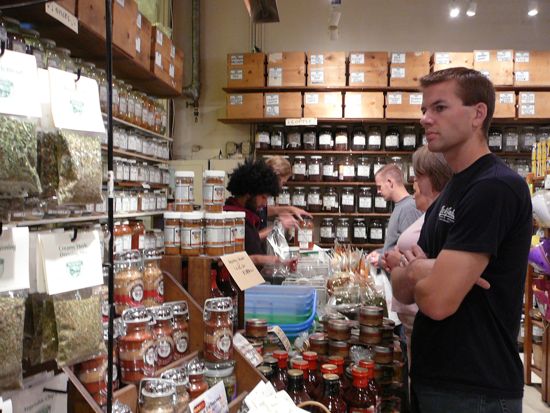

In the 1970’s, the market was a little run-down and shabby, and many business people wanted to raze it and use the space for office buildings. Seattle residents said “NO!” and instead, the market was revitalized. It is one of the major tourist destinations in the city, and a lively spot every day of the week.
A long time ago, before the big Seattle fire, my family lived just up the street from this market.
It’s The Law
There is something about Oregon I love. I don’t know if this is true anywhere else in the country, but in Oregon, you are not allowed to pump your own gas. So when it is cold and rainy and foggy and drizzly, you can sit in your warm car and someone else fills up your tank.

Just like Kuwait!
I asked the very nice young man who filled my tank if people ever tip him, and he said “Some people do!” with a big smile. I was happy to tip him for filling my tank.

(I asked him if I could take his photo for my blog, and he said “sure” it was fine. )
Wooo Hoooo, Oregon!
Combination of Events
Yesterday I visited our house. We have been seriously blessed with good renters, people who are good hearted, and take care of the house. We have a good property manager; when something needs to be done – a new roof, a new furnace, a new fence – he has people who can handle the job, and the job gets done well.
The house still has it’s original refrigerator from when it was built. I think it needs a new one – before an emergency happens and our renters lose their food. I measure, take stock of how the house is doing, and then . . . I have to go buy a refrigerator.
For me, this is stressful. A refrigerator is something that is supposed to last for a while. I go to Consumer Reports and I read about all the refrigerators. Here is what is interesting – the top rated model, in terms of keeping things cold or frozen, in terms of energy use, etc. has thirteen consumer reviews, and most of them are negative! Most needed repairs, and most of the repairs had to do with the ice maker and the cold water on the door thingie (to use the technical term)
So I visited three stores, looked at refrigerators. At two of the stores, you had three choices – white, stainless steel or black. I am not a black-appliance person, I am not a person who wants black in my kitchen. Neither, I discovered, am I a white-appliance person. And the stainless steel just makes me tired; it is a fad that is already passing. So what to do?

I went to the third store and there is more choice. I find the top rated model, which is on sale, and then ask the salesman if he has the same model WITHOUT the cold water and ice dispenser on the door, and he does! And it is on sale! And WITHOUT the fancy extras – it is exactly the same price as the ones WITH the fancy extras!
How funny is that?
I went ahead and ordered the one without all the water dispensers. It does have an ice cube maker, that is fine with me. Then, it took me longer to pay for it and arrange for delivery than it took me to research and decide which model to buy.
The salesman was very good, he knew his stuff. This wasn’t his fault. The problem is that I am an anomaly. My billing address is not the same as the address to which the refrigerator will be delivered. I have several different phone numbers, one of which is only active when I am in the USA, one of which rings in Kuwait, and I don’t want people calling in the middle of the night, oh, what to do?
I don’t exactly know what time is a good time for delivery for the renter; that is always handled by the property manager. I don’t have his phone number with me. GROAN!
When I finally get back to my Mother’s place, I am exhausted. A soft rain starts falling around 4 pm and from then on, I keep falling asleep. I am probably still jet lagging, yes, I know, it’s been a week but my body still has a time zone all its own.
I know it is too early to go to sleep so I make myself stay awake, I try to read, but at 9 pm, I totally give up. It’s the exhaustion, and it is the soothing sound of the steadily falling light rain. I keep my window open; I love the fresh air, and I love to hear the birds, and oh, the sound of rain! This morning, yes, 4 a.m. and I am wide awake. It is a GORGEOUS, sunny day, the clouds and rain have gone, and I had better start packing for the next leg of this journey while I have all this energy.
Seattle OKs Bag Fee
From the Seattle Post Intelligencer:
City OKs 20-cent fee on plastic, paper bags
Council also outlaws foam food and drink containers
By KATHY MULADY
P-I REPORTER
Move over, baseball caps and T-shirts.
Logo-emblazoned cloth grocery bags could soon become the most popular company freebie in the Puget Sound region.
Seattle became on Monday one of the first major American cities to discourage the use of paper and plastic shopping bags by requiring grocery, drug and convenience stores to charge 20 cents per bag. In a related action, the City Council also banned plastic foam food and drink containers.
Both laws will go into effect Jan. 1.
People can avoid the fees by bringing their own reusable bags when they shop. The city of Seattle will launch a 90-day education effort to help people figure out the best ways to use cloth bags, and remember to take them when they go shopping. The city also plans to provide residents with a couple of free bags.
One of my favorite stores, Trader Joe’s, has been selling reusable bags forever. They now have a display with many sizes and designs to choose from:

I’m really trying hard. I have a friend who is so conscientious about recycling, she always carries her own bags, and her actions have influenced me greatly. She believes even one person makes a difference, and I believe her – I can see that her behavior has already changed mine! I am trying to carry my own reusable bags now, too.
Especially for my Kuwait/Gulf/Middle East readers, I got a big grin when I saw this in the prepared food section:

A ready-to-go lunch, with felafel, hummous, tabouli and a little bit of flat bread.
Off the Banned Driver List
When I got to the car rental counter, the polite man behind the counter typed in all the information and then blanched.
“Ummm, ” he started off, very embarrassed, “there is a problem . . . . ”
I knew, I just knew what was coming. I had even sent the car rental agency an e-mail asking them to check to make sure everything was straight.
“You’re on our banned driver list.” he finished up.
If it hadn’t happened before – TWICE – I would have been a lot more embarrassed. Now, I am just annoyed.
When I came in here last time, I didn’t know my license had expired. Fortunately, I have another driver’s license, so they let me use that one – it is the license that is banned, not the driver (yeh, go figure). The very next day, I was the first one in line at the driver’s license place and renewed my license in less than five minutes. It’s easy. I just explain that I live in Kuwait and don’t always have access to registration facilities! They understand.
But when I got to California and went to rent again – same problem. Again, they let me drive on my other license.
So third time is the charm. Once again, they give me a car based on the second license (I mean, isn’t that funny in itself; you have this BANNED person and you give her a car because she can show you another license???)
The counter guy gave me a sheet of paper with an intimidating list of the possible reasons I was banned, including expired license, but also things like fleeing the scene of an accident, or felony warrants and things like that. (If you could see me, you would know how dyingly funny this is.) Before I even took the car, I called their security people. It took a total of 30 seconds. I told them I renewed the license, they checked, found out I was not lying and BINGO! I am no longer a BANNED person.
I knew what the problem was, but being BANNED made me feel terrible. It was so unfair. It made me think about labels, and how even though they are just words, words can make you feel really really BAD. I truly hated being a BANNED person.
How Long?
AdventureMan was driving, which left me free to take photos on my way to the airport. Here is the exact same set of traffic lights I photographed April 14th and I hope you will notice, while there actually is a very very dimly lit red light, we can’t discern it in this photograph, and you can barely discern it with your naked eye. Three months later, nothing has changed.

It doesn’t take that much. Send the traffic-light-bulb-changing guy out every single day, and this will not be an issue. How long will it be before we have working red lights?
Now, this truck full of paving stones:

This is not a secure load. This is an accident waiting to happen. The driver is also very aggressive, and hates being passed. His tires are also bald.
Ministry Cracking Down on Porn Sites
A little over a year ago, May 18th, 2007, I remarked on an article in the Kuwait Times called MOC Bans Porno Film Sites. I had no idea that even over a year later, that blog entry would continue getting countless hits.
In this morning’s Kuwait Times, it’s like they say – deja vu all over again.
KUWAIT: Communications Minister Abdulhahman Al-Ghunaim has ordered the establishment of a committee to improve Internet services by finding ways to stop the spread of pornographic websites, which contradict local cultural and religious values.
The committee will reportedly be headed by Engineeer Ali Al-Zibin, the ministry’s Assistant Undersecretary of Information Technology, and will include representatives from the Interior, Awqaf, and Information Ministries, as well as Kuwait University.
A Communications Ministry official said that the committee will coordinate with and supervise the country’s Internet service providers in order to formulate a strategy to limit this phenomenon, by strengthening their supervisory role in this field.
It will also work continually updating the country’s systems to ensure that they are on a par with the latest technological developments to put an end to the spread of pornographic sites, in addition to establishing a map for joint coordination between all ministries.
You can live in a country a long time and barely scratch the surface. I honestly try to figure out what is going on, and even so, I get surprised often. I feel so encouraged when I see people tackling a problem, but then, so often, it turns out to be just meeting, just talking – no fixing.
As I have said before – I hate pornography. It isn’t part of my country’s values, either. It is certainly counter to my values. And yet, when I think of spending a country’s resources on trying to fight pornography, which we have had with us since probably the earliest times, I just feel tired. I don’t think you can win a fight against pornography. I think, to eliminate pornography, prostitution, alcohol and drug abuse – you have to change the way people think. Haven’t you noticed? You restrict something, it only makes it more attractive. Look at the countries that brutalize people arrested for possession of pornography – Saudi Arabia and Iran – have they been successful in eliminating access to pornography – on the net, or elsewhere? Where there is a demand, there will be suppliers, or that is how it seems to me. How do we eliminate the demand?
Who accesses and downloads porn the most, do you think? My bet would be on the 15 – 35 year old male, the most technologically savvy group in any population. How long do you think it will take them to break through any barriers you can place? And how many nanoseconds before they spread the “fix” all over the internet?
There is another article today, one on the air conditioning breakdown at Ibn Sina hospital, patients keeling over from the heat and humidity and then sewer-dwelling insects swarming into the children’s ward. How disgusting is that?
Attack the problems you can solve. Put people first. Fix the infrastructure – the roads, the hospitals, government services, licensing, visas. Make Kuwait state-of-the-art in communication accessibility. Kuwait is RICH, Kuwait can do anything. I hate pornography, but I don’t think any nation has the capacity to stop it.
Ministry Conducts Demographics Study
This is from today’s Kuwait Times. I LOVE demographics. I love tagging factors, loading them all into a data base and seeing where the stats fall. You learn so much.
The Ministry of Social Affairs and Labor is studying effective means to rectify the country’s demographic imbalance. The ministry has reportedly reached the conclusion that the blend of different nationalities in Kuwait has proved detrimental to its societal fabric. One Arab nation’s expatriate population in the country has exceeded 300,000, sources say, which puts the states economic and political stability at great risk. Sources said that the matter is complicated and needs all the ministries’ undivided support.
Expatriates, it is felt, bring with them their own modern culture and customs which are alien to the local citizens, most of whom follow archaic customs deeply rooted in tribal practices. Expatriates are also accused of taking the law into their own hands without approaching the concerned authorities whenever they are confronted with a problem. It has also been observed that expatriates belonging to a certain nationality inhabit certain areas in droves, leaving security officials at a loss to change the situation.
As a move towards controlling the situation, the ministry is to form a permanent committee comprising officials from different ministries to scrutinize all the expatriates who arrive at Kuwait.
It will issue a fitness certificate to eligible expatriates on the lines of medical fitness test. Employers will then be able to decide whether to appoint those workers or repatriate them. The ministry also plans to come down heavily on expats who obtain jobs using illegal residence permits.
Hmmm. Rectifying the population imbalance might require giving up expatriate labor. What laborers do you want to give up? The largest number are probably doing low-skill level work – cleaning houses, cleaning the streets . . .Or do you want to give up those who are managing your stores, taking your orders in all the restaurants, cooking, taking care of the office chores?
I can guess which expatriates are bringing in alien modern customs and practices, but unless you are going to give up television, cable, the internet and travel . . . that train has probably left the station.
So which nationality has over 300,000 expats in Kuwait? And which nationalities “inhabit certain areas in droves?”
Who takes the law into their own hands?
More Three Cups of Tea
The timing couldn’t be better. Thank you, Phantom Man, for sending a link to this New York Times article on Three Cups of Tea, from the July 13th New York Times.
By NICHOLAS D. KRISTOF
Published: July 13, 2008
Since 9/11, Westerners have tried two approaches to fight terrorism in Pakistan, President Bush’s and Greg Mortenson’s.
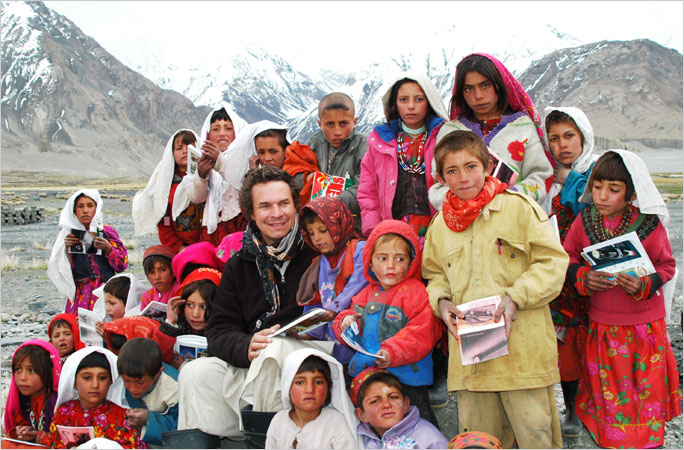
Greg Mortenson with Sitara “Star” schoolchildren. Photo: Fred R. Conrad/The New York Times
Mr. Bush has focused on military force and provided more than $10 billion — an extraordinary sum in the foreign-aid world — to the highly unpopular government of President Pervez Musharraf. This approach has failed: the backlash has radicalized Pakistan’s tribal areas so that they now nurture terrorists in ways that they never did before 9/11.
Mr. Mortenson, a frumpy, genial man from Montana, takes a diametrically opposite approach, and he has spent less than one-ten-thousandth as much as the Bush administration. He builds schools in isolated parts of Pakistan and Afghanistan, working closely with Muslim clerics and even praying with them at times.
The only thing that Mr. Mortenson blows up are boulders that fall onto remote roads and block access to his schools.
Mr. Mortenson has become a legend in the region, his picture sometimes dangling like a talisman from rearview mirrors, and his work has struck a chord in America as well. His superb book about his schools, “Three Cups of Tea,” came out in 2006 and initially wasn’t reviewed by most major newspapers. Yet propelled by word of mouth, the book became a publishing sensation: it has spent the last 74 weeks on the paperback best-seller list, regularly in the No. 1 spot.
Now Mr. Mortenson is fending off several dozen film offers. “My concern is that a movie might endanger the well-being of our students,” he explains.
Mr. Mortenson found his calling in 1993 after he failed in an attempt to climb K2, a Himalayan peak, and stumbled weakly into a poor Muslim village. The peasants nursed him back to health, and he promised to repay them by building the village a school.
Scrounging the money was a nightmare — his 580 fund-raising letters to prominent people generated one check, from Tom Brokaw — and Mr. Mortenson ended up selling his beloved climbing equipment and car. But when the school was built, he kept going. Now his aid group, the Central Asia Institute, has 74 schools in operation. His focus is educating girls.
To get a school, villagers must provide the land and the labor to assure a local “buy-in,” and so far the Taliban have not bothered his schools. One anti-American mob rampaged through Baharak, Afghanistan, attacking aid groups — but stopped at the school that local people had just built with Mr. Mortenson. “This is our school,” the mob leaders decided, and they left it intact.
You can read the entire article in the New York Times by clicking on the blue type.
Recent Comments
ExpatAlien on What Country am I Living … intlxpatr on Yellowstone: Old Faithful to C… Michelle on Yellowstone: Old Faithful to C… Cathy on No Grown-Ups in Charge intlxpatr on Waiting for Snow Wikipedia Donate Button

Amazina


Early Voting in Florida


 Here There and Everywhere