Roasted Tomatoes
A friend brought me a huge bag of tomatoes, and also a serving of the same tomatoes roasted up – oh WOW. Roasting these already tasty tomatoes concentrates their flavor.
I serve them as a side dish. I add them to salads, and to salad dressings. I serve them as a salad with a little Balsamic vinegar. I add them to the spaghetti sauce. I make them into a roasted tomato soup, with basil (be sure to use real cream; it’s OK, it just makes the taste richer and more satisfying. If you are satisfied, you won’t eat more and the cream won’t make you fat. I promise.) They are like magic, anything they touch tastes wonderful.
Chop cherry tomatoes in half, bigger tomatoes into quarters. Place in a long flat pan (with sides; these get juicy at first) and spray with a really good olive oil and sprinke with sea salt.
Roast at 180°C / 350°F for 40 minutes, longer if you want less juice.
You will find it hard to resist eating them right out of the pan.
A Case of Two Cities with Inspector Chen: Qiu Xiaolong
When my sister Sparkle recommends a book, I have learned to listen. I think I ordered this book about six months ago, but never cared enough to actually read it. After reading a recent Donna Leon (like dessert, I use it as a reward for reading something more challenging) I decided it was time to tackle Qiu Xiaolong.
I believe A Case of Two Cities is the first in the series; I tried very hard to make sure it was. When I first started reading it, it was difficult, but it didn’t take long to adjust. When you read a detective story written in a foreign culture, you have to park your old way of thinking, and quickly adapt to a new way of thinking. First, you have to learn what that new way of thinking is. They don’t just tell you at the beginning of the book “Here are the differences in values – you will notice . . .” no, but Qiu Xiaolong is courteous enough to take us by the hand and lead us gently into the Chinese way of thinking, the Chinese way of getting things done, and the technicalities of Chinese detective work.
As we meet Inspector Chen, a published poet, and a detective, ten pages into the book, a new anti-corruption campaign is starting in Shanghai, and Inspector Chen has been given a special assignment – a qinchai dacheng – as “Emperor’s Special Envoy with an Imperial Sword.” Even though imperial days are long gone, this warrant gives him emergency powers to search and arrest without reporting to anyone – and without a warrant. He is to seek and find Xing, a corrupt businessman who has caused huge loss to the national economy and is in danger of tarnishing the Chinese national image, and Xing’s associates.
Just as in the Donna Leon books about Commissario Guido Brunetti, and the Bowen books about Gabriel duPre, and James Lee Burke’s books about New Orleans, and Cara Black’s books about Aimee LeDuc, the detectives and investigators have to walk a fine line between going after the criminal and overstepping their warrant – stepping on the toes of those also engaged in corruption so entrenched that it has become a way of life. Each of these detectives has to maneuver that treacherously fine line – who determines when corruption has become too much? It usually puts their own lives in danger at some point, as those manipulating the system and making a fortune out of it do not want to be caught, do not want to be exposed, and will go to great lengths to protect their ill-gotten gains.
And just as in the above books, the book is more about the actual process than the crime itself. Inspector Chen must go about his task indirectly, having chats here and there, gathering threads of information with which he tries to weave a plausible tapestry of events.
As I was reading A Case of Two Cities, I kept making AdventureMan take me out for Chinese food! The meetings are often held over food, and the descriptions are mouth-watering.
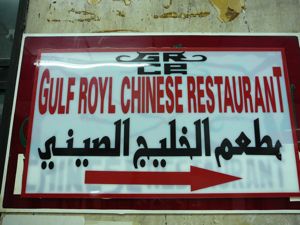


Best of all, when you read these books, you get a tiny little glimpse into another way of thinking, another way of doing business. We are all human, we all have the same needs, and we differ in how we go about getting those needs met. We differ in the way we think. It helps to enter another way of living, another way of thinking, it helps to visit through these books so that we can increase our own understanding that our way of doing things is not the only way, maybe (gasp!) not even the “right” way! Maybe (crunching those brain cells really hard to output this thought) there is more than one “right” way?
Lazy Mubarakiyya Friday
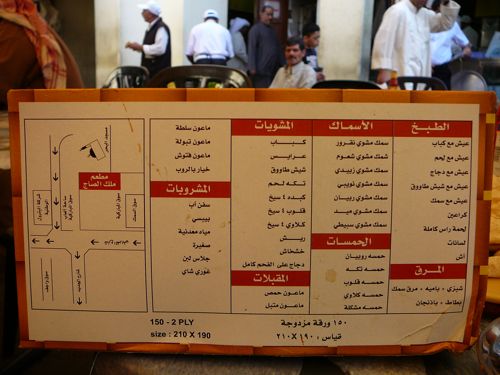
For our non-Kuwaiti friends, Friday is the day off in Kuwait if you only have one day off, Friday and Saturday for a few. It’s the perfect time of the year to visit the Mubarakiyya Souks – not too hot, not too cold and always something interesting to see. Grab your friends and family, and have lunch in the square where all the restaurants are.
In our two years of visiting the restaurant, we never realized the menu was on the bottom of the kleenex box:
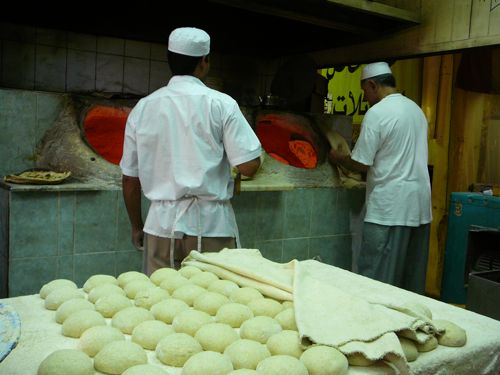
Bread making:
So good!
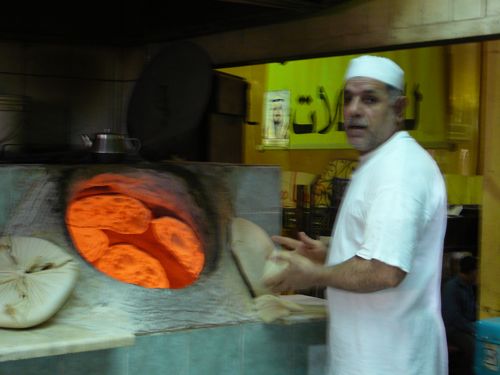
Kebab making:

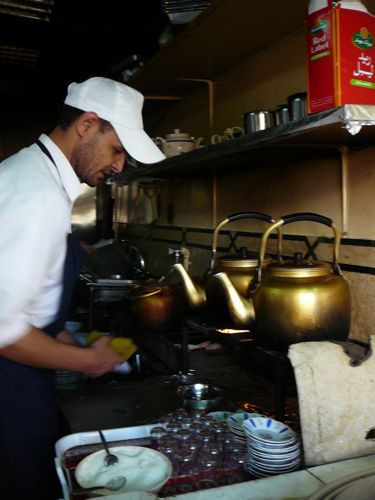
Busy in the tea stall:
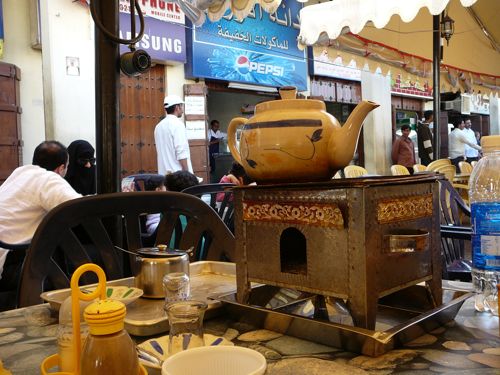
The tea stays HOT on the table tea-grill:
Something Stupid
I had a birthday a while back, and decided that I was no longer going to mourn my Cuisinart, stuck in storage lo, these last ten years while my husband and I vagabond around the earth. I had bought a cheap food processor in Germany, and left it behind (whew! bought it when the dollar was $1.20 to the Euro, those were the days!) and then I bought a cheap food processor in Doha and brought it with me, but it doesn’t grate Parmesan, and . . . well, it isn’t a Cuisinart, and I really loved working with my Cuisinart. Isn’t it wonderful when they invent a piece of machinery that truly decreases labor, and is a pleasure to use?
I just bought a little one, knowing I will get rid of it when I leave. It is 110 volts, so I could even take it back with me if I wanted. The very first thing I grated was Parmesan cheese, and it was good. And then I grated cheddar, and it was good. And then I chopped onions and parsley, and it was very very good. I used it three times.
Yesterday, I went to grind some sausages and it only worked for one second, then quit. I checked all the plugs, checked the fuse box, checked everything I could. I couldn’t figure out why it wasn’t working.
Then I figured it out. I had fried my beautiful new Cuisinart. Can you figure out what I did?
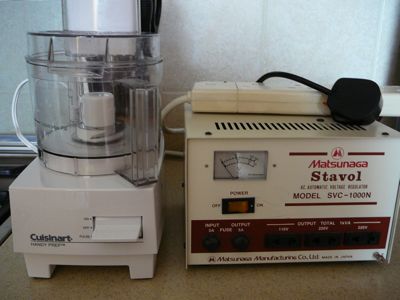
I will show you a close-up of the transformer, maybe that will help:

Yes, I plugged my sweet little 110 brand new Cuisinart into the 220/240 output plug instead of the 110 output plug.
Do you think it can be fixed? Is there somewhere in Kuwait I can take it and get it re-wired? (Sigh.)
Al Mohaleb Restaurant
My friend called me, all excited.
“Kareem took me to the most wonderful restaurant for my birthday last night!” she exclaimed, and I could just hear the delight in her voice. “We just know you and AdventureMan will just love it! It’s Kuwaiti! They only serve fish and related things like appetizers and rice, but the fish is out of this world, and the atmosphere is lovely; gracious and refined. When can the four of us go together?”
We quickly compared calendars and came up with the soonest compatible date. I rarely hear my friend wax enthusiastic about a Kuwaiti restaurant.
The night arrived, and as we picked up our friends, we sat in the garden, which for some unknown reason is flourishing this year in spite of the drought. At her house, you can see stars in the sky, the air is perfumed with growing things, and the night is so sweet, with just a light breeze, that we are almost reluctant to go.
Who would know where this restaurant is? There is no sign at The Palms Hotel, next door to the SAS Radisson, that this restaurant exists. I remember when they had a “Wasabi” sign up for nearly a year, and no Wasabi ever showed up there – but this restaurant exists, and there is no signage. I am a little concerned because the front parking lot is packed, with people waiting to find a spot, but Kareem tells us to drive to the end of the dirt parking lot. There, at the very end of the Palms hotel, next to their highly publicized new Tajine restaurant, is Al Mohaleb, overlooking the sand and sea.
This is what you see at the entrance, the huge Dallah (coffee pot) and in the background, the sign for Al Muhaleb, which, AdventureMan tells me, is the biggest dhow, the one used for trading in days of old, across the seas. Suddenly the light goes on, and I remember my friend taking me to a mall of the same name, and . . . the Mall is shaped like a great, huge ship!

As you enter, there is a diwaniyya-like area for meeting up or waiting for a table, and then you go up three steps to the restaurant:
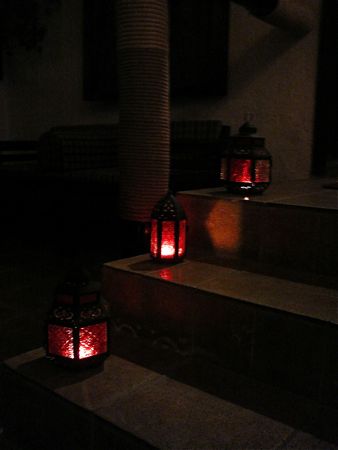
It’s already a little magical. The restaurant is decorated with old fishing equipment, nicely displayed, nicely framed old photos and memorabilia. It has a beam and woven palm leaf ceiling (I am a sucker for those) and a spacious dining room, with an outer area for smokers and shisha. The waiter brings tiny cups, and pours the coffee with cardomon for us, and welcomes us. Another waiter brings Kuwaiti nibbles, simply cut lettuce and vegetables, Kuwaiti pickles and a green mabooch, which I happily recognize because you, my readers, have told me.

This is not fast food, and it is a good thing, because when you are with good friends, there is always so much to talk about. We don’t just catch up, we have to discuss all the politics, the US election, the Kuwait demonstrations, recent editorials, my friend’s garden, my current projects, our children . . . the evenings are always too short. No matter how much we chat, there is always so much more to discuss.
The kitchen at Al Muhaleb is glassed in. We spot our fish coming out of the oven, and oh, it looks magnificent. As good as it looks, it tastes even better:
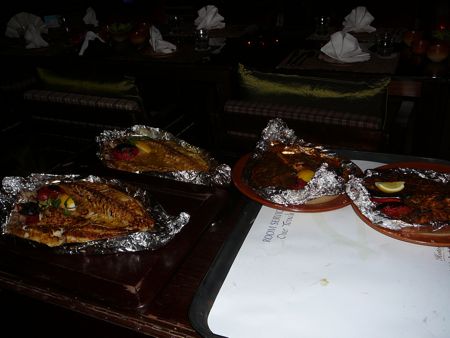
I didn’t even look at the menu, I just ordered what my friends recommended, but they also said you can’t order anything wrong there, it is all good. I had the zubaidi cooked flat; it is served with rice and a green marag (sauce) that was delicious. Because it was so delicious, we all ate too much, and sat looking at all the food we couldn’t finish in dismay. Next time we go, I think we will share one fish to every two people – I hate wasting such exquisitely prepared food.
Kareem has told us many times about the words of Mohammed that a good Moslem should only eat to the point of “enough,” not to the point of “full” but I think we all violated it that evening. We meant to stop, we really did, but it was so delicious we kept nibbling.
Thank God, this is not a fast food restaurant. There is a man playing Al oud live in the background, as we continue to chat, but with less animation as our bellies groan . . .
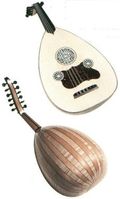
We are finished eating, truly finished, but then they bring a plate of beautiful fresh fruit, every piece perfect, and we continue our evening together, refreshed by the fruit, drinking hot tea, relaxing – there is no pressure to leave, they are not hurrying us out of the restaurant.
I’ve been looking for a Kuwaiti restaurant, and I just love it that when they found it, our friends shared their find with me. It’s a great place to take visitors who come to Kuwait. It is expensive – so AdventureMan tells me (I didn’t look at the menu, remember?) and so worth it. The menu is mostly limited to fresh fish and fresh salad/appetizers – hummous, mutable, etc. and everything is prepared with thoughtful care.
If there are any drawbacks, it is that with all the hard surfaces, once the restaurant fills up and the music starts, it is harder to make conversation. Also, the smokers get the best part of the restaurant, out near the beach. Having said that, when it is dark, it hardly matters and you can see the city lights of Kuwait from any part of the restaurant. Service is excellent and the food is memorable for its excellence.
Sabille Shop
I love sabilles. Sabilles are localized charity, “in a dry and thirsty land” they are provided by generous souls that the thirsty might have cool, fresh water to refresh thenselves in the heat of the day. You will see them at mosques, along city streets, in every neighboorhood. They come in fanciful shapes; if you type “sabille” into the HT&E search window, you will see more. I love the Kuwait Liberation Tower ones, and also the water-tower wannabes, but I also like the ones that look like old castles or old doors or jugs. I love it that people go to the trouble to make something utilitarian interesting, even artistic.
Recently, I found a shop in the Wafa Mall that sells sabilles:
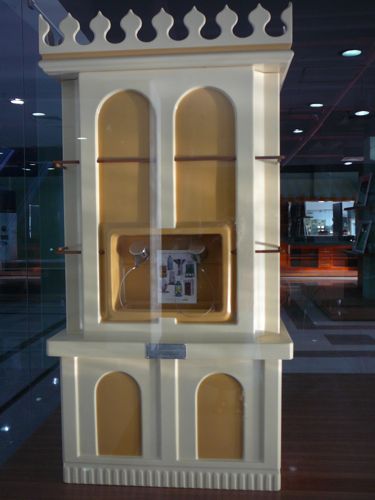
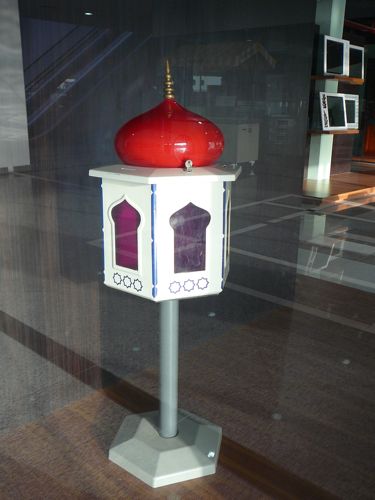
The shop is called Fine Things, and also has some fancy presentation boxes and this, which looks like a mail box to me, but might be for collecting charitable donations, or . . . ? I might be totally wrong. Your guess is as good as mine:
I like this tiny little mall because it has commercial kitchen supply shops with all kinds of display cases and things you don’t find very often. There is also a mattress shop; I always laugh when there is a family shopping there for mattresses because the parents don’t say “NO!” to their kids, so the kids are JUMPING ON THE MATTRESSES! The salesmen seem unable to ask the parents to make them stop.
History of Architecture in Old Kuwait City (2)
I love this book. It is such a treasure. For those of you who have ever wondered about the construction of old Gulf dwellings, this book is a MUST have – so much detail, so much to help us understand what we are seeing.
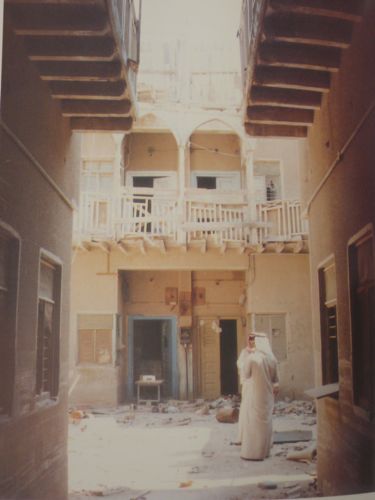
More from author Saleh Abdulghani Al-Mutawa, Architect:
House design and location specified unity existing in the Kuwaiti society. In old times, the poor livednear the rich, where no differences between them. The only difference was that the houses of the rich were vast. Ordinary Kuwaiti house, occupied by the majority of Kuwaitis, consisted of a vast courtyard, surrounded by many rooms, and a hallway secured privacy to the family by separating the house from the street. In that architectural design, the courtyard ventilated the house to find it cool at night and after sunset. This was due to the exchange of radiation between the floor of the courtyard and the outer space. At night the house became cool and sleep was comfortable. During summer, the majority of Kuwaitis prefer to sleep in the courtyard or on the roof. Usually, there is a room on the roof used to store mattresses in or sometimes for napping. A small bath is usually located beside that room. . .
Walls were built of rock and mud, and decorated internally with white gypsum. Ceilings consisted of rows of jandal (trunks), basajeel (bamboo) and manqour (straw mats), covered with a 30cm or a 40cm layer of mud. In winter, when rain was heavy, that layer should be attended to and maintained by adding more mud. Houses of the rich used gypsum for protection. When wood was used in fixing the ceilings, thejandal was only 4 m long, and for the wide rooms they used square pieces of wood of 6m. The floor was covered with mud, then with tiles which was imported from neighboring countries. To let the water flow from the roofs, they used the wooded marazims (gutters) which extended from the roofs to the outside. In the houses there were wells for supplying the underground water, and there were pools to store water in.
As regards the houses of the rich, they were divided into a number of courtyards, each serving a certain purpose. There was a courtyard used to include a Diwaniya for male guests, consisting of a large room annexed with other buildings needed to accomodate the servants or for other purposes.
The other courtyard was located for family female members, including a number of rooms and bathrooms. A third courtyard was used as a kitchen, including the kitchen, storage room for fuel and a store room for the different kinds of food. There were more courtyards for the animals: goats, cows, horses. Kuwaiti houses also had a “baqadeer” (wind tower) which was a natural air-conditioner, not one Kuwaiti house was without it.
Where Things Go?
This last week I had a lot of shopping to do, and specific things I was looking for. I pretty well know where to look for what I am seeking now, in spite of the fact that the grocery stores here have a different logic than the logic I am used to.
It’s not a right or wrong thing; it is a different cultures thing. I had the same issues when I would be looking for things in the German supermarkets, or the French supermarkets, or even shopping in Florida supermarkets as opposed to West Coast supermarkets.
I was looking for chopped pimentos, (AdventureMan has a yearning for a Southern staple called Pimento Cheese) which I sort of found and sort of didn’t. What I eventually found, in the condiment section, with the pickles, was canned roasted peppers, which I then chopped into tiny pieces.
Most of the time, I don’t have any trouble finding pimentos, but for some reason, the last month or two, I haven’t been able to find them until today. Usually, if I am going to find pimentos, I find them in the same section with tomato paste, hot pepper paste, and spicy Indian pickles. Condiments like mustards, mayonnaises, steak sauces, ketchups and baby foods are all up on top of the frozen foods. (See! I don’t KNOW why!) Today, I actually found them in the American pickle section. I don’t know why.
In the dairy department, there isn’t a yoghurt section, or a milk section, there is a KDD Dairy section and an Al Marai Dairy section, and (there are more) today none of the sections had sour cream, and in fact, they didn’t think they had ever had sour cream although I buy it there all the time.
At this point, I have bought so much “just in case I never see it again, ” that I can’t get a single thing more in my freezer.
There is a deli section, where they sell fresh soft cheese, a huge variety of olives, and big flats of eggs, 30 at a time. In the bread section, they also sell potato chips and taco chips. Soda crackers are sold mixed in with what we think of as cookies, sweet biscuits. Cat food is sold next to the baby food and bottled water. Go figure!
After a while, you just kind of know, you kind of get used to it.
The market we used to go to in France was about 1/3 wine, 1/3 fresh vegetables, cheeses, meats and terrines, and the remaining 1/3 was regular groceries!

(Not my photo. I found it at about.com GoFrance)
Shrimp Or Clam Salad
This is a great salad to take to a potluck / covered dish lunch. It can be made with either clams of shrimp, and can be made more or less spicy by the addition of Tabasco sauce.
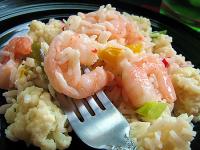
Shrimp / Clam Salad
3 cups freshly cooked hot rice
3 -4 Tablespoons Miracle Whip or Mayonnaise
2 Tbls cocktail sauce (or ketchup + horseradish)
2 -3 chopped green onions
i stalk chopped celery
1/2 cup chopped sweet pickle
12 – 16 oz cooked frozen shrimp
or
2 cans whole clams, drained (use the clam liquid as part of the water for cooking the rice)
Cook rice, add solid ingredients (no need to thaw shrimp if rice is hot). Add sauces and very little pepper to the rice. Stir, cover and refirgerate until cold. Serve on lettuce leaves, if serving individually.
Hummos Wa Burghul

Do you see that black stone dish on the table, the one that has a dish in it called Hummos wa Burghul (Chickpeas and Cracked Wheat?)
I am trying to find a recipe to make it. Please, if you are Syrian or Jordanian, and you know how to make this, or maybe you have a mom or an aunt who knows how to make this, would you please share your recipe with me?
I found one recipe, for a Burghul Pilaf, from a 1959 Lebanese cookbook. It calls for 1 1/4 lbs of butter. (!!! AACK !!!) I remember it really did taste buttery, it was really yummy, but that sure seems like a lot of butter!
It was delicious. I’d really like to try to make it, if someone out there can help me out.
Recent Comments
ExpatAlien on What Country am I Living … intlxpatr on Yellowstone: Old Faithful to C… Michelle on Yellowstone: Old Faithful to C… Cathy on No Grown-Ups in Charge intlxpatr on Waiting for Snow Wikipedia Donate Button

Amazina


Early Voting in Florida


 Here There and Everywhere
