Google Banned From Military Bases
News from BBC
Google Banned From Military Bases
Last Updated: Friday, 7 March 2008, 05:45 GMT
There are concerns that detailed maps may threaten security
The US defence department has banned the giant internet search engine Google from filming inside and making detailed studies of US military bases.
Close-up, ground-level imagery of US military sites posed a “potential threat” to security, it said.
The move follows the discovery of images of the Fort Sam Houston army base in Texas on Google Maps.
A Google spokesman said that where the US military had expressed concerns, images had been removed.
Google has now been barred from filming and conducting detailed studies of bases, following the discovery of detailed, three-dimensional panoramas online – and in particular, views of the Texan base.
It said such detailed mapping could pose a threat.
Google spokesman Larry Yu said the decision by a Google team to enter the Texas base and undertake a detailed survey, had been “a mistake”.
He told the BBC News website that detailed study of such sensitive sites was not Google policy.
You can read the rest of the story HERE
EcoTerrorists in Seattle?
Hunt is on: Who torched the Street of Dreams?
By Steve Miletich
Seattle Times staff reporter

ELLEN M. BANNER / The Seattle Times
An aerial view of efforts Monday to put out fires in four Street of Dreams homes in Snohomish County. The homes were part of what’s called a “rural cluster development” and were built to higher environmental standards. The home on the left was a Craftsman known as Copper Falls, and the one on the right was the Greenleaf Retreat.
Working with few clues, federal investigators face a daunting task as they try to determine whether a shadowy group of radical environmentalists torched three multimillion-dollar homes along a Street of Dreams in Snohomish County on Monday.
Although a spray-painted banner left at the scene contained the initials of the Earth Liberation Front, it took nearly a decade of groundwork in a previous case before investigators cracked a Pacific Northwest cell of the ELF responsible for more than a dozen arsons beginning in 1996.
The homes gutted in Monday’s inferno had drawn tens of thousands of people last summer who paid to gawk at their architecture, interiors and sheer size.
The fires left law-enforcement officials questioning whether they were timed to coincide with jury deliberations in the federal trial of an alleged ELF member accused of helping set the 2001 fire that gutted the UW Center for Urban Horticulture.
“I guess you could say we’re not surprised,” said Mark Bartlett, a senior federal prosecutor involved in the UW-related trial.
The pre-dawn fires in the Maltby area of Snohomish County destroyed the three homes and damaged a fourth, and investigators were looking into the possibility that an attempt was made to torch a fifth house. None of the homes was occupied, and no one was injured in the three-alarm fire that shot flames 100 feet into the air.
The FBI is investigating the fires as a possible “domestic terrorism act,” said FBI spokesman Fred Gutt in Seattle. The Snohomish County sheriff’s Office and the federal Bureau of Alcohol, Firearms, Tobacco and Explosives also are participating as part of the Joint Terrorism Task Force.
You can read the entire article HERE
How Decisions are Made in Kuwait
Here is the problem expats have in any country: you don’t know what you don’t know.
If you know you don’t know something, you can learn it. If you don’t know that you don’t know, there is this huge void in your understanding. Many times you can suspect there is a void, and if you ask, people will look at you like you are a little odd, and they will tell you there is no difference.
There IS a difference.
Working together with people of different nationalities, I have learned that some nationalities just forge on ahead and do things. Some nationalities use a more consultative process. Some nationalities expect to be told what to do and don’t do what they are not told to do.
In Friday’s Kuwait Times (February 21) is a column by Shamael Al-Sharikh, called The red, white, green and black. She talks about Kuwait National and Liberation Days, she talks about the shared heritage of all Kuwaitis (honestly, I would love to link you directly to this article but the website is still down) and then – I got a huge “AHA!” She talks about how decisions are made in Kuwait. I will quote a brief section, but I urge you all to find this column and read it in it’s entirety.
“. . . it has become painfully clear that there are nationals of this country who have no sense of belonging to it whatsoever.
However, the storm is about to subside. In a move that shows just how ready Kuwaitis are to mobilize for the sake of their national pride, a few diwaniyas in Kuwait signed a petition and sent it to the Takatul Shaabi political alliance at the National Assembly. It stated that unless MPs Adnan Abdulsamad and Ahmad Lari are asked to withdraw their membership from the Takatul Shaabi, none of it’s members will be welcome in Kuwait’s diwaniyas nor at weddings and funerals.
The move worked: the MPs have been asked to leave. . . the petitions included diwaniyas from all corners of the Kuwaiti society, both Sunni and Shiite, and it covered all sorts of ethnic backgrounds. . . I have never been more proud to support the red, white, green and black than I have now, and I am so proud to be a Kuwaiti.”
Not being welcome in diwaniyas, at weddings or at funerals is not something I would have considered political pressure. It matters here. It mattered enough that when diverse communities within Kuwait made the threat, it was effective. Who knew? Thanks to this column, I learned something I didn’t even know I didn’t know.
Corrupt Officials Beware
I don’t usually type out the whole article from the Kuwait Times, but because this one is so small, and buried way down on the page, I am making an exception and typing in the whole thing:
Responding to recent stories published by Al-Rai concerning alleged violations and corruption cases committed by ministers and MPs, HH the Prime Minister Sheikh Nassar Al-Mohammed noted that HH the Amir had instructed them to enforce the law to everybody. “And you can start with enforcing it on me,” the prime minister added.
Sheikh Nassar pointed out that the law would be enforced on everybody, be them (sic) (they) senior or minor officials. He added that he had instructed all concerned law-enforcement authorities to treat everyone equally with no exceptions at all.
Comment: WOOOO HOOOOOOOOO, HH Prime Minister Sheikh Nassar Al-Mohammed and BIG WOOOO HOOOOOOOOOOO to HH the Emir! If I knew how to make red letters, this would be a big RED letter day! WOOOOO HOOOOO law enforcement!
Berry and The Alexandrian Link
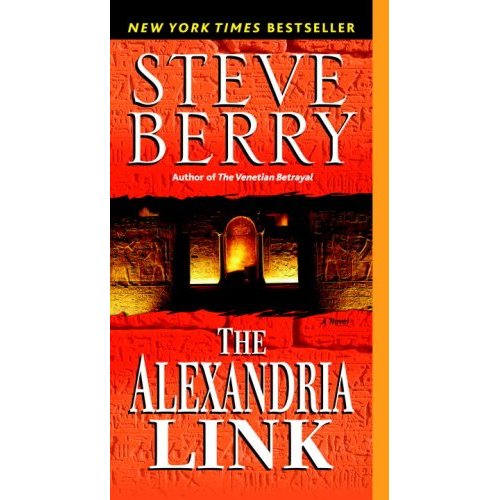
On his way back from a recent trip, AdventureMan bought a book in an airport, which he read and then asked me to read. Here is what he said:
“It’s not a great book, but I don’t know why I say that. It has an interesting idea and I want to know what you think.”
So just after I finished Inheritance of Loss I started in with this book, and it was the second book I will not recommend to you.
It is wooden. The characters are about a millimeter deep. The plot is unbelievable and doesn’t make sense and doesn’t hang together. It is full of adventure and travel and shoot-outs, which our “hero” miraculously comes through without a scratch while all around him his foes are dropping like flies.
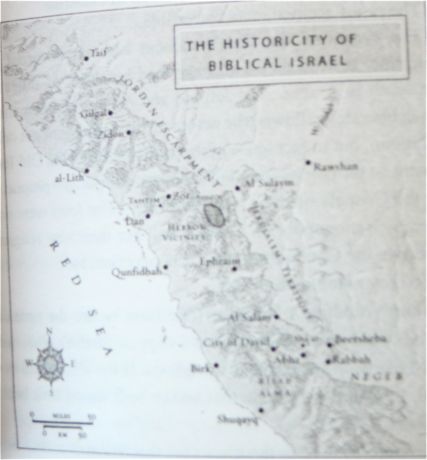
It DOES hinge on an interesting theory, one I had never heard before. There is a Lebanese historian and archaeologist, Kamal Salibi, who published a book called The Bible Came from Arabia. In this book Salibi makes his case for the “holy land” which was given to Abraham not being in Palestine at all, but rather in what is currently Saudi Arabia, along the western coast. He uses the utter lack of archeological findings in current day Israel/Palestine which support biblical accounts, and the plentitude of place names in the Asir region which closely resemble what the place names would have looked like and sounded like in ancient Hebrew, the language of the earliest biblical times.
The book, and the theory was, of course, controversial. If the contentions were true, it would undermine the foundation of the state of Israel in Palestine; it would mean that people have been fighting for the last 60 years over the wrong piece of land.
Here is a (very bad) photo of the map in the book which shows where Salibi believes the biblical cities were actually located. He believes “Jerusalem” was not a city, but an area within which were several cities. He believes “the Jordan” was not a river, but a mountain range, and that here, also, Moses and his refugees from Egypt wandered.
Unless you really love reading badly plotted books with cardboard characters, I would not recommend reading The Alexandrian Link. As a jumping off point for an interesting line of research – AdventureMan was right; this book gives you something new and different to contemplate.
Do You Know These Men?
Adventure Man and I took an early morning walk along the waterfront – a week gone from Kuwait and we are still jet lagging, awake at 5 a.m. and it is a great time for a walk. As the sun comes up in the east, the moon is setting in the west, out over Puget Sound. At the pier, we see this poster:
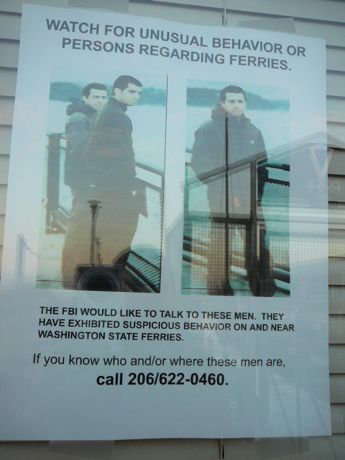
This was an issue when I was here last summer, for Mom’s birthday. Security has tightened on the ferry runs.
Rape in Kuwait (2)
There seem to be some misconceptions running around about rape in Kuwait. One misconception is that Kuwaitis commit a lot of rape. If you read the newspapers, however, you will discover that a lot of the rapes committed are nationality on nationality, for example, one senior Phillipina lady will befriend an unhappy domestic worker, will “help” her get away, and the domestic finds herself abducted, gang raped and in sexual slavery. That’s one common story.
Domestics of all nationalities are abducted off the streets, taken to apartments or villas, raped repeatedly by two or more men, and then dropped off on the street (or dropped off a balcony). People don’t seem to be very concerned about domestic servants being people here, having the right NOT to be raped, it sort of seems like business as usual, no matter who is raped or doing the raping. I have yet to read of one single case being prosecuted or sentenced in the Kuwait newspapers, but maybe I missed a day or two.
Another common story is Indian/Bangladeshi/Pakistani on Indian/Bangladeshi/Pakistani, and that can be men abducting/raping men, or men abducting/raping women. Some of these women are also recruited into prostitution, and are found when the police raid the dens of iniquity, catching the men and men or men and women in “uncompromising” positions, or, even better – RED HANDED!
There is a whole catagory of abductions – Kuwaiti, Bedoun or other Gulf or Arab nationality where a man or woman, or men or women, is/are abducted and taken to camps in the desert and raped multiple times. Sometimes they are left naked by the side of the road. Sometimes their dead bodies are found, and occasionally enough clues to guess at the identity of the abductors/rapists.
Then there are the men that rape children. It can be within a family. It can be within a building. It can be within a neighborhood. Many times the child knows the rapist, and is told that if they say anything, the rapist will kill or harm the child’s parents. There was an epidemic of child rape in Hawali, and although the man arrested cries “I didn’t do it!” the fact is that the epidemic of rape in Hawali has stopped. That doesn’t mean that children aren’t being raped, it just means that the Hawali Monster seems to be off the streets of Hawali.
Objectively, if there can be said to be a “good” thing about rape in Kuwait, it is that so few of them are fatal.
What can, accurately, be said about Kuwait is that there seems to be a lot of rape. If you think I exaggerate, I challenge you to read the Kuwait papers every day for a month.
When there is a lot of rape, it means there is a social, legal and political climate that tolerates rape. It means that rape cases are not handled with a lot of attention to gathering evidence. It means that men and women are not encouraged to persue rape charges. It means that the police are not very interested in investigating accusations of rape. It means that the legal system is not very interested in prosecuting rape. It means that the rape victims are not valued highly enough to deserve not to be raped.
Rape happens everywhere. Rape happens in wars, rape happens on the streets. In most places, we are taught, rape isn’t about sex as much as it is about power. Here, in Kuwait, I am inclined to think it may be a little bit of both.
I’ve worked with rape victims in several different locations. Working with the victims gives you so much admiration for women, what they endure, what they survive, and their deeply ingrained sense of priorities and self. You’d think the experience would be devastating, but the women who have experienced rape and overcome it have been anything but devastated – many of them become truly awesome individuals, literally, awe-inspiring. They refuse to be victims. They carry on with their lives. They accomplish. They let their anger fuel and energize them to become incredibly accomplished individuals. It isn’t surprising – wealth and accomplishment also give you additional protection against it ever happening again.
There is another tragedy in Kuwait – male rapes. When men rape another men, like in prison, it is very much a power thing. Me big – you little. Me do what I want with you. Most of the victims I have met, or heard about are young teens. Being raped by a bigger, older male really skews their lives. They begin to question what it was about themself that got them raped, they question whether maybe they are gay and don’t know it, they ask, over and over – Why ME? Young men who were good at school start getting bad grades, they can’t concentrate, they often turn to drugs.
Being forced to have sex, whether you are man, woman, or child, is wrong. And doing nothing to stop this epidemic is also wrong. To look the other way is wrong. To say it isn’t happening is wrong. To become so used to it that your heart becomes calloused is just plain wrong.
I know most of the time my blog is a nice place to visit, and these entries make you uncomfortable. I’m sorry if it makes you uncomfortable. I myself am so uncomfortable that, as Martin Luther said (only he said it in German) “I cannot other. God help me.”
Invasion Kuwait – Jihan Rajab
I have one very ragged copy of Jihan Rajab’s Invasion Kuwait which she published in 1996. All my house guests have been given an opportunity to read it, and not one single one has been other than blown-away.
When you look at Kuwait today, there is no sign that the disasterous invasion took place. The invasion and occupation are barely a blip on the screen of modern history, to those who were not involved.
And yet – when you listen to those who went through it, there are tales of sheer heroism. If you get the conversation started, in a group, you can hear hair-raising tales, heartbreaking tales, told by the people who went through it.
I had to buy the book through Amazon.com because I looked all over Kuwait and couldn’t find it, not even at the Tarek Rajab museum. When I bought it, I bought it used, because there were no new copies available, but this morning when I went to include the book in the Warrior Women post, I found that you can now buy it new, and I decided it was worth a post of it’s own. It is well worth a read, and it makes Kuwait so much more alive when you pass sites mentioned in the book and remember what took place there in Rajab’s book.
I have read one other book detailing the horrorific experience in Kuwait, but that is all. Are there others? Are there books on the invasion, and the individual experiences, written in Arabic?

Back it up! #2 Khalid Al-Hajri
WOOOOOOO Hoooooooooooo Khalid Al-Hajri!
You WILL find this one in the Kuwait Times Online, by clicking right here.
Khalid Al-Hajri, representing The Green LIne Environmental Group, held a press conference and demonstrated how the Wafra Agricultural Area – and all of Kuwait – faces an environmental disaster due to irresponsible disposal of petroleum related wastage.
This takes a bucket full of courage, in a nation where so much wealth is produced by petroleum. And Khalid Al-Hajri didn’t just go on record giving an emotional speech, no. He had graphs and maps and photos – he had the FACTS to back up his assertions.
And bravo to the Kuwait Times for giving him page 3 coverage.
The truth is that I don’t understand the whole of the report. I understand that there are problems with oil products being illegally dumped in the al Wafra farm area and it could have a devastating impact on the farming there. And – I understand that their injecting the oil production by-products deep into the earth NEAR THE SAUDI – KUWAITI BORDER could cause EARTHQUAKES.
Hmmmmmm. . . . didn’t we just have an earthquake? And where was it? Oh . . . yeh! Near the Kuwaiti – Saudi border, wasn’t it?
And worst case of all, these by products pollute the underground aquifer.
I applaud people like Khalid Al-Hajri who care about their country enough to do their homework, and then to speak up in a responsible way to bring our attention to practices that can hurt Kuwait in the future.
The Wrong Kind of Attention
Yep. If I wanted people to notice me, I would buy a yellow – orange car. Statistically, they are the easiest to see, and the color people most notice. Think fire trucks (in many countries, not here) and taxis – yellow grabs the eye.
Maybe that’s not enough. Maybe we want to be really really really sure people see us. Aha! Let’s put “Terrorist” on the spare cover, in big letters!

It got my attention.
I am guessing it is some band or something.
I am also guessing that it could get a lot of the wrong kind of attention. Yeh, some people just don’t have any sense of humor. Go figure.
Recent Comments
intlxpatr on Shampoo Ginger tigerbutterya0c5ff1d… on Shampoo Ginger intlxpatr on British Soldier Kidnapped, Esc… John on British Soldier Kidnapped, Esc… intlxpatr on British Soldier Kidnapped, Esc… Wikipedia Donate Button

Amazina


Early Voting in Florida


