Islamic Solution to Kuwait Unemployment: Women Stay Home
From today’s Kuwait Times:
Islamic system way to resolve unemployment
KUWAIT; Dr. Ahmad Aziz al Muzaini, the Secretary of the Shura and Salam group, said that following Islamic doctrine concerning work would be one solution to the problem of unemployment and the excessive numbers of expatriate workers.
Calling on women to take care of their own homes and families, rather than employing domestic staff, Dr. Al Muzaini said that by doing so millions of Kuwaiti Dinars transferred outside the country annually would be saved and invested in the local economy. If domestic workers proved to be essential, he said, local and other Arab people could do these jobs, rather than bringing in expatriates from thousands of miles away.
Dr. Al-Muzaini said that his group has also recommended a temporary suspension of the import of cars to Kuwait, saying that each household in the country currently owns several cars which is causing numerous accidents and traffic congestion.
He also recommended that more women be employed as taxi drivers catering to all-female clientele, which would be in female passengers interests and insure their safety.
There’s more. You can read it yourself in the Kuwait Times.
(Sigh) Where to start?
Did you know there is a law on the books in Kuwait that to have a driver’s license, a woman must have a college degree and/or be employed full time? When I asked our sponsor/fixer, he told me that “of course, madam, that doesn’t apply to you.”
But if Dr. Ahmad Aziz al Muzaini wants us to stay home, do you think he also prefers that the men hold responsible jobs rather than women? How do you think he feels about female Ministers? Does he think women should be restricted from driving as a solution to traffic congestion?
I have female Muslim friends who say that there is nothing un-Islamic about women going out to work, that on the contrary, women were encouraged to have their own businesses and were encouraged to seek education and knowledge in true Islam.
Why is it when things start going south, the ultra-religious start throwing restrictions on women?
The Demise of Tanureen
As we were sitting outside, having one of our very best days in Kuwait, eating lunch at Tanureen, we got some very sad news. Our kind old Egyptian waiter told us there is a strong possibility Tanureen will close in May, the land may be used (sigh) for another mall. (Here’s the first review of Tanureen.)
What a great pity. We have enjoyed so many happy hours at Tanureen, so many good meals. It’s one of the treasures of Kuwait, only in Fehaheel.
Here is what we were eating, out in the breezy warm sunlight. Sorry that it is already half eaten by the time I got around to taking photos:
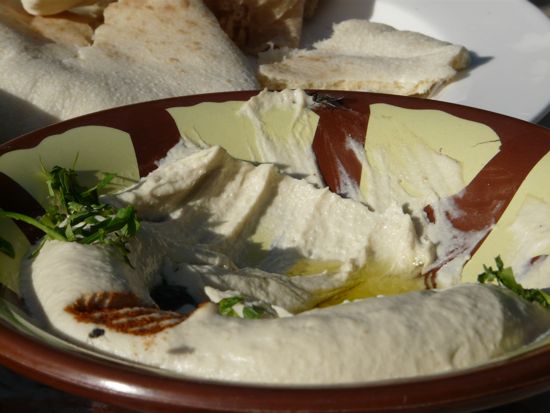
Hummos
Muttabel
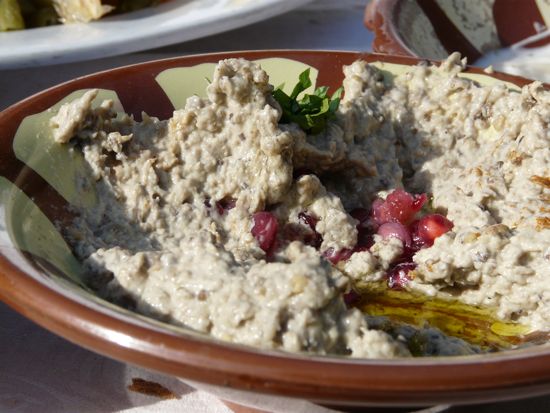

My favorite, baba ghanoosh, especially with pomegranate seeds

Pan-sauteed Hammour

Grilled Shrimp
One of our funniest memories of going to Tanureen was taking Little Diamond, who asked the waiter how the Tanureen salad differed from the Garden Salad. “They are same-same” he replied. Little Diamond’s little eyebrows came together in a frown. “But one is priced at KD 1.500 and the other at KD 1.750?” she continued. “Same-Same!” said the waiter, this time with a little impatience. She ordered one, and we have always wondered what the difference REALLY is, if any.
The weather is perfect for dining out. Go quickly, before the heat sets in, before the Tanureen is no more.
Mubarakiyya Souk Magic
These are not part of The Great Kuwait Market Magic Challenge. (If you haven’t voted, please go there and vote for your favorite.) These are photos I take to document what places “used to look like.” In Germany, I took photos, but twenty years later I could take the same exact photo. Most of the buildings built a couple hundred years ago are still standing – even some built three or four hundred years ago still have the same foundations (and problems with seepage, etc. )
Not so in places like Kuwait and Doha. You look away for a second and something is gone. Can anyone tell me where the Tarek Rajab Museum store has gone? Do they have a new location? It used to be in Salmiyya; the last time I took people there – it was gone. Just gone! And entire block of stores has disappeared.
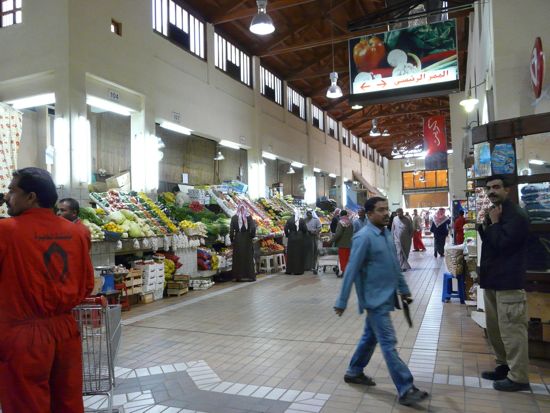
So here, for posterity, are some photos I have taken of Mubarakiyya Market, because I love the quirkiness of the place and because there is some really interesting public art there. Also, because so many of my readers are in schools across the US and Europe, and they are hungry to see what different places look like.
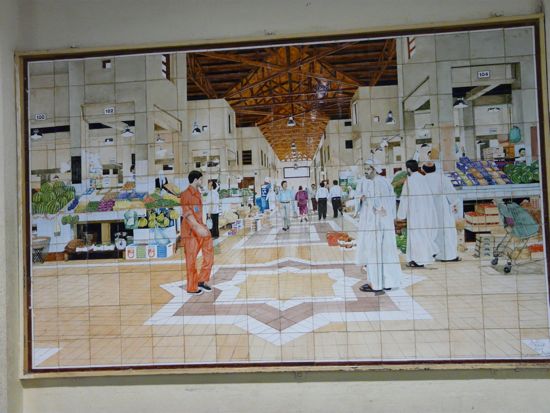
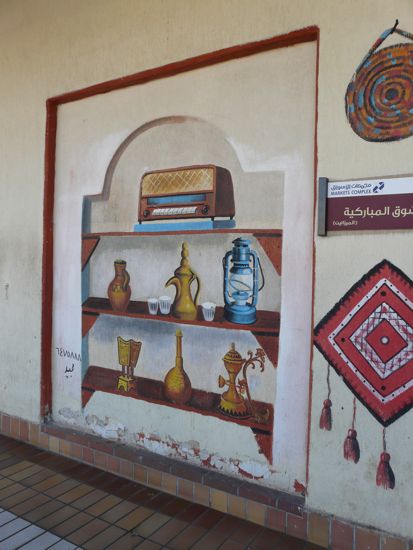


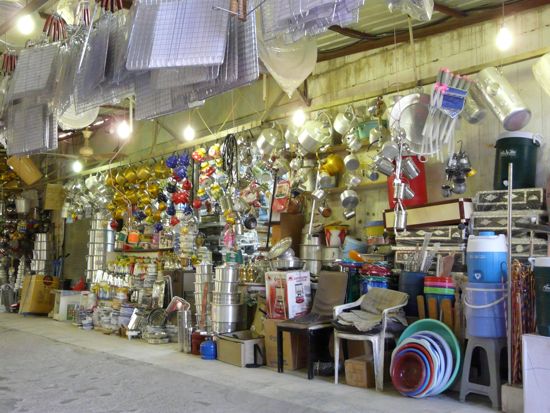


Delicious olives, every one different!
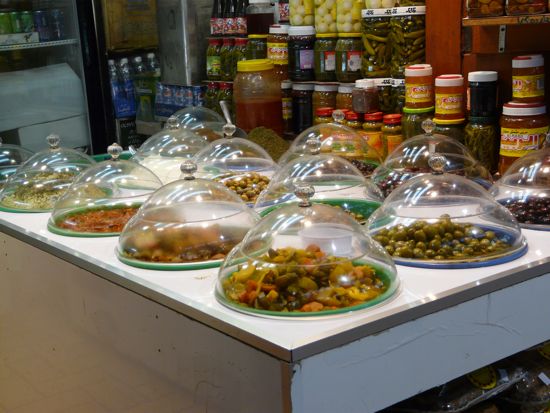
I am totally addicted to these dried pomegranate seeds, which are also called anardana:

These portraits of two different butchers show such individuality. These are not some stylized ideographs; these portraits give the impression of being real butchers. I wonder if I could find the originals and stand them next to their portraits?

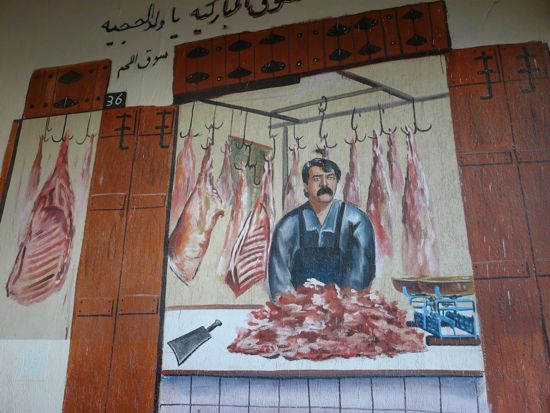
Look at these painted carpets! They lift the entire mood of this utilitarian area. Look how bright and clean this area is, easily washed down, entirely of tiles and washable surfaces:

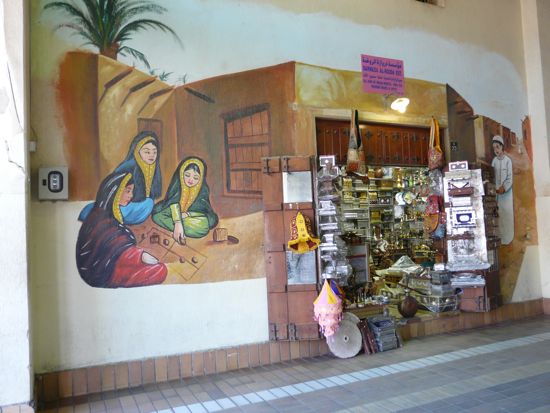
Look how this artist extended his painting to include the store on the right:
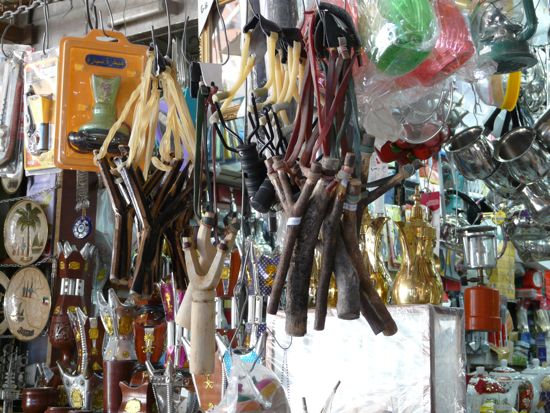
Where does anyone else sell slingshots these days? I fear for the poor market cats, when young men get their hands on these.

Architecture in Kuwait
Fascinating article in today’s
Arab Times on architectural transitions in Kuwait from a talk given by Salah Abdullah, an expert in the analysis of architectural history, at the Aware Center. This is just an interesting excerpt, but you can read the entire article by clicking on the blue type above.
Old Kuwait
Eng Abdullah also explained the architecture of old Kuwait and how a number of elements have influenced Kuwait in making its buildings and architectural layout what it is today. “In the past city development in Kuwait was completely spontaneous and simply divided. In this it has been similar to many old cities, like London. But what dominated was the Arabic and Islamic culture which is the mainstay of interior designs of many Kuwaiti homes. Building materials were usually taken from nature — sea rock, mud, limestone and gypsum. The shape of old Kuwaiti architecture came to suit the environment and circumstances. Houses were adjacent in a manner that indicated the unity and corporation of the people and streets were usually narrow. Mosques were placed very close to houses, to allow the elderly to walk without trouble.
Construction in the past depended on Kuwaitis themselves. The engineer called ‘ustad’ at that time supervised the buildings and the laborers. They carried rocks, prepared mud bricks and started building. This process was called ‘collective vernacular architecture’. At that time three critical customs were kept in mind when constructing the houses. These included the privacy of women, segregation of guests — male and female — and future family expansion. Therefore to tackle these problems, the family part of the house where women rested was pushed to the back, far away from the street, so it was impossible for anyone passing by to see inside. The family entrance was also separated from the guest entrance. There was also a separate entrance for male and female guests. “The Diwaniya which persists until today also dominated the architectural buildings of the past. Diwaniyas for women were built on the west side of the house and male Diwaniyas on the east side,” explained Eng Abdullah.
I remember moving to Kuwait, I was shown 21 villas, and most of them had a kitchen outside. I was puzzled, then a friend told me that Kuwaitis don’t like the smell of food hanging around inside. What happens is . . . you forget. You get used to things, and after a while, it is like “oh yeh, the kitchen is outside” and you forget that it’s different. Recently, having dinner with Kuwaiti friends, they told us that their kitchen is inside, but they have a separate oven outside for cooking fish, because of the smell. I’ll have to remember that when they come to visit me in Seattle! Don’t cook fish, Intlxpatr! The smell goes all over the house!
Year of the Ox Starts 26 January!

(The US Postal Service has issued a Year of the Ox postal stamp, above)
To our great surprise, there are several very good Chinese restaurants in Kuwait – if you don’t think so, check out the number of Chinese people eating in a place, and eat what they eat. Several Chinese restaurants in Kuwait even have honest-to-God Chinese cooks!
Chinese New Year’s is a great excuse for a party, and wearing your favorite red dress. 🙂 It’s almost here – January 26th.
Chinese New Year
The Year of the Ox
by Holly Hartman
from InfoPlease website on Chinese New Year
4707 (or 2009) is the year of the ox
Chinese New Year is the longest and most important celebration in the Chinese calendar. The Chinese year 4707 begins on Jan. 26, 2009.
Chinese months are reckoned by the lunar calendar, with each month beginning on the darkest day. New Year festivities traditionally start on the first day of the month and continue until the fifteenth, when the moon is brightest. In China, people may take weeks of holiday from work to prepare for and celebrate the New Year.
An Obstinate Year
Legend has it that in ancient times, Buddha asked all the animals to meet him on Chinese New Year. Twelve came, and Buddha named a year after each one. He announced that the people born in each animal’s year would have some of that animal’s personality. Those born in ox years tend to be painters, engineers, and architects. They are stable, fearless, obstinate, hard-working and friendly. Jack Nicholson, Jane Fonda, Walt Disney, and Anthony Hopkins were all born in the year of the ox.
Fireworks and Family Feasts
At Chinese New Year celebrations people wear red clothes, decorate with poems on red paper, and give children “lucky money” in red envelopes. Red symbolizes fire, which according to legend can drive away bad luck. The fireworks that shower the festivities are rooted in a similar ancient custom. Long ago, people in China lit bamboo stalks, believing that the crackling flames would frighten evil spirits.
The Lantern Festival
In China, the New Year is a time of family reunion. Family members gather at each other’s homes for visits and shared meals, most significantly a feast on New Year’s Eve. In the United States, however, many early Chinese immigrants arrived without their families, and found a sense of community through neighborhood associations instead. Today, many Chinese-American neighborhood associations host banquets and other New Year events.
The lantern festival is held on the fifteenth day of the first lunar month. Some of the lanterns may be works of art, painted with birds, animals, flowers, zodiac signs, and scenes from legend and history. People hang glowing lanterns in temples, and carry lanterns to an evening parade under the light of the full moon.
In many areas the highlight of the lantern festival is the dragon dance. The dragon—which might stretch a hundred feet long—is typically made of silk, paper, and bamboo. Traditionally the dragon is held aloft by young men who dance as they guide the colorful beast through the streets. In the United States, where the New Year is celebrated with a shortened schedule, the dragon dance always takes place on a weekend. In addition, many Chinese-American communities have added American parade elements such as marching bands and floats.
We heard in church a couple weeks ago that the Chinese labor force is the fastest growing segment of the expat labor force in Kuwait, did you know that? The come in, they focus, they work hard, they produce what they have promised and then – they go back to China. They bid competitively on the contracts, they speak English fairly well, and they get the job done, with none of this human rights baggage that many of the Western countries carry around. Nope. No problem, says the Chinese embassy.
DaisyMae: Number 1 Entry in the Great Kuwait Market Magic Challenge
DaisyMae is our first challenger, with recent photos from the souks. Woo Hoooo on you, DaisyMae! Thank you for showing us the markets through your eyes.
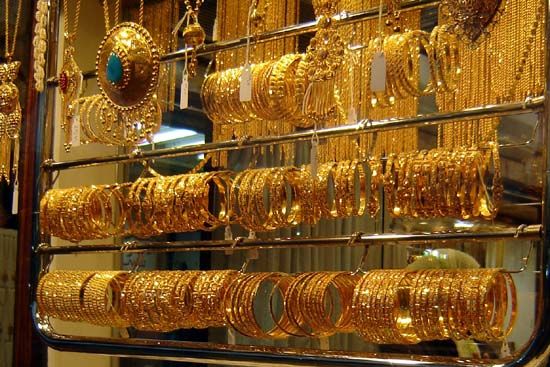
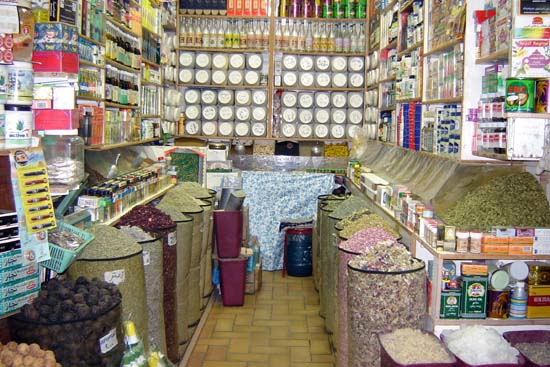

WHO is next? Is it YOU? 🙂
Rape, Abduction and Sorcery
I’ve always loved reading the newspaper, but even more so in other countries, where things are seen differently. These two items are from the Arab Times
11 out of 30 youths held in rape of 2 Asian women
KUWAIT CITY : Police have arrested 11 Bedoun youths out of the thirty who had kidnapped two Asian women near a commercial complex in Jahra and sexually assaulted them for four days in a camp in Mutla’a area.
It was reported that the two victims managed to escape after the four-day ordeal and reported the incident to a night patrol team who informed the Jahra police.
The police then raided the camp and arrested the eleven suspects and referred them to North Jahra Police Station. A case was registered.
Sorceress held: Police have arrested an unidentified Iraqi sorceress and referred her to the concerned authorities, reports Al-Dar daily.
The arrest came following a complaint filed by an unidentified Kuwaiti man who told police the woman had cheated by selling him a magic charm for KD 230. He also told police he had been wearing the charm for three months and failed to get what he aspired for.
Acting on this information police set a trap for the sorceress and caught her in the act while selling a charm worth KD 300 to a police agent. Armed with a search and arrest warrant, police then raided the apartment and confiscated various kinds of tools used by the suspect in black magic.
During interrogations she admitted to the charge and said her clientele includes well-known personalities and female university students. She also said she has until now ‘earned’ KD 85,000 from her ‘work’.
It has also been reported many people, particularly those who believe in her power, intervened in vain to secure her release.
By Mezyad Al-Saeedi
Special to the Arab Times
First, I cannot imagine the horror of being abducted, held in a remote location, and raped by up to 30 different men. The worst fear, of course, is whether you will live through it. Some victims don’t. Wouldn’t you think the names of these young rapists would be published so that women could be protected from marrying them? Imagine, being married to a man who rapes women . . . it would be a little bit of hell on earth.
Secondly – the first guy spent over $800 on a charm and then waited three months for it to work. In the interest of full disclosure, I sure would like to know what the charm was supposed to do? The police officer who entrapped the sorceress was going to pay over $1000 for her magic. That she claims she has earned 85,000 KD per year – that is around $325,000, that’s some serious income for some sorcery.
They are very good at obtaining confessions in Kuwait.
I can’t remember the last time I heard of someone being arrested for sorcery in my home town. There are similar sorts, people who con the elderly, people who prey on the deepest fears and hopes of others, but rarely are they accused of anything but fraud and theft.
Regional Crime
I know it is “crime” but this small article in today’s Al Watan made me smile. It is such a far cry from drugs, overdoses, knifings, rapes and abductions – smuggling nightingales. I don’t know why, it just makes me smile:
KUWAIT: Customs officers foiled an attempt that was made to smuggle 6 hawks and 55 nightingales coming from Iran in a wooden boat. Inspection supervisor, Khalid AlـFailakawi said: “The birds were hidden in a secret compartment, and owner of the boat confessed that he tried to smuggle the birds in order to sell them in Kuwait. And he also does not have any legal or health documents regarding his concealed shipment.” The necessary legal actions are being taken against the man who attempted the smuggling.
Do You Have Reservations?
AdventureMan and I read a lot, and there is a standing joke between us – there are times, like reading a detective novel set in China, when one of us just gets a craving for Chinese food. Or it could be reading James Lee Burke and we have to have some Jambalaya or shrimp. The day we went to the Arabic Early Bird, AdventureMan had been reading the latest Odd Thomas book and needed a breakfast fry-up.
So Friday, after church, when I told him I really needed to go to Tang Chow because a minor character in a book I am currently reading ate Peking duck and Tang Chow is the only place I know in Kuwait that serves Peking Duck without needing advance warning. We usually go to China Queen, but for Peking Duck – only Tang Chow will do.
So we walk in and there is not one single other customer there. The hostess says “do you have a reservation?”
The rational part of me figures some people have called ahead and requested specific tables and she is trying to ask if we are one of those. The irrepressible part of me just laughs to hear such a question when the restaurant is absolutely EMPTY!
We eat around 7 most nights, it’s cultural and also we don’t like to go to bed on full stomachs, we like to have some time between dinner and bedtime. We make jokes about “the American seating” and “the Kuwaiti seating,” like if you are on a ship, and there are separate dining times for the children and the parents. We eat with the children, and as we are leaving, we watch the culturally-late-diners streaming in as we are streaming out.
There are times when it is a special event, and all the tables are reserved. AdventureMan figured out that we can sometimes wheedle a table saying “We are American! We will be gone before they ever show up for their reservation! I promise!” and they will give us the table, and sure enough, we are gone before the reservers ever show up.
It’s still funny to hear that question when the entire restuarant is full of empty seats, like they are going to turn us away if we don’t have reservations.
Qurain Cultural Festival – AARRGH
Doesn’t this look like fun? This Qurain Cultural Festival Event was held at the Souk Sharq, so accessible, for shoppers. I would have been there in a heartbeat – had I known.
Qurain Cultural Festival highlights national heritage: Official
Kuwaiti Writers Association celebrates poet AlـFayez”s legacy

Compiled by
Al Watan Daily
KUWAIT: As part of the 15th AlـQurain Cultural Festival, the Kuwaiti artistic group Mayouf AlـMajli for folklore art performed at Souk Sharq before shoppers.
Qurain Cultural Festival Vice Chairman Mohammed AlـAsousi in comments to AlـWatan stated that the inclusion of such items into the festivals was of particular importance and highlighted the significance of local art and folklore. He added that such folklore was also represented outside the country as the Qurain Cultural Festival organizers were keen on having such national folklore represented in regional festival activities.
Meanwhile, the Kuwait Writers Association recalled the poetic artistry of late poet Mohammed AlـFayez, as a part of activities of the Qurain Cultural Festival, in an evening organized by The National Council of Culture, Arts, and Letters (NCCAL).
Writer Abdullah AlـKhalaf noted the late poet, 1938ـ1991, was a remarkable example of Kuwaiti poets, known for his high quality and rich writings. He noted the many writings and poems and diwans of the poet, including the one published posthumously by his daughter.
He added that AlـFayez started by writing short stories, under the nickname of “Zeseif,” which featured later in his writings of “The memories of a sailor,” which was a an epic story, written in a poetic form and narrating a standard example of Kuwaiti life in the days of pearl diving.
AlـKhalaf said that AlـFayez was a pioneer in writing on that topic of hardships of older days in the Arab World, saying that he published this work in the newspapers in the year 1964, and it was printed later as one diwan.
Last updated on Tuesday 6/1/2009
Recent Comments
ExpatAlien on What Country am I Living … intlxpatr on Yellowstone: Old Faithful to C… Michelle on Yellowstone: Old Faithful to C… Cathy on No Grown-Ups in Charge intlxpatr on Waiting for Snow Wikipedia Donate Button

Amazina


Early Voting in Florida


 Here There and Everywhere