The Apple Store Christmas
Just before leaving, we make one last stop at the Apple store; AdventureMan needs a tune-up. All the Apple employees have on shirts with Christmas related sayings, very clever, wish I could remember a few to share with you.
In an instant, AdventureMan has an appointment, and with another instant, the glitch is fixed and we are on our way.
Love their display windows:


The other stores at the mall may look a little ghost-town-y, but not the Apple store (although this is NOT busy for the Apple store):

The air is crisp, to say the least, and no relief is in sight. Guess it’s time to get on back to Kuwait, where the temperatures are above zero F. 🙂
An Eye for an Eye in Iran – Penalty for Acid Disfigurement?
I found this today in the Washington Post
Woman Blinded by Spurned Man Invokes Islamic Retribution
By Thomas Erdbrink
Washington Post Foreign Service
Sunday, December 14, 2008; Page A01
TEHRAN — Ameneh Bahrami once enjoyed photography and mountain vistas. Her work for a medical equipment company gave her financial independence. Several men had asked for her hand in marriage, but the hazel-eyed electrical technician had refused them all. “I wanted to get married, but only to the man I really loved,” she said.
Four years ago, a spurned suitor poured a bucket of sulfuric acid over her head, leaving her blind and disfigured.
Late last month, an Iranian court ordered that five drops of the same chemical be placed in each of her attacker’s eyes, acceding to Bahrami’s demand that he be punished according to a principle in Islamic jurisprudence that allows a victim to seek retribution for a crime. The sentence has not yet been carried out.
You can read the rest of the article Here.

You may think you know how I feel about this. The man stole from this woman. He violated her very life. He stole her ability to see, her ability to support herself, he disfigured her for life and stole the likelihood of the love match she was holding out for. He treated her like property – if he can’t have her, then he will have revenge.
She fought – and won – for him to be blinded with the same acid she has been blinded with. She doesn’t ask that he be disfigured, only blinded. The court in Iran agreed. The sentence has not yet been carried out.
I’m interested in what YOU think. I feel sympathy for the woman, Ahmena Bahrami. I love the way she went after her attacker in the courts. I love it that she didn’t just collapse and be a victim.
On the other hand, I wish she had gone after something different. The thought of purposely blinding someone is SO repugnant to me, I can’t support it. I wish she had gone after his money, forcing him to support her at the level she was earning, for the rest of her life – and his. I find myself thinking – what good does it do to blind him?
He committed a heinous act. Hideous, unthinkable. And yet I find the punishment equally hideous, and unthinkable. I worry that in the future, she will regret having enforced this upon her assailant. I think that revenge, getting revenge, can extract it’s own price from our character. Do you think she will feel better? Do you think she will be happier knowing he was blinded in retrubution? I kinda sorta doubt it.
What do you think?
Joe Patti’s and Joey Patti’s in Pensacola
My son’s wife looked at me thoughtfully, and said “Has anyone ever told you about Joey Patti’s?”
“I’ve seen his ads,” I replied.
“Pensacola people say his seafood is the BEST,” she says. “I’ve eaten there once, and I thought it was pretty good. You might want to give it a try.”
I understand what she means. She knows that wherever I go, I like to look behind the curtains, to know where the locals go, what they talk about, how they think. I like to know what makes peoples tick. We are all more alike than we are different, but the differences are so interesting.
Joe Patti runs his own fishing fleet. He processes and sells some of the freshest seafood in the Gulf. He is a big feature on the Pensacola waterfront, and nearby is Joey Patti’s restaurant. We saw lots of happy seagulls and pelicans around the boats and seafood plant, and the parking lot at the restaurant was totally full.


We followed the signs for Joey Patti’s, connected – we don’t know exactly how – one is a seafood seller, one is a restaurant. We were given the very last available booth in the very large restaurant, which was totally bustling with customers – all of Pensacola seemed to be eating lunch there the same day we were there. We soon learned why – the food was simple Southern seafood at its best – fresh, hot and oh, so good.

Clam chowder

Crab Cake Sandwich

Oyster Po'Boy Sandwich

Hush Puppies (actually, there were more, but we couldn't wait)
If you get to Pensacola, look down on the waterfront for Joey Patti’s. You’ll be in for a treat.
Southern Thanksgiving Photos
First, apologies – No matter how many photos I take, you can’t begin to imagine the scope of this event. Three sisters, out of a family of ten brothers and sisters, gather the clan and provide a truly old fashioned Southern Thanksgiving on a large country estate. While the photos are mostly of food, the most important element of the gathering is the love that brings and binds this family together.


The weather was magnificent, allowing people to be inside and out, the kids out playing chase, football, exploring the grounds, sitting on the old swing, etc. Out in the way-back, men started shucking oysters for the pre-meal appetizers around 9 in the morning.

While the three sisters are pulling together all the last minute details, there is already an abundance of food to keep people nibbling while anticipating the main meal, served around 1:00 in the afternoon.
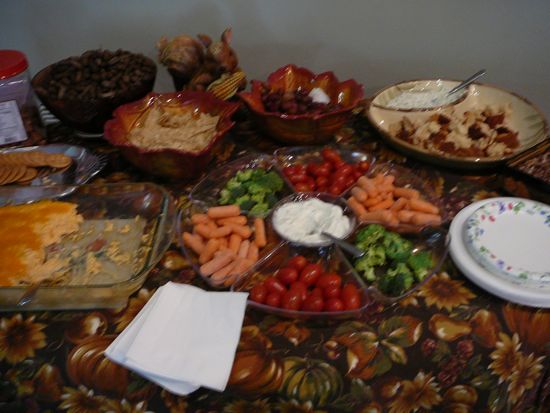
As people arrive, they bring more food – mashed potatoes, sweet potato casseroles, green beans, turnip greens, collard greens, creamed corn, creamed onions, all in slow cookers to keep them warm until dinner-time.


Meanwhile, things are heating up in the command center (kitchen) as time nears to get the food on the groaning tables:
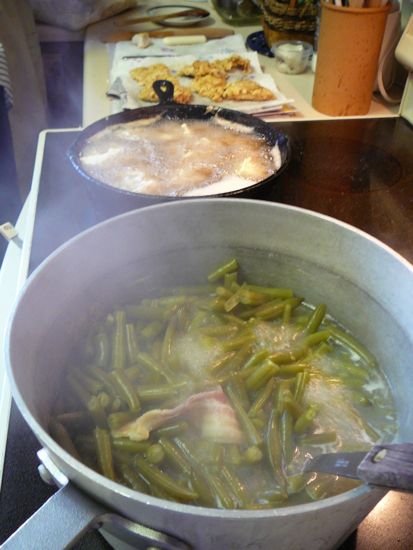
Frying up turkey breast meat:

Usually, the men carve the turkeys – this year, a smoked turkey and a deep fried turkey:

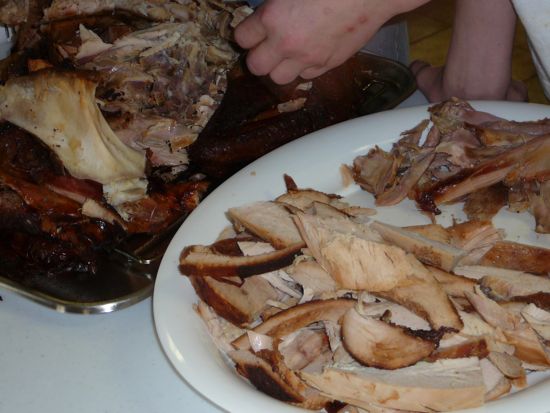
Getting close to dinner time, people start gathering closer to the house:

Just before the dinner is served, the organizers thank the guests for coming and the food is blessed. Now here is where I really need to apologize – there are no dessert photos, and the desserts were magnificent. But once you have filled your place with turkey, dressing, vegetables, salads – and you have to take a little bit of everything so you don’t hurt anyone’s feelings – then you need to sit a while before you think about dessert. Actually, I didn’t even have any room for dessert! So I missed out on taking dessert photos, and for that, I totally apologize.
Then, about an hour after dessert, the family photos are taken. First, all the surviving and attending brothers and sisters, then each family, with various children and their families attending. This tradition is a lot of fun, but takes another hour or so. At the very end, we take photos of the three sisters who spend weeks and hours organizing the annual event, coordinating all the food, cooking for days and cleaning up afterwards. These women are my heroes – it is an unbelievable amount of work, and they do it out of love for their family:

Internal Revenue Service Scam
This was in my mailbox this morning:
After the last annual calculations of your fiscal activity
we have determined that you are eligible to receive
a tax refund under section 501(c) (3) of the
Internal Revenue Code. Tax refund value is $189.60.
Please submit the tax refund request and allow us 6-9 days
in order to IWP the data received.
If u don’t receive your refund within 9 business
days from the original IRS mailing date shown,
you can start a refund trace online.
If you distribute funds to other organization, your records must show wether
they are exempt under section 497 (c) (15). In cases where the recipient org.
is not exempt under section 497 (c) (15), you must have evidence the funds will
be used for section 497 (c) (15) purposes.
If you distribute fund to individuals, you should keep case histories showing
the recipient’s name and address; the purpose of the award; the maner of
section; and the realtionship of the recipient to any of your officers, directors,
trustees, members, or major contributors.
To access the form for your tax refund, please click here
This notification has been sent by the Internal Revenue Service,
a bureau of the Department of the Treasury.
Sincerely Yours,
John Stewart
Director, Exempt. Organization
Rulings and Agreements Letter
Internal Revenue Service
The IRS uses “u” for “you?”
An IRS e-mail signed by a real person?
Hahahahahahahahahahahahahahahahahahahahahahahahaha!
Just another scam.
Aware Center: November Schedule
If you are feeling a little clueless in Kuwait, the Aware Center is a great place to get started. They offer classes in Arabic, in addition to multiple opportunities to understand the culture and all that Kuwait has to offer.
AWARE Center November Calendar
“Advocates for Western-Arab Relations”
The AWARE Center is a non-profit and non-governmental organization that was established in 2003 by a group of Arabs and Westerners whose aim was to promote positive relations between Westerners and Arabs through dialogue and friendship. Since our opening in 2003, individuals from more than 50 countries have visited AWARE to take part in our cross-cultural activities.
We hope you will join us as we share the culture of the Arabs and Muslims through a variety of programs scheduled during the month of November.
For further details on any of our programs, you may contact our staff by telephone at
2 5335280 or by email at info@www.aware.com.kw or delores.aware@gmail.com or view our webpage atwww.aware.com.kw
November at AWARE:
Nov. 2-8
Tues. 4th Nov. Diwaniya: “The Status of Women in the World and Islam’s Response”, by Dr Teresa, 7:00pm
Wed. 5th Nov. Cultural Orientation Course: “Cultural Clothing of Kuwait” by Iman Martin, 7:00pm
Thurs. 6th Nov. Arabic Winter Courses Begin (Please refer to the attachment for a full schedule of class offerings)
Nov. 9-15
Mon. 10th Nov. Tour: Tareq Rajab Museum Please note: This tour meets directly at the Museum at 5pm. For directions and further details, contact amina@aware.com.kw
Tues. 11th Nov. Diwaniya: “What is the Real Jihad?” by Shayma Mahmoud, 7:00pm
Wed. 12th Nov. Cultural Orientation Course: “Etiquette when visiting Kuwaiti Homes” by Wadha, 7:00pm
Thurs. 13th Nov. International Friends Film and Coffee Social: “Inside Mecca“, A National Geographicdocumentary film, 7:00pm
Sat. 15th Nov. Tour: Grand Mosque 9.30am Please note: This tour meets directly at the Grand Mosque at 9:15am. For directions and further details, contact amina@aware.com.kw
Nov. 16-22
Tues. 18th Nov. Diwaniya: “Globalization Vs Universalism“ by Kevin Stoda, 7:00pm
Wed. 19th Nov. Cultural Orientation Course: “Kuwaiti Weddings & Islamic Married Life” by Iman Martin, 7:00pm
Nov. 23-30
Tues. 25th Nov. Diwaniya: “Why are human beings different?”, by Hassan Taha, 7:00pm
Thurs. 27th Nov. Carpet Exhibition & Lecture, “The Art of Persians Carpets”, by Nazi Riasati Al-Dashti, 7:00pm
Stonehenge a Center for Healing
This is from BBC News: Nature, and you can read the entire article by clicking on the blue type, but I wanted you to know about the upcoming BBC Special on Stonehenge, September 27th.

Archaeologists have pinpointed the construction of Stonehenge to 2300BC – a key step to discovering how and why the mysterious edifice was built.
The radiocarbon date is said to be the most accurate yet and means the ring’s original bluestones were put up 300 years later than previously thought.
The dating is the major finding from an excavation inside the henge by Profs Tim Darvill and Geoff Wainwright.
The duo found evidence suggesting Stonehenge was a centre of healing.
Others have argued that the monument was a shrine to worship ancestors, or a calendar to mark the solstices.
A documentary following the progress of the recent dig has been recorded by the BBC Timewatch series. It will be broadcast on Saturday 27 September.
The mystery of Stonehenge, it’s origins, is purpose, has fascinated people for centuries. How amazing that one twelve day dig has discovered so much information – new pieces for a hugely complicated puzzle with lots of work left to be done.
As I write this post, I am also reminded of one of the all time funniest movies I have ever seen – This is Spinal Tap, one of those mocumentaries, this one about a rock group. Not a very bright rock group. It is a very funny movie.
They ask a set designer to create a magnificent recreation of Stonehenge, and give her a napkin with how they want it to look. The result is . . . hysterical:
Hildegard of Bingen
I don’t often do this, reprint an entire article. I usually leave it to you to click on the blue type and read it for yourself. I am guessing very few people would make any effort to read this article, so for the few who have the interest, I am making it easy for you.
The article is written by James Kiefer, who writes many of the articles on saints in The Lectionary. He makes them human; his articles are so readable.
I like Hildegard of Bingen because she was a woman ahead of her time. She followed the yearnings of her soul to become a religious person, a nun, but rather than escaping from life, she engaged in it fully, as an administrator and as a musician. She engaged fully – and capably. She would probably be a remarkable woman in any age.

(This photo is from Geocities where there is another extensive article on Hildegard von Bingen and her life and times, with additonal information.)
“Listen: there was once a king sitting on his throne. Around him stood great and wonderfully beautiful columns ornamented with ivory, bearing the banners of the king with great honor. Then it pleased the king to raise a small feather from the ground, and he commanded it to fly. The feather flew, not because of anything in itself but because the air bore it along. Thus am I, a feather on the breath of God.”
Hildegard of Bingen has been called by her admirers “one of the most important figures in the history of the Middle Ages,” and “the greatest woman of her time.” Her time was the 1100’s (she was born in 1098), the century of Eleanor of Aquitaine, of Peter Abelard and Bernard of Clairvaux, of the rise of the great universities and the building of Chartres cathedral. She was the daughter of a knight, and when she was eight years old she went to the Benedictine monastery at Mount St Disibode to be educated.
The monastery was in the Celtic tradition, and housed both men and women (in separate quarters). When Hildegard was eighteen, she became a nun. Twenty years later, she was made the head of the female community at the monastery. Within the next four years, she had a series of visions, and devoted the ten years from 1140 to 1150 to writing them down, describing them (this included drawing pictures of what she had seen), and commenting on their interpretation and significance. During this period, Pope Eugenius III sent a commission to inquire into her work. The commission found her teaching orthodox and her insights authentic, and reported so to the Pope, who sent her a letter of approval. (He was probably encouraged to do so by his friend and former teacher, Bernard of Clairvaux.) She wrote back urging the Pope to work harder for reform of the Church.
The community of nuns at Mount St. Disibode was growing rapidly, and they did not have adequate room. Hildegard accordingly moved her nuns to a location near Bingen, and founded a monastery for them completely independent of the double monastery they had left. She oversaw its construction, which included such features (not routine in her day) as water pumped in through pipes. The abbot they had left opposed their departure, and the resulting tensions took a long time to heal.
Hildegard travelled throughout southern Germany and into Switzerland and as far as Paris, preaching. Her sermons deeply moved the hearers, and she was asked to provide written copies. In the last year of her life, she was briefly in trouble because she provided Christian burial for a young man who had been excommunicated. Her defense was that he had repented on his deathbed, and received the sacraments. Her convent was subjected to an interdict, but she protested eloquently, and the interdict was revoked. She died on 17 September 1179. Her surviving works include more than a hundred letters to emperors and popes, bishops, nuns, and nobility.
(Many persons of all classes wrote to her, asking for advice, and one biographer calls her “the Dear Abby of the twelfth century.”)
She wrote 72 songs including a play set to music. Musical notation had only shortly before developed to the point where her music was recorded in a way that we can read today. Accordingly, some of her work is now available on compact disk, and presumably sounds the way she intended. My former room-mate, a non-Christian and a professional musician, is an enthusiastic admirer of her work and considers her a musical genius. Certainly her compositional style is like nothing else we have from the twelfth century. The play set to music is called the Ordo Virtutum and show us a human soul who listens to the Virtues, turns aside to follow the Devil, and finally returns to the Virtues, having found that following the Devil does not make one happy.
She left us about seventy poems and nine books. Two of them are books of medical and pharmaceutical advice, dealing with the workings of the human body and the properties of various herbs. (These books are based on her observations and those of others, not on her visions.) I am told that some modern researchers are now checking her statements in the hope of finding some medicinal properties of some plant that has been overlooked till now by modern medicine.
She also wrote a commentary on the Gospels and another on the Athanasian Creed. Much of her work has recently been translated into English, part in series like Classics of Western Spirituality, and part in other collections or separately. If your university library or bookstore cannot help you, try a Christian bookstore. If they do not have it, try a trendy (feminist, New Age, ecology) bookstore.
But her major works are three books on theology: Scivias (“Know the paths!”), Liber Vitae Meritorum (on ethics), and De Operatione Dei. They deal (or at least the first and third do) with the material of her visions. The visions, as she describes them, are often enigmatic but deeply moving, and many who have studied them believe that they have learned something from the visions that is not easily put into words.
On the other hand, we have the recent best-seller, The Man Who Mistook His Wife for a Hat, by Oliver Sacks, Professor of Clinical Neurology at Albert Einstein College of Medicine, and author of Migraine and various other books. Professor Sacks is concerned with the relation of the brain to the mind, and ways in which the phsical state of the nervous system can affect our ways of perceiving reality. He views the pictures in Hildegard’s books of what she saw in her visions, and says, “The style of the pictures is a clear indication that the seer suffered regularly from migraine attacks. Migraine sufferers tend to see things in this manner.” And indeed, it is true that Hildegard suffered throughout her life from painful attacks of what may have been migraine. Professor Sacks hastens to add that this has nothing to do with whether her visions are authentic insights into the nature of God and His relation to the Universe.
Hildegard has undergone a remarkable rise in popularity in the last thirty years, since many readers have found in her visions, or read into them, themes that seem to speak to many modern concerns.
For example:
Although she would have rejected much of the rhetoric of women’s liberation, she never hesitated to say what she thought needed to be said, or to do what she thought needed to be done, simply because she was a woman. When Pope or Emperor needed a rebuke, she rebuked them.
Her writings bring science, art, and religion together. She is deeply involved in all three, and looks to each for insights that will enrich her understanding of the others.
Her use of parable and metaphor, of symbols, visual imagery, and non-verbal means to communicate makes her work reach out to many who are totally deaf to more standard approaches.
In particular, non-Western peoples are often accustomed to expressing their views of the world in visionary language, and find that Hildegard’s use of similar language to express a Christian view of reality produces instant rapport, if not necessarily instant agreement.
Hildegard wrote and spoke extensively about social justice, about freeing the downtrodden, about the duty of seeing to it that every human being, made in the image of God, has the opportunity to develop and use the talents that God has given him, and to realize his God-given potential. This strikes a chord today.
Hildegard wrote explicitly about the natural world as God’s creation, charged through and through with His beauty and His energy; entrusted to our care, to be used by us for our benefit, but not to be mangled or destroyed.
You can listen to some of her extraordinary and ethereal music of worship by clicking on the YouTube video below:
Job and Islamic Tradition
One of the things I learned later in life, like when I lived in Doha, is that you (my Gulf and Moslem readers) have many of the same characters and stories in the Qur’an that we have in the Bible. Interesting, to me, the stories are not always exactly the same. Today’s reading in our lectionary (Old Testament) is from Job (you call him Ayoub, I think.)
First – if you read this, will you tell me if the story in Islam is similar to our story – that Satan is allowed to torment Job, because God believes him to be a faithful servant who will not turn away from him in times of hardship? Satan believes he can demonstrate that Job will be faithless?
Second – why is Satan called “the accuser?” I know Arabic is very close to the old Aramaic; is Satan always called Sheitan? Do you have other names for Satan? (These are not rhetorical questions; these are things I really don’t know) For example, Satan, in our tradition, is called The Father of Lies, The Great Deceiver, etc. But I don’t understand him being called The Accuser.
Third, toward the end of this reading his wife says essentially, give it up, Job, curse God and die. But the little asterisk says “bless”. This is a great puzzlement to me – a curse is the absolute 180° opposite of a blessing, I think. And then again, sometimes what appears to be a curse can be a blessing, and what appears to be a blessing can end up really being a curse. I just don’t understand why, in this context, the word curse could also mean bless? Do you?
Job 2:1-13
2 One day the heavenly beings* came to present themselves before the Lord, and Satan (*Heb the accuser) also came among them to present himself before the Lord. 2 The Lord said to Satan,* ‘Where have you come from?’ Satan* answered the Lord, ‘From going to and fro on the earth, and from walking up and down on it.’ 3 The Lord said to Satan,* ‘Have you considered my servant Job? There is no one like him on the earth, a blameless and upright man who fears God and turns away from evil. He still persists in his integrity, although you incited me against him, to destroy him for no reason.’ 4 Then Satan* answered the Lord, ‘Skin for skin! All that people have they will give to save their lives.* 5But stretch out your hand now and touch his bone and his flesh, and he will curse you to your face.’ 6 The Lord said to Satan,* ‘Very well, he is in your power; only spare his life.’
7 So Satan* went out from the presence of the Lord, and inflicted loathsome sores on Job from the sole of his foot to the crown of his head. 8Job* took a potsherd with which to scrape himself, and sat among the ashes.
9 Then his wife said to him, ‘Do you still persist in your integrity? Curse* (bless) God, and die.’ 10 But he said to her, ‘You speak as any foolish woman would speak. Shall we receive the good at the hand of God, and not receive the bad?’ In all this Job did not sin with his lips.
11 Now when Job’s three friends heard of all these troubles that had come upon him, each of them set out from his home—Eliphaz the Temanite, Bildad the Shuhite, and Zophar the Naamathite. They met together to go and console and comfort him. 12 When they saw him from a distance, they did not recognize him, and they raised their voices and wept aloud; they tore their robes and threw dust in the air upon their heads. 13 They sat with him on the ground for seven days and seven nights, and no one spoke a word to him, for they saw that his suffering was very great.
Colors and Localities
One of the things we joke about, AdventureMan and I, when we come back to the Seattle area, is that all the houses are grey. Some might look brown, but it is a very grey brown. Some might look green, but it is a very grey kind of green. Some houses are purely grey – maybe they have white trim, but they are very very grey. An occasional truly brown house sticks out, anything not toned down by grey sticks out. And oh! now and then someone with a Mediterranean soul will build a pink or terra cotta house with a red tile roof and people will say “Oh! Look at that! They must not be from around here!”
Yesterday, I was in one of my most favorite places, Home Depot, wandering around looking at what the contracters are putting in the newest houses.
“High rise toilets!” I exclaimed to AdventureMan, who was on the phone with me. “For people who are older, and don’t have the strength in their legs to lower themselves too far!”
I was looking to see what was available in small bathtubs, because I love a hot bath on a cold day, and I want a deeper, smaller tub in which I can lean back with a good book, not one of these huge tubs that take all day to fill. I was looking at shower apparatus; I am thinking one day I want to go the European way with those wall flash-heaters that give you hot water when you need it and don’t keep heating it all day when you don’t.
And then I saw the carpet samples. I just had to laugh. When we lived in Florida, I loved walking into the model homes, with their seafoam green carpets, or even a mellow shade of tropical pink. Everything looked so welcoming and laid back.
In the Pacific Northwest, people choose from shades of sand. I never knew there could be so much variation on beige, which is somewhere between white and brown:




To those of you who say that sand isn’t as dark as the darkest brown swatches of carpet, I can only say you have never walked along a Pacific Northwest Beach on a dark and stormy day. Believe me, sand can be very very dark.
Recent Comments
ExpatAlien on What Country am I Living … intlxpatr on Yellowstone: Old Faithful to C… Michelle on Yellowstone: Old Faithful to C… Cathy on No Grown-Ups in Charge intlxpatr on Waiting for Snow Wikipedia Donate Button

Amazina


Early Voting in Florida


 Here There and Everywhere