Return to Five Sisters in Pensacola on a Rainy Saturday
It was another endlessly rainy Saturday when my husband asked where I would like to go for lunch.
I knew immediately where I wanted to go. I love Five Sisters almost any day, but especially on a rainy Saturday. I like it that they have live music on Sundays, and sometimes on Thursday nights, but I really like it that there is no music on a rainy, dreary Saturday, so we can talk and hear each other. 🙂
Five Sisters is packed – it often is – with people seeking the same thing, a warm, cheery place filled with great smells and great cooking.
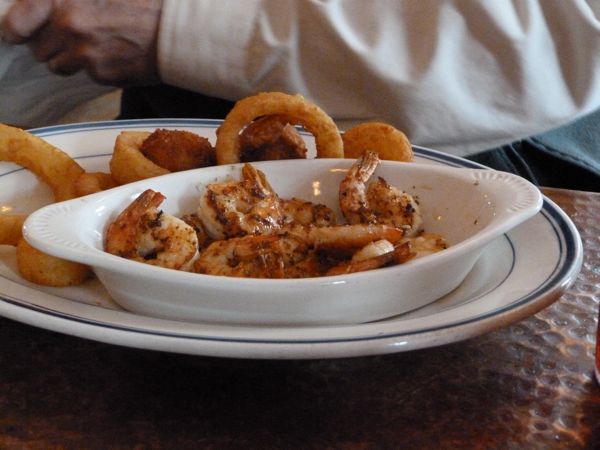
AdventureMan ordered the grilled shrimp platter:
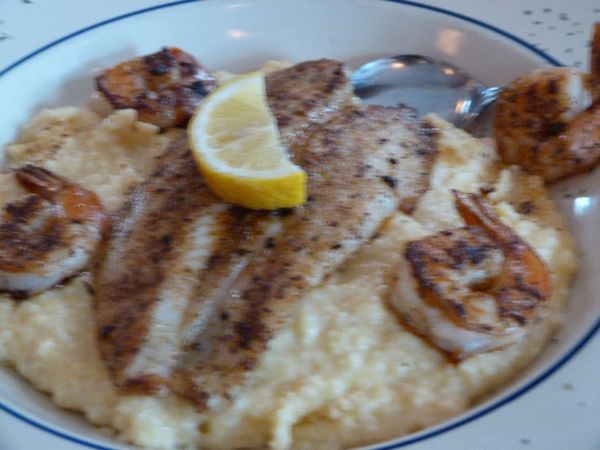
And I ordered the Blackened Fish on Cheese Grits (sorry, it is a little blurry, I must have been shaking with hunger . . . )
I never get tired of Five Sisters.
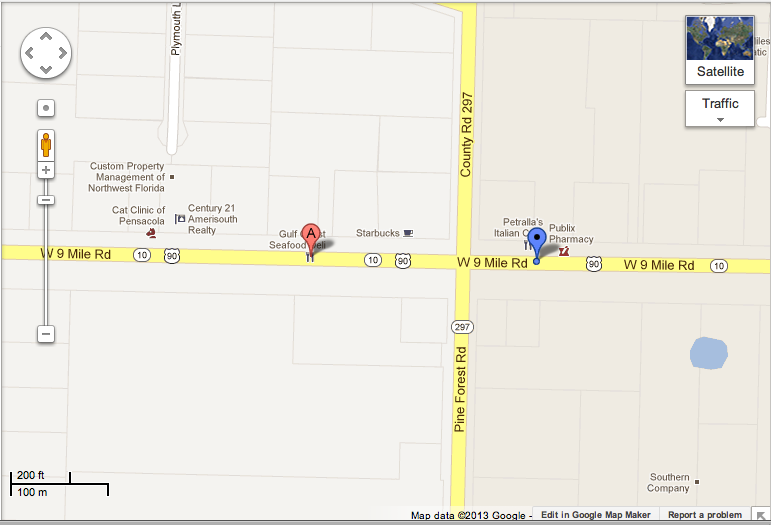
Seafood Platter Deli AKA Gulf Coast Seafood Deli on 9 Mile Road
“We’re going to drive ‘all the way’ out there,” AdventureMan tells me and we laugh, because ‘all the way’ is such a relative term. When we lived in Kuwait and in Qatar, we would drive a minimum 30 minutes to get to a restaurant, any restaurant, not only because of distances but also because of traffic, horrendous traffic, in the evenings. While the Seafood Platter Deli is 13 miles away, it takes us less than 20 minutes to get there. Welcome to Pensacola 🙂

This is a very unusual restaurant. It is so old-timey Gulf Seacoast, and at the same time, I thought as we entered “My Moslem friends would love this!”
Many of my Moslem friends think Americans are unbelievers. They think we don’t talk about God. They don’t know we pray – sometimes without ceasing. Just as I was astounded as I learned things about Islam and Moslem culture living in the Middle East, they were also astounded learning things about us, like that we take care of our families. Think about it – most of what many people in the world know about Americans comes from the impact of cable TV. They watch American TV and they think they understand American culture. Horrifying thought, isn’t it?
So how amazing is it to walk into a restaurant where, as you stand at the counter to order, and you look at the big menu on the wall, there is a stand, with a bible on it. And there is paper, and a pencil, and a sign saying “Prayer requests.” I don’t know about your restaurant experiences, but this is unique in my experience – in America. In the Middle East, there are all kinds of restaurants with Qu’ranic verses on the walls, and the sounds of religious services piped into the restaurant. People talk about God all the time. It’s a whole different world; and my Moslem friends would feel right at home in the Seafood Platter Deli.

Of course, in Saudi Arabia, we would rush to buy our pre-sunset felafels, and then sit and munch, listening to all the souk grates coming down as shops closed for the Mahgrib prayer. Everything closed, five times a day, in Saudi Arabia, for prayer.
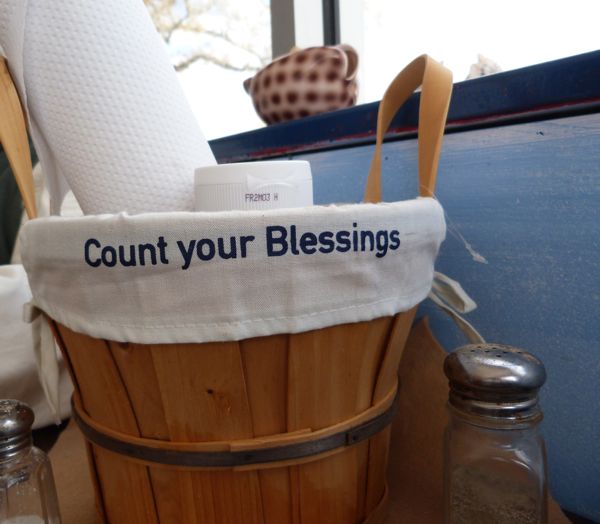
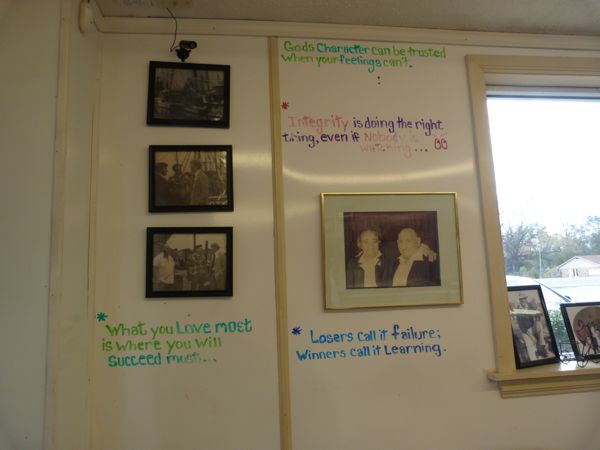
At the Gulf Coast Seafood Deli / Seafood Platter Deli (I don’t know what the real name is, and both names appear when you Google it) there are scriptures on the wall. When you sit down, the little basket holding condiments tells you to “count your blessings.”
The interior dining room (as opposed to the deli section, and the counter where you order food when you come in) is wall-to-wall sea mural, family friendly, Fish and sea life everywhere. There are also families who pray when their meal is delivered to the table, before they eat. The wait-staff is patient, and personal. You get the impression they truly want you to have a good experience at this restaurant.
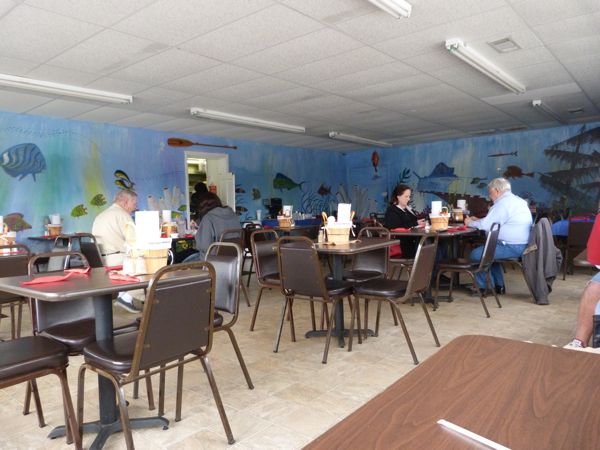
We were hungry. We are mildly disgruntled to see piping hot food delivered to tables around us who arrived after we did, but not very. Even though we are hungry, we know that our ordering our food grilled or blackened slows things up in the kitchen, where the majority of the meals are fried. It is really really hard for people like us to watch other customers thoroughly enjoying their fried shrimp, fried catfish, fried grouper, fried scallops, etc. They look SO delicious. Every now and then, maybe once every couple months, we slip up and eat something deep fried, just because yes, yes, it tastes so good, and we know it is like the WORST thing for us. What a pity that deliciousness can be so lethal.
Ah! There it is! Our meals! We tuck right in and then I remember “Oh no! I haven’t taken any pictures!” AdventureMan is used to this, and bless his heart, he stops eating so I can shoot what is left of his grilled scallops, so tasty and delicious, so fresh!
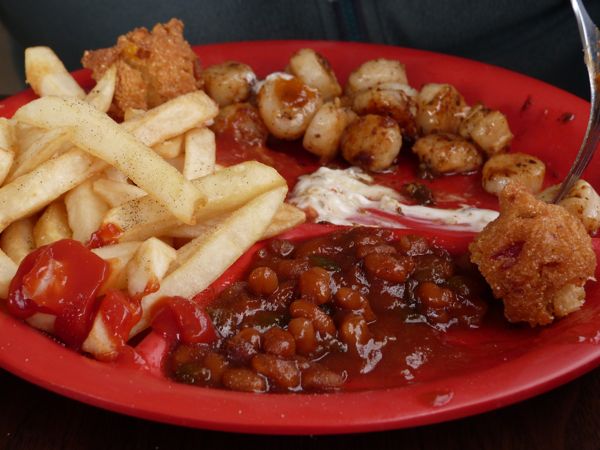
I had so much salmon on my platter that I had salmon and steamed vegetables for dinner, too! The salmon was copious, lightly blackened, seared on the outside, moist on the inside, just the way I love it. It was some of the best salmon I have had in Pensacola (not exactly salmon country, but that little Alaska girl still lives in my heart and I can’t resist salmon when I see it on the menu.)

There’s another thing we loved about the Seafood Platter Deli – remember Dembo’s Smokehouse? We love restaurants that honor their heritage, and the Seafood Platter Deli has this wonderful wall:
Last, but not least, the food was so good, and so plentiful, that we couldn’t eat it all and ended up taking some home. We also took home some dessert, one dessert, $1.99 for a goodly portion of Vanilla Wafer pudding, that old-fashioned kind, maybe Banana pudding. It was so GOOD, we wish we’d gotten two. 🙂
Gulf Coast Seafood Deli / Seafood Platter Deli
Address: 2250 W Nine Mile Rd, Pensacola, FL 32534
Phone:(850) 969-3299
We love this place, and look forward to driving ‘all the way out there’ for more fabulous Gulf seafood.
START with Sea of Poppies, by Amitav Ghosh
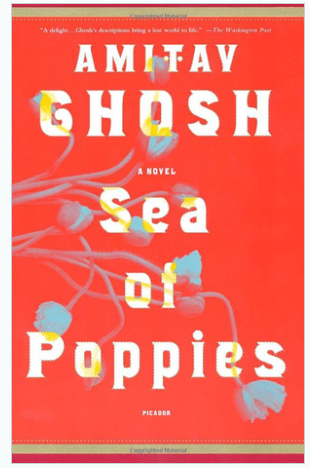
I recently wrote a book review on River of Smoke, by Amitav Ghosh, which held me spellbound, so riveting that I had to order Sea of Poppies, which is actually the first volume of the trilogy. I had heard a review of River of Smoke on NPR and although it was written as the second volume in a trilogy, it can be read as a stand-alond.
Yes. Yes, it can be read as a stand-alone, but it is so much easier, I can state with authority, if you read them in order. Once I started Sea of Poppies, I also discovered an extensive glossary in the back, several pages, a list of the words, annotated with suggested origins, and it adds so much color to an already brilliantly colored novel. Much of both novels uses words from many cultures, and words that have been formed by another culture’s understanding of the words (some hilarious). If you like Captain Jack Sparrow, you’re going to love the polyglot language spoken by ship’s crews from many nations trying to communicate with one another. It can be intimidating, but if you sort of say the words out loud the way they are written at the beginning, you begin to find the rhythm and the gist of the communication, just as if you were a new recruit to the sea-going vessels of the early 1800’s. I loved it because it captured the difficulties encountered trying to say the simplest things, and the clever ways people in all cultures manage to get around it, and make themselves understood.
Sea of Poppies starts in a small Indian village, with one of the very small poppy gardens, planted on an advance from an opium factory representative, thrust upon the small farmer, with the result that most small Indian farmers converted their entire allotment from subsistence foods to poppies. Ghosh walks us through an opium processing factory, which is a little like walking through the circles of hell. We meet many of the characters we will follow in River of Smoke, and learn how this diverse group bonded into one sort of super-family through their adventures – and misadventures – together.
It is an entirely engrossing work. Sea of Poppies was short listed for the Man Booker award, and was listed as a “Best Book of the Year” by the San Francisco Chronicle, Chicago Tribune, Washington Post and The Economist. The theme is the opium trade, leading to the Opium Wars, with China, and is a chilling indictment of how business interests manipulate a population’s perceptions of national interests to justify . . . well, just about anything, in the name of profit.
The theme is woven through human stories so interesting, so textured, so compelling, that you hardly realize you are reading history and learning about the trade, cultures, travel, clothing, traditions, religions, food, and motivations as you avidly turn the pages.
I can hardly wait for the third volume. Get started now, so you’ll be ready for it when it comes out!
Maldives Rape Victim Sentenced to 100 Lashes for PreMarital Sex
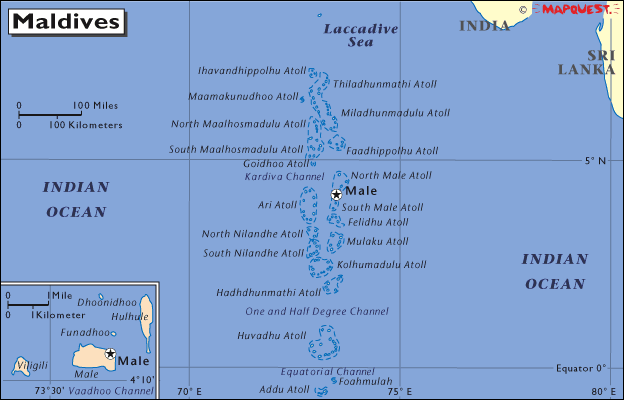
Where are the Maldives Islands?
Raped by her stepfather, impregnated against her will, her stepfather killed the baby, and now, sentenced by Sharia law to 100 lashes for pre-marital sex. How can this be justice? (This is from BBC News)
Maldives girl to get 100 lashes for pre-marital sex
By Olivia Lang
BBC News
A 15-year-old rape victim has been sentenced to 100 lashes for engaging in premarital sex, court officials said.
The charges against the girl were brought against her last year after police investigated accusations that her stepfather had raped her and killed their baby. He is still to face trial.
Prosecutors said her conviction did not relate to the rape case.
Amnesty International condemned the punishment as “cruel, degrading and inhumane”.
The government said it did not agree with the punishment and that it would look into changing the law.
Baby death
Zaima Nasheed, a spokesperson for the juvenile court, said the girl was also ordered to remain under house arrest at a children’s home for eight months.
She defended the punishment, saying the girl had willingly committed an act outside of the law.
Officials said she would receive the punishment when she turns 18, unless she requested it earlier.
The case was sent for prosecution after police were called to investigate a dead baby buried on the island of Feydhoo in Shaviyani Atoll, in the north of the country.
Her stepfather was accused of raping her and impregnating her before killing the baby. The girl’s mother also faces charges for failing to report the abuse to the authorities.
The legal system of the Maldives, an Islamic archipelago with a population of some 400,000, has elements of Islamic law (Sharia) as well as English common law.
Ahmed Faiz, a researcher with Amnesty International, said flogging was “cruel, degrading and inhumane” and urged the authorities to abolish it.
“We are very surprised that the government is not doing anything to stop this punishment – to remove it altogether from the statute books.”
“This is not the only case. It is happening frequently – only last month there was another girl who was sexually abused and sentenced to lashes.”
He said he did not know when the punishment was last carried out as people were not willing to discuss it openly.
Defending the World Against Bland Food
One of our life dreams came true when we were able to visit Avery Island and the McIlhenny Company. Tabasco sauce is on every table in almost every restaurant in the South, right along with the salt and pepper. When AdventureMan was serving in VietNam, soldiers had a tiny bottle of Tabasco in each ration, to spice up the food. The quote “defending the world against bland food” gave me a big grin. Rest in Peace, Paul C.P. McIlhenny. (This is from AOL News/Huffpost today)

Paul C.P. McIlhenny Dead: CEO Of Tabasco Company Dies At 68
AVERY ISLAND, La. — Paul C.P. McIlhenny, chief executive and chairman of the board of the McIlhenny Co. that makes the trademarked line of Tabasco hot pepper sauces sold the world over, has died. He was 68.
The company, based on south Louisiana’s Avery Island, said in a statement that McIlhenny had died Saturday. The statement, released Sunday, credited McIlhenny’s leadership with introducing several new varieties of hot sauces sold under the Tabasco brand and with greatly expanding their global reach.
McIlhenny was a member of a storied clan whose 145-year-old company has been producing the original world-famous Tabasco sauce for several generations, since shortly after the Civil War. The statement said McIlhenny joined the company in 1967 and directly oversaw production and quality of all products sold under the brand for 13 years.
Under his management, the company experienced years of record growth in sales and earnings, according to the company.
McIlhenny also worked to develop an array of items that could be marketed and emblazoned with the Tabasco logo: T-shirts, aprons, neckties, stuffed toy bears, and computer screensavers, the Times-Picayune of New Orleans noted. The newspaper first reported the death and noted that McIlhenny was an executive with a keen sense of humor, quipping days before he reigned as Rex, the King of Carnival, for Mardi Gras in 2006: “We’re defending the world against bland food.”
The Times-Picayune said he had taken up the post of company president starting in 1998 before adding the title of CEO two years later. It added that his cousin, Tony Simmons, took over as president last year.
“All of McIlhenny Company and the McIlhenny and Avery families are deeply saddened by this news,” said Tony Simmons, president of McIlhenny Company and a McIlhenny family member, in the company’s statement.
He added: “We will clearly miss Paul’s devoted leadership but will more sorely feel the loss of his acumen, his charm and his irrepressible sense of humor.”
The statement said McIlhenny led the way on new brand merchandising, taking an instrumental role in the company’s catalog business of licensed merchandise. He also was a driving force behind the growing global reach of Tabasco products, today sold in more than 165 countries and territories.
The company said McIlhenny, at the time of his death, was also a company director. He was a sixth-generation member of the family to live on Avery Island and among the fourth generation to produce the Tabasco brand sauce on Avery Island, where patriarch Edmund McIlhenny had founded the company in 1868.
Born on March 19, 1944, he grew up in New Orleans and spent much of his childhood moving between New Orleans the family compound on Avery Island, according to The Times-Picayune.
Reports noted he also had been an impassioned board member of America’s Wetland Foundation because of his longtime interest in preserving south Louisiana coastlines crumbling under the onslaught of decades of erosion.
Attorney Edward Abell called his friend McIlhenny “a well-known figure.”
“It really kind of puts us on the map here,” Abell said, “because the Tabasco products are known all over the world.”
Kuwait Independence / Kuwait Liberation Congratulations
LOL, I actually congratulated Kuwaitis about a month ago when I thought I had missed the date and . . . I did! I missed it by a month! I was too soon!
So now it is really here – February 25 – 26. Congratulations, and we wish you well. We wish you resolution to your challenges of leadership and infrastructure issues. If you’ve noticed; it’s not like these are challenges unique to Kuwait; the flip-side of democracy can be logjams and stalemates, and then, suddenly, it can all shift and flow. We wish you some shift and flow after years of logjam.

Sephora Coming to Pensacola, Wooo HOOOOO!

Coming soon: Sephora to Cordova Mall! Interested applicants please call 866-845-5627. If you have your resume or the Sephora application complete, please submit to fax 415-449-6104 or email sephora.pensacola@sephora.com. Management is recruiting now and will host a Job Fair Friday, February 8th – Sunday, February 10th in front of the future store’s location (between Chico’s and Aeropostale).
I don’t wear or buy that much make-up, but when I do, I buy it at Sephora, where I can always find what I am looking for. . . mostly Urban Decay and Philosophy products, but also the odd brush or specialty product – Sephora always has it. I’ve been doing all my Sephora shopping on my trips to Seattle, LOL, but no more! Now . . . where is the Macy’s I’ve been waiting for?
Season Finales Downton Abbey and Suits
How can it be? How can “seasons” be so short?? Last Sunday, we had an unexpected thrill as Downton Abbey went TWO hours instead of one, and then we had the unexpected downer of hearing that this week, tomorrow, will be the season finale.
Finale?
Downton Abbey just started it’s new season! What is a season? Eight hours? Ten hours? No! No! We want more!
We watched Suits Thursday night, only to learn that this coming week is the finale episode of Season 3. Aarrgh! It seems like it’s only been on three weeks, but the website says 16 episodes . . . that cannot be!
AdventureMan asked me why some shows and not others? Why do we clear our schedules for Downton Abbey? Our recent houseguests were overjoyed to know we follow DA – as they do – and we happily tucked in Sunday night to watch the review of the last week’s episode along with this week’s two hours of Downton Abbey, oh, we were in heaven. 🙂 Downton Abbey is the big topic at aqua aerobics; Downton Abbey is the big topic at the women’s church circles . . . how does Downton Abbey create so many fans?
We have consolation to the loss of Suits and Downton Abbey; Survivor just started up again and we enjoy that on Wednesday nights, Southland just started up again on TNT and . . . “winter is coming.” We are holding our breath for the new Game of Thrones March 31st. 🙂

I’m guessing that the common thread that ties all these shows together is that 1) they succeed IMMEDIATELY in grabbing and holding our attention 2) they are filled with unpredictability; the unexpected happens all the time and 3) the main characters are flawed, and their flaws leave them vulnerable to the kinds of unpredictabilities that hold us enthralled.
What are your favorite shows – and why?
Petrella’s Italian Cafe on 9 Mile Road in Pensacola
One of the reasons AdventureMan and I have been married almost 40 years is that we agree on some very irrational basics – like nothing says romance on Valentine’s Day like Italian food. He had recently been to Petrella’s and suggested I might like it – so off we went, on the worst day of the year to try to get in someplace without a reservation. I remembered all our Valentine’s Day dinners in Kuwait, trying to get in someplace, anyplace, Italian was out of the question, fully booked. We usually ended up bribing someone to let us have an early dinner, promising to be out before our later-eating Kuwaiti Valentines diners arrived; they would never even know they had shared their reservation with us.

We were in luck. Although every table in Petrella’s was taken, within five minutes one group left and we got their booth. AdventureMan had truly nailed this one; this is a neighborhood eatery, full of people who have been eating at Petrella’s for a long time. There were lots of couples, like us, but also many groups of four, many working people having their daily lunch, and a very large table of women affiliated in some way. We speculated, maybe church? Maybe a retirement home? Maybe a club?
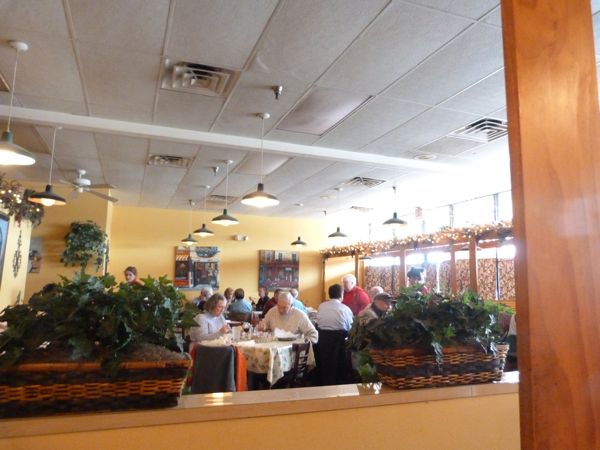
Petrella’s took me back to my childhood, where Italian food was “foreign” food and very exotic. People didn’t eat out so much. The very most special restaurants were steak restaurants, or clubs. Even pizza was new, not uncommon; there were frozen pizzas and home-made pizza dough, but it wasn’t the normal American kind of food – meat, potatoes, veg. It was kind of “spicy.” Yes, I can hear you laughing, but things were different, eating out was not a daily or even a weekly event, eating out was something you did maybe once a month. Even then, it was sometimes, hamburgers! Dairy Queen was about the fastest-food there was and there were no McDonalds or Burger King chains, no Kentucky Fried Chicken. There was A&W Hamburgers; there were ice-cream and soda bars, and of course, in Seattle, there was Chinese and Japanese foods.
Petrella’s is comfortable. The salads and the dishes they served are the dishes Italian restaurants have been serving for a hundred years. The lunch specials are all under $8.00, and they all come with salad and garlic bread. They take it for granted you are going to need a box to take home the excess; portions are large. We also had our lunches for dinner 🙂

This was AdventureMan’s main course, the Baked Spaghetti:

and here was mine, Petrella’s Famous Marsala (with shrimp):

It was comfort food. Nothing fancy or unexpected, but good, honest ingredients, crafted well. It’s a kind of food that calls you back again and again when you want a good reliable meal. I know we will be going back, and we will probably take family and friends, it’s that kind of place.

They have an excellent website, with their complete menu.
Relationship Anxiety Hard on Your Immune System
Relationship Anxiety Is Hard On The Immune System, Study Says
Katherine Bindley
katie.bindley@huffingtonpost.com
This is from AOL News/Huffpost:
Relationship anxiety is known to be tough on a person’s mental well-being, but a new study suggests that fear of rejection — and worry that someone doesn’t love you enough — can also serve as chronic stressors that tax the immune system.
In a study of 85 couples who’d been married for an average of 12 years, a team of researchers led by Lisa Jaremka with Ohio State University College of Medicine examined the level of anxiety participants had about close relationships, as well as samples of their blood and saliva.
They found that the levels of cortisol — a hormone associated with stress — were on average 11 percent higher in people with higher levels of attachment anxiety than those who were less anxious. In addition, the more anxious people had between 11 percent and 20 percent fewer T-cells, which help the body to fight off disease.
“The thing that was surprising was the magnitude of the difference, especially in the immune cells that we saw,” Jaremka told The Huffington Post. “Some of the differences in the immune cell numbers, between the higher and the less high anxious attached people, were on the magnitude of what you’d see between obese and non-obese people.”
Attachment styles are believed to be derived from the type of caregiving people experienced in childhood, but the effects extend to, and impact, relationships in adulthood.
Most people are bound to have some level of concern and stress during the ups and downs of a relationship, Jaremka explained to HuffPost. But those with higher levels of attachment anxiety are hypersensitive to signs that a person they’re close to will leave them on a regular basis. They’re also more likely to seek reassurance and interpret their partner’s behaviors in a negative way.
Because the team did not include study participants who fell on the very high end of the anxiously attached spectrum, it’s possible that the effects of relationship anxiety could be even greater than the study suggests. Incidentally, while more women in the study suffered from higher levels of attachment anxiety, the researchers saw the same elevated levels of cortisol and lower T-cells in the men who were anxious.
Previous research had already established that relationship anxiety can have negative effects on a person’s physical health, but less was known about how exactly the anxiety and the health effects related to one another.
According to the Wall Street Journal, it’s believed that about 20 percent of the population falls on the anxious side of the anxiously attached spectrum. Another 25 percent fall into the avoidant category, which means those people may not get close to their partner out of fear that it could lead to a loss of autonomy.
Experts told the Journal that emotional opposites are often initially attracted to one another, but they may eventually face obstacles if they exacerbate one other’s attachment tendencies. For example, an anxious person might push for more affection and attention. This behavior might make an avoidant partner pull further away, in turn, making the anxious person even more insecure.
Despite the negative effects that attachment styles can have on a person’s relationships and physical health, Jaremka explained these traits are not inalterable.
“Anybody that is experiencing something that feels like high levels of attachment anxiety would think, ‘Oh great I’m doomed, but I think it’s important to acknowledge the fact that just because you are highly anxiously attached now doesn’t mean you have to be that way forever,” Jaremka told HuffPost. “We do know based on research that people can change and people can be very anxiously attached in one relationship and not at all in a different relationship.”
So what kind of relationship can serve as an antidote to pre-existing anxiety? One with a secure partner.
“If they are a very caring and loving and responsive partner, who attends to your needs when you need them, who is there for you when you’re stressed…Those relationships seem to be the types of relationships that people are able to feel secure in and are able to overcome anxieties in, if they have them,” Jaremka said.
The study, titled “Attachment Anxiety Is Linked to Alterations in Cortisol Production and Cellular Immunity,” is slated to be published in the journal Psychological Science.
Recent Comments
intlxpatr on Shampoo Ginger tigerbutterya0c5ff1d… on Shampoo Ginger intlxpatr on British Soldier Kidnapped, Esc… John on British Soldier Kidnapped, Esc… intlxpatr on British Soldier Kidnapped, Esc… Wikipedia Donate Button

Amazina


Early Voting in Florida


