Kuwait Has Test To Detect LBGT?
This is a very odd article from The Middle East Eye:
Kuwaiti police have busted a “wild party” and arrested 23 “cross-dressers and homosexuals” at a chalet in the south of the country on Sunday.
“The vice police received a tip about the party and a warrant was issued by the public prosecution to take action against the cross dressers and homosexuals,” a security source told local daily Al Rai.
“The police encircled the chalet to make sure no one escaped and proceeded to arrest the people participating in the party. Some of them tried to escape by using the backdoor of the chalet and heading to the sea, but they were caught,” the source added.
The daily said that investigations revealed the party was exclusively for “cross-dressers and homosexuals” who would face the charges of “engaging in immoral activities.”
Lesbian, Gay, Bisexual and Trans (LGBT) rights receive no protection in Kuwait and homosexual acts between two male adults can result in a six-year prison sentence, though there are no laws against sexual acts between two women. Cross-dressing is also illegal.
In 2013, Public health official Yousuf Mindkar announced the introduction of a screening process at Kuwait’s International Airport to prevent LGBT expatriates from entering Kuwait or other Gulf Cooperation Council (GCC) countries.
“Health centres conduct the routine medical check to assess the health of the expatriates when they come into the GCC countries,” he said.
“However, we will take stricter measures that will help us detect gays who will be then barred from entering Kuwait or any of the GCC member states.”
The same paper later showed the minister appearing to backtrack on the move saying it was a “mere proposal.”
“It may or may not be accepted,” he said.
“The debate will reflect the keen interest of the GCC countries in human rights, taking into consideration the teachings of our religion and international agreements.”
Some suggested that concerns over the hosting of the FIFA 2022 World Cup in Qatar, and the potential controversy that would ensue were fans to be screened, may have led to the backtrack.
Isaiah: the desert shall rejoice and blossom

The Lectionary reading in the Old Testament today is from Isaiah, one of my favorite books in the bible, and when I read it, I think of all my time in the Arabian peninsula, in Saudi Arabia, Qatar, and Kuwait. I think of this land, on the route from the rift valley in Kenya where man is supposed to have originated, how earliest humans would have crossed through these countries as they moved slowly away from their origins.
My Qatari and Kuwaiti friends tell me that legends say that these countries were once lush, green and beautiful. They are still beautiful, but the lushness and the greeness is only in small pockets when and where the arid land has water. I think nothing is impossible for God, and how wonderful it would be to see these countries lush and green and fertile once more.
The King is coming, coming as a tiny baby in human form to live with us and turn us away from our wickedness. He sees things differently. He tells us to love one another, to love our enemies, to take care of one another. He makes the blind to see, the lame to leap, and the deaf to hear. Come! Come, Emanuel!
Isaiah 35:1-10
35 The wilderness and the dry land shall be glad,
the desert shall rejoice and blossom;
like the crocus 2it shall blossom abundantly,
and rejoice with joy and singing.
The glory of Lebanon shall be given to it,
the majesty of Carmel and Sharon.
They shall see the glory of the Lord,
the majesty of our God.
3 Strengthen the weak hands,
and make firm the feeble knees.
4 Say to those who are of a fearful heart,
‘Be strong, do not fear!
Here is your God.
He will come with vengeance,
with terrible recompense.
He will come and save you.’
5 Then the eyes of the blind shall be opened,
and the ears of the deaf unstopped;
6 then the lame shall leap like a deer,
and the tongue of the speechless sing for joy.
For waters shall break forth in the wilderness,
and streams in the desert;
7 the burning sand shall become a pool,
and the thirsty ground springs of water;
the haunt of jackals shall become a swamp,*
the grass shall become reeds and rushes.
8 A highway shall be there,
and it shall be called the Holy Way;
the unclean shall not travel on it,*
but it shall be for God’s people;*
no traveller, not even fools, shall go astray.
9 No lion shall be there,
nor shall any ravenous beast come up on it;
they shall not be found there,
but the redeemed shall walk there.
10 And the ransomed of the Lord shall return,
and come to Zion with singing;
everlasting joy shall be upon their heads;
they shall obtain joy and gladness,
and sorrow and sighing shall flee away.
John the Baptist and Brood of Vipers
It is a rainy, chilly morning in Pensacola.
Even as I write those words, I smile. Our grandson inherited my cold genes through his father. By cold genes, I mean we are more comfortable being cool than hot. We sleep cool. We need less clothing to stay warm. He told his Baba, AdventureMan, that “chilly is not cold” because he didn’t want to wear long pants, he prefers shorts.

(There are a lot of images of John the Baptist, but this one made me grin; he looks a little Rastafarian, and I hadn’t thought of him as so long haired and skinny, but he was living in the wilderness and eating locusts and honey . . . )
I can still feel the air grow still as the British Ambassador to Kuwait read a very odd scripture about John the Baptist. It was odd because while it talked about John, it was unfamiliar to me. At the end, he said “A reading from the holy Qu’ran” and I was astonished for two reasons. First, I didn’t know that the Muslims recognized John the Baptist (they do, he is called Yahya Yahanna, and they have a beautiful tomb to him in the Ummayad Mosque in Damascus, Syria, where many visit and pray) and second, I didn’t know I belonged to a church that would allow the Qu’ran to be read as Holy Scripture.

Life is long, and full of surprises. I love it. I think the ability to be surprised, and to ponder those quick flickers of perspective keeps us young in heart, and young in spirit.
Today, John speaks to us, each and every one. The true path is coming, the word of God embodied in a human being, born a tiny baby, a human baby, God come down into flesh. (My Muslim friends are quivering with fear at this point, waiting for me to be struck down for such blasphemy. They don’t believe Jesus was the son of God, but that he was a messenger, like Mohammed. They also believe Jesus will be the judge at the end of times.)
Life among the Moslems. Bible study with the Baptist. My very Mormon friends. My own very Episcopalian faith. All these influences – and my Alaskan heritage – mashed together with smatterings of others, have gone into making me a very odd sort of Christian.
I’m OK with that.
Luke 3:1-9
3 In the fifteenth year of the reign of Emperor Tiberius, when Pontius Pilate was governor of Judea, and Herod was ruler* of Galilee, and his brother Philip ruler* of the region of Ituraea and Trachonitis, and Lysanias ruler* of Abilene, 2during the high-priesthood of Annas and Caiaphas, the word of God came to John son of Zechariah in the wilderness. 3He went into all the region around the Jordan, proclaiming a baptism of repentance for the forgiveness of sins, 4 as it is written in the book of the words of the prophet Isaiah,
‘The voice of one crying out in the wilderness:
“Prepare the way of the Lord,
make his paths straight.
5 Every valley shall be filled,
and every mountain and hill shall be made low,
and the crooked shall be made straight,
and the rough ways made smooth;
6 and all flesh shall see the salvation of God.” ’
7 John said to the crowds that came out to be baptized by him, ‘You brood of vipers! Who warned you to flee from the wrath to come? 8 Bear fruits worthy of repentance. Do not begin to say to yourselves, “We have Abraham as our ancestor”; for I tell you, God is able from these stones to raise up children to Abraham. 9 Even now the axe is lying at the root of the trees; every tree therefore that does not bear good fruit is cut down and thrown into the fire.’
Pensacola Christmas Parade
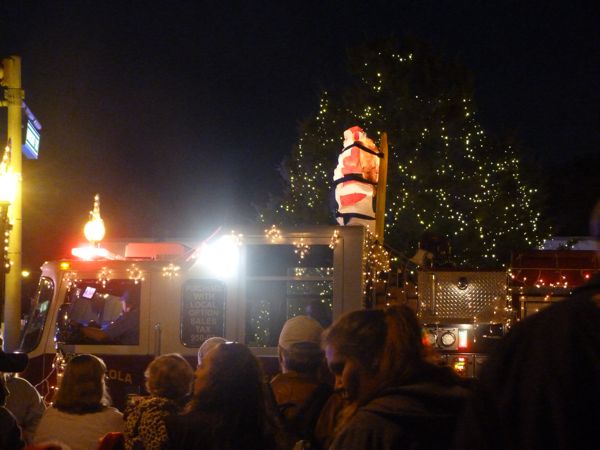
Why do they groan? Why do they grumble and look annoyed when I say it’s time for the Christmas Parade?
Once they get there, they have the best time! Who wouldn’t? It’s all noise and flash, great floats and loud bands, dancing in the street, dancing on the sidewalk, seeing all our friends from church and school and waving to friends on the floats – throwing BEADS!
Even 1 year old baby N totally gets into the beads! “Beads! Beads!” she shouts and holds out her hands. She marvels at their sparkle as they hang around her neck.
Here is what I love about Pensacola. It’s been a bad month, with Ferguson, with New York, and in Pensacola 50,000 people gather peacefully and party on the streets. It’s New Orleans with our clothes on, it’s Christmas/Mardi Gras Family Style. We dance, we party, we jump for those beads – and then we pass them along to the children. It’s a long, happy parade, with every school marching band and Mardi Gras group, a local radio station or two, the homeless, the counter culture, drinks in open containers, church groups, neighborhood meet-ups, Jesus is there, with Mary and Joseph – it’s all cool.
When the parade ends, we all go home. Peacefully.
Some may grumble, but for me, they show up, every year, and we celebrate a family tradition, the Pensacola Christmas Parade.

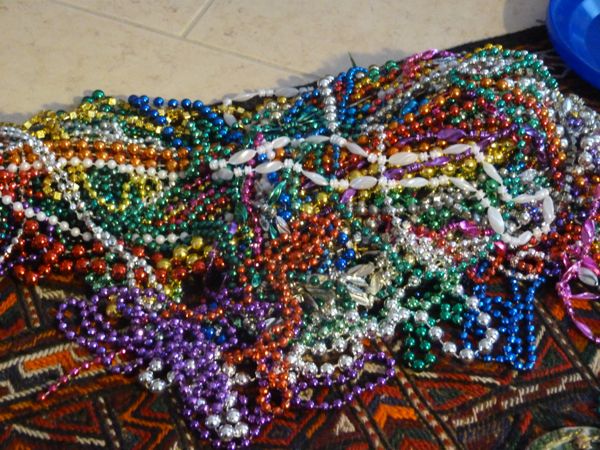
AdventureMan and his helper went down early Sunday morning and pulled a great Bead harvest out of the trees. Little grandson Q carefully sorted them into piles for his friend Chris, his mama and daddy, his two other sets of grandparents and for his room upstairs in our house.
Middle East Map of Deadliest Infectious Diseases

This is from AOL News/Upworthy, where you can view the deadliest infectious diseases in all parts of the world.
*A note from GlobalPost on how these maps are set up: The numbers in black boxes show how many thousands of people died from the dominant infectious disease in that country in 2012. Keep in mind that these are absolute numbers, so they’re not scaled to account for a country’s population. They also don’t convey the total number of deaths from all infectious diseases in each country, just the number of deaths from the deadliest disease. You’ll also notice that many countries in the maps are grayed out (like the USA). That indicates the deadliest infectious disease wasn’t among the ones monitored by the WHO.
Dinner at Hofbrau Haus in Panama City Beach, FL
We lived so many years in Germany, and one of the phrases that would drive me crazy is people exclaiming about schnitzles that “were so BIG they were hanging off the plate!” (said with big googly eyes). Big and schnitzle do not necessarily go well together. Schnitzle can be tough, it can have too much fat, it can be gristly. Living there for so long, I’ve had some really bad schnitzles, big and small. During our later years in Germany, we avoided schnitzle altogether; there were so many other alternatives, more refined dishes – pumpkin raviolis, white asparagus soups, St. Martin’s goose, venison ragout, duck breasts . . . (drooling in a very un-refined way . . . )
But lately, I had tiny hankering for a plain old schnitzle, and here we were in Panama City Beach, where there is a HofBrau House.
When we lived in Heidelberg, there was a HofBrau House nearby. Growing up in Germany, it seemed to me HofBrau House was everywhere, sort of like a German version of McDonalds. Now, you don’t see them so often as you used to, except for the original one in Munich.
AdventureMan is a great sport; he likes schnitzle less than I do, but off we go to HofBrau House, and actually, we have a great time.
I order a pretzel, it is huge and it is very hot, and served with a mustard dipping sauce. (This is nothing like we ever had in Germany; pretzels were mostly street-food.) It was salty and the sauce was delicious. I loved it.
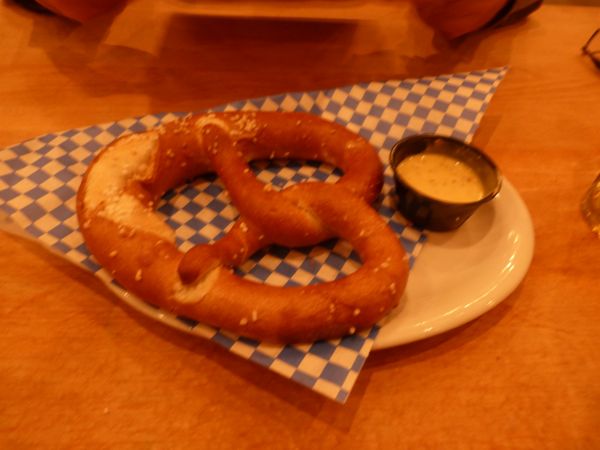
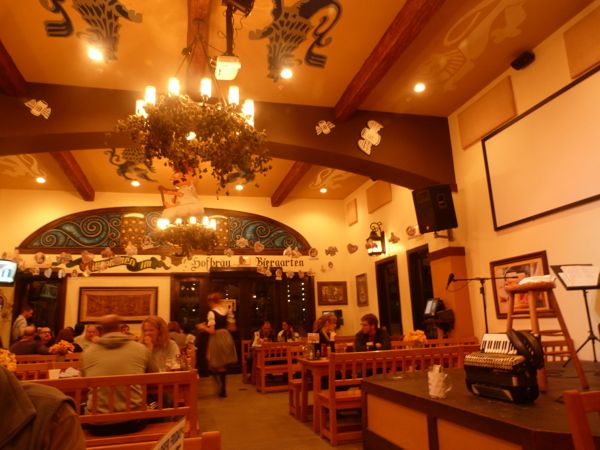
The pretzel went great with the beer – very good beer – and the accordion music. The atmosphere in the HofBrau house is festive. The beer is VERY good.


When my schnitzel came, it covered the plate. I was aghast, but . . . it was crisply fried, not any fat, not any gristle and lots and lots of lemon wedges to squeeze onto it. We cut it in half and took half home for a late Thanksgiving snack the next night. We cut the remainder in half and enjoyed every bite. It will be a long long time before I feel a need for a schnitzel again, but this one did the HofBrau Haus proud.
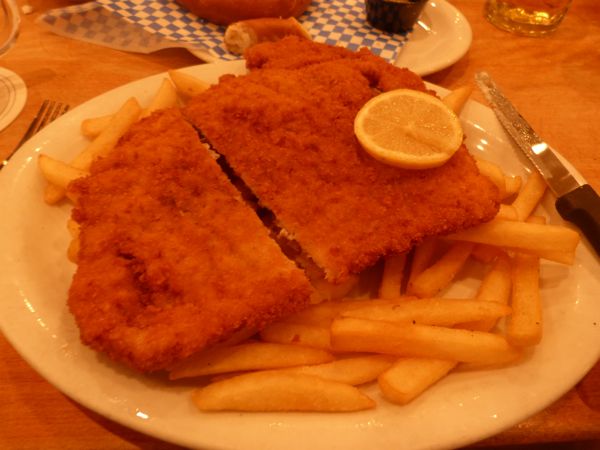
Service was the best. All the wait staff looked really happy to be there, even those who had to wear the serving wench costumes. It is located in Pier Park, a great place to go walking after a schnitzel dinner, great shopping and a kid’s park with rides and a huge slide.


Thanksgiving at the Sunset Inn
Back in Panama City for our annual gathering with our sweet daughter-in-law’s family, we check in at the Sunset Inn on a glorious day in late November. The view that greets us thrills our hearts:

There aren’t too many people staying at the beach, go figure, it’s Thanksgiving and families are gathering, but this is a GREAT time to be here. We have a full kitchen, so I can still roast my garlic-broccoli, make my Mom’s Cranberry Salad and make the topping for the Soused Apple Cake all while having the door wide open and listening to the waves roaring to the shore. This is one of my happiest places on earth.
These small surf boards give a lot of pleasure on smaller waves:

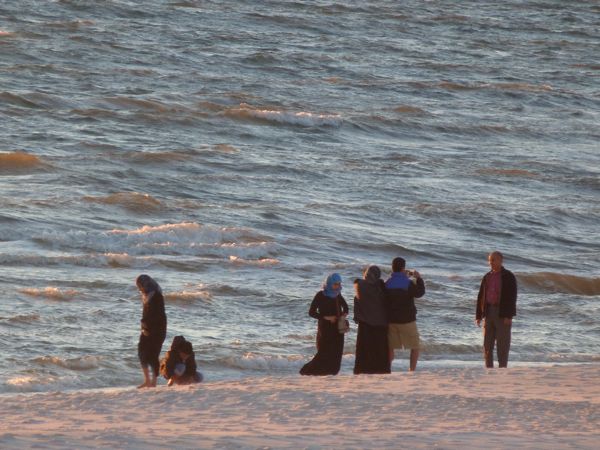
I thought I was back in Kuwait, overlooking the family park in Fintas:

I can see things slipping a little at the Sunset Inn, carpets not being replaced, linens getting thinner from so many washings, small repairs not being made – and I know our days there are numbered. Sigh. What they can’t replace in the personal character of the management – I can run down and beg a couple pieces of tinfoil to cover my broccoli; it is their motel, they manage it personally. There are countless soulless condos and motel rooms in Panama City Beach, but only one Sunset Inn.
Qatari Ambassador to US Speaks to Full House in Pensacola
Yesterday, the Qatari Ambassador to the United States, Mohammed Jaham Al Kawari, spoke to a packed house at the New World Landing as the Tiger Bay Club gathered to hear how little Qatar is exerting big influence in the world peace-making arena.

The ambassador has an impressive biography, and in appearance very polished, very French. He isn’t afraid to tackle the tough questions, and presents Qatar’s position in a way that people can hear and understand.
Abu Dhabi Police Capture Suspect in Killing of American Teacher
. . . And they put together a movie to show how it was done. Wow. If our police could do this, cases would clear courts a lot faster. Here is the story:
From AOL News:
DUBAI, United Arab Emirates (AP) — The United Arab Emirates’ interior minister says police have arrested a suspect in the killing of an American schoolteacher in the capital, Abu Dhabi.
State news agency WAM says Interior Minister Saif bin Zayed Al Nahyan said on Thursday that the suspect also planted a makeshift bomb outside the house of an American doctor. He says the device was successfully dismantled.
Police say the teacher was stabbed to death by an attacker wearing the full black veil commonly worn by women throughout the Gulf Arab region.
When I watched it YouTube, it showed sponsorship by No Nonsense, LOL, which I thought ironically appropriate.
Beginning to Look a Lot Like Christmas . . .
I’m not a person who likes to be rushed, and I am a person who front-loads, who gets things done early, so as not to have to make decisions or preparations in a rush. If I can plan, and execute early, it all falls into place.
So when we had another early cold spell this week, our second ‘unseasonal’ cold spell, so cold we had to cover our more sensitive plants and bring others into protected areas, and with Thanksgiving coming so late this year, I decided I could let myself do a little early Christmas prep.

No, no tree, not yet, and no lights outside. Time enough for all that, just a little sparkle to get us started. As much as I love real greenery, real garlands, the temperatures here are too high for it it stay green longer than a week, so I use the artificial kind. You’d think the benefit would be no dropping needles, but this stuff also drops ‘needles’, and we laugh at where we find them hiding in August.

We bought our crêche many years ago in Germany, and it has gone with us everywhere we lived. It has lost a lot of its Germanic moss through the years, but I wouldn’t dream of replacing it:

The normal crêche occupants through the years have been supplemented by extra sheep and camels, and actually, by French santons, extra wise men, an angel ornament . . . hmmm, maybe it’s getting a little kitchy, but we wouldn’t sacrifice a single thing. One of our Saudi friends contributed a line of camels 🙂

In France and in Germany, crafters make the cutest sheep, and we found ourselves buying them at Christmas or crafts markets.

And, from Doha, The Church of the Epiphany, our “Aboona” or Our Father, the Lords Prayer written in Arabic calligraphy, one of our treasures.

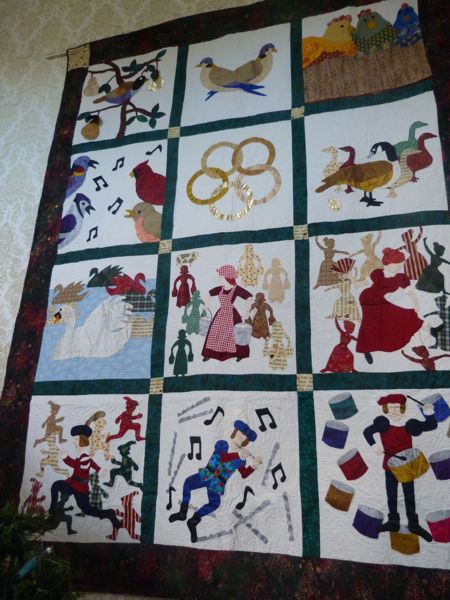
Last, but not least, time to change the hallway quilt, and The 12 Days of Christmas will reign for more like 40 days 🙂
Recent Comments
intlxpatr on Shampoo Ginger tigerbutterya0c5ff1d… on Shampoo Ginger intlxpatr on British Soldier Kidnapped, Esc… John on British Soldier Kidnapped, Esc… intlxpatr on British Soldier Kidnapped, Esc… Wikipedia Donate Button

Amazina


Early Voting in Florida


