Show Me the Money
Two themes came together, early this Sunday morning in Pensacola, first, as Father Harry spoke to us at Christ Church this morning on stewardship, and giving generously, and then later, as I was reading my Sunday Pensacola News Journal, an article on our elected officials, and their finances, their net worth and where their money is coming from.
Father Harry spoke about the rich man, at whose gate Lazarus begs, covered with sores, and then, at death, how the rich man asks God to send Lazarus to wet his lips, as he burns in the eternal hellfires, and Lazarus sits with God. He also asks God to send Lazarus to warn his rich family members that their choices, their lack of generosity, will have consequences, but God says (I paraphrase here) that Moses already told them, and earlier prophets, and that if the rich didn’t listen to them, they are not going to listen to Lazarus.
To me, it seems a given, that if you are blessed with plenty, then you have an obligation to help those who struggle. It isn’t necessarily money, it can be food, it can be time, it can be expertise, or – in my case – it can even be fabric. 🙂 We learn it in pre-school and kindergarten, don’t we? Share what you have, and everyone gets along.
It totally boggles my mind that many of our good friends, government and military people, have excellent health care under a highly socialized system – that’s what the military health care system is all about, we all have access to the same treatment. Many of the people who have access to medical treatment become rabid about supporting health care for those who don’t. Part of it seems to be “I earned it, and those lazy bums expect it for nothing.”
Most of my life, I’ve worked with ‘those lazy bums’ and have grown to have a lot of understanding and compassion for the circumstances that can make an entire family bone poor. Sometimes, it is poor choices – but how do people learn to make better choices without help? How do people aspire to more when they think that the ‘more’ is inaccessible to them?
The face of our nation changed after World War II when many more Americans gained access to higher education as a veteran’s benefit; prior to the GI Bill, higher education was only available to those comfortable people who could afford it.
Also in today’s Pensacola News Journal is an article about Study: Educating Women Saves Millions of Children which is an Associated Press Story about a study published this month in Lancet. “Educated women tend to use health services more and often make better choices on hygiene, nutrition and parenting,” the study (funded by the Bill and Melinda Gates Foundation) concludes.
And last, in the Pensacola News Journal, is an article that makes my heart sing, that makes me proud to live in a democracy, the article about how much our elected officials are worth, and where there money is coming from. I love it that we hold our leaders accountable, and that their wealth is (theoretically) transparent to us.
I’m a great advocate of wealth. I admire people who create wealth, who invest, who work hard for their money. The best of these people, and I mentioned Bill and Melinda Gates (above) for a reason, give back generously. Many people don’t start out rich, they start from little or nothing and build slowly slowly until they have reached a comfortable level. Sometimes, even in hard times, if you have built a strong foundation, that money just keeps multiplying, especially if it is invested with some diversity.
“It’s called the law of the harvest,” my Mormon friends told me when we were discussing how what you give comes back to you multiplied. It was so graphic, I’ve never forgotten it. There is nothing wrong with money. Money is just another tool, like a computer, or a hammer. It’s what you do with your money (tool) that makes the difference. Money is kind of like a seed, you plant and you harvest, but it is also like fertilizer – you spread it around, and amazing things happen.
Having money is a blessing, and giving it away is even more of a blessing. When you give, good things come back to you, multiplied. It’s the Law of the Harvest.
Only As Old as You Think You Are :-)
I found this great story in BBC Health News. The part that cracks me up is that they made these people carry their own bags, and they left all the uneven floors and throw carpets in place and forced them to pay attention to where they walked. . . and the result – they all did BETTER than they had been doing before!
Can You Trick Your Body into Feeling Younger?
Our volunteers were actors Liz Smith (88), Sylvia Syms (76) and Lionel Blair (78), cricket umpire Dickie Bird (77), newsreader Kenneth Kendall (86) and former Daily Mirror editor Derek Jameson (80).
They agreed to live in our time capsule house for a week, during which they dressed in 1970s clothes, slept in replicas of their very own 70s bedrooms, watched television from that era, and talked about 1975 in the present tense.
It proved to be a fascinating but draining experience – for both experimenters and experimentees.
From the beginning we made it clear to our volunteers that they would be expected to look after themselves. Research in nursing homes shows clearly that giving residents control over their own lives and their own choices has a hugely beneficial impact on health and happiness.
In one study, residents who were allowed to choose a plant to care for, and when and where to receive visitors, were found 18 months later to be significantly more cheerful, active and alert. They were also far more likely to be still alive.
Another thing about our 1970s house was that it was full of physical challenges. There were shag pile carpets to trip over, door ridges to step over and lots of slippery linoleum. Research on mice has shown that those who live in a challenging environment live nearly 30% longer than those who in a secure but boring environment.
In this spirit, on their arrival, our volunteers were asked to carry their bags up a flight of stairs to their bedrooms. It was the first time they’d been forced into such physical activity in many years, and they were not happy.
But they rose to the challenge. When they started at the bottom of the stairs, a couple were adamant it would be impossible to make it to the top. Watching from a laboratory close by, it was hard to resist going to their aid.
Slowly, step by step, they succeeded. We had made them question whether, perhaps, they were more physically capable than they had given themselves credit for.
It was a tough initiation, but a core element of Ellen’s original experiment was the idea that our prior beliefs play a huge part in how we perceive the world, and how we perceive ourselves. By immersing our volunteers in a 1970s world, we were hoping to make them think of themselves as younger, fitter and healthier.
For many of them, the 70s had been a golden decade, a highlight of their careers.
We took Dickie Bird back to Lords to relive the atmosphere. As he walked through the tunnel, onto the grounds, he blossomed before our eyes. Dickie had had a stroke, suffered 18 months of illness, lost confidence and come to think of himself as old. By the end of the week, his confidence was back and he showed remarkable improvement across a range of tests, including memory and stamina.
Over the week we gave all the celebrities tasks to do, but we also left them to fend for themselves. For up to 12 hours a day, we observed them through our surveillance cameras and, just as Ellen had discovered all those years before, we saw great changes.
Half way through the week, Liz Smith took 148 steps with the aid of just one stick. For someone who had not walked without both sticks since her stroke – and who often relied on a wheelchair – it was a real breakthrough. She was no longer willing to be limited by the physical constraints she had imposed on herself.
At the end of the week we put our guinea pigs through the same rigorous battery of physical and psychological tests we had at the beginning. Memory, mood, flexibility, stamina and even eye sight had improved in almost all of them.
The results were not uniform, but in some cases they shed up to 20 years in their apparent biological age.
It made a compelling case for Ellen Langer’s argument that opening our minds to what’s possible can lead to better health, whatever our age.
Wyoming to Colorado Springs
We are eager to get going, but oh, we are shivering, and happy we brought a little fleece with us:

It is a glorious morning, bright sunshine, clear air, a day when we are glad to be alive and on the road.
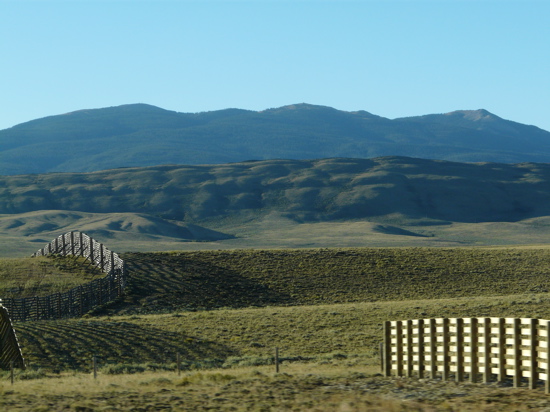

Across South Dakota and Montana, we saw the huge round rolls of hay that we saw in France and Germany, but across Wyoming, most of the bales are the old fashioned square ones. We are thinking square is easier to store, but there must be some advantage, also, to the round ones, as they seem to be the latest invention. Anyone know why?

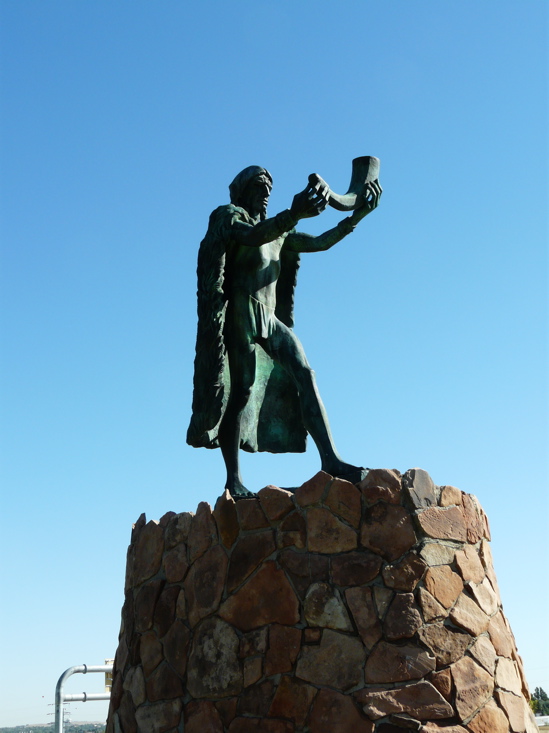
We find a rest stop so we can change drivers, and there is a set of sculptures there called The Greeting and the Gift, just as you are exiting Wyoming and entering Colorado:

I love this one. It looks noble. The First Nation (Native American) is offering a pipe of water. When I was a kid, I would have thought it was a peace pipe, but the explanation says otherwise. The Greeting statue I don’t like as much for two reasons – his hands seem out-of-scale large to me, and the hair does not look like a mountain man or explorer (to me) but looks sort of Hellenic. What do you think?

At the end of a very short drive is a city I love, Colorado Springs. I love it because (most of the time) the air seems clear and clean to me. I love it in the winter, when it is cold, and in the summer, when it is hot, it is dry heat, like Kuwait, but not so hot, so it doesn’t bother me. There are a million quilt shops here, all of which I intend to hit today while AdventureMan does some consulting and I drive the gypsy-mobile. There are also Macy’s department stores, which Pensacola doesn’t have, and Sephora, which Pensacola may be getting soon but did not have when I left.
We went to see George Clooney’s new film, The American, which gave us hours of conversation, and on our way to our Marriott home picked up a feast from Whole Foods – all vegetable! Balsamic grilled brussel sprouts, marinated grilled beets, a vegetarian meatloaf that really tasted like meat (!), guacomole, a pico de gallo with some bite, pita bread, sauteed garlic spinach, and some wonderfully tasty olives. AdventureMan picked up a really good bottle of Colorado merlot (yes, it exists, and is called Two Rivers: Chateau Deux Fleuves Vineyards.
Crowning our day was a sunset over Pike’s Peak. I don’t like a lot of drama in my life, but I love a lot of drama in a sunset. I loved this one so much that I am going to show you three different shots, because I can’t choose the one I like the best.



Cockroaches VS Drug-Resistant Bacteria
You have to know, I truly hate cockroaches. They give me the creeps. When I see one – and cockroaches are a part of life in Florida, even with a pest service – my knees feel weak, and I feel shaky, but I have to force myself to stomp on them and flush them away. Now, AOL News tells us cockroaches can help us fight serious infections, including the one I hate the most, MRSA. You can read the entire article by clicking on the blue type above.

(Sept. 7) — Cockroaches, the creepy critters reviled for invading kitchens the country over, might be modern medicine’s best option for fending off dangerous, drug-resistant bacterial infections.
British researchers at the University of Nottingham’s School of Veterinary Medicine and Science are behind the discovery, which entails harnessing molecules from the tissues of cockroaches and locusts to combat bacteria like E. coli and MRSA (drug-resistant staph infections).
Chemicals found in the brain and central nervous tissues of cockroaches are able to kill 90 percent of dangerous bacteria in lab-based tests.
The potent chemicals, found in the brain and central nervous tissues of the critters, are able to kill 90 percent of E. coli and MRSA in lab-based tests.
“Superbugs … have shown the ability to cause untreatable infections and have become a major threat in our fight against bacterial diseases,” Dr. Naveed Khan, who supervised the work of lead researcher Simon Lee, said in a press release. “Thus, there is a continuous need to find additional sources of novel anti-microbials to confront this menace.”
In a twist that’s an ironic upside to our own revulsion for roaches, it’s their “unsanitary and unhygienic environments,” Lee speculated, that spurred the critters to develop toxins against the bacteria.
You can read the rest of the original news article by clicking here.
“How Do You Want to Die?”
I had taken my mother to her internal medicine specialist, she had an earache, and as an aside, had mentioned she no longer is taking Lipitor, because it gave her problems with her legs, but should she go back on it?
“How do you want to die?” asked the doctor, and we just looked at her with our mouths hanging open. It seems kind of a bald question, doesn’t it? But the doctor was entirely serious.
“Doctors ask themselves this all the time,” she continued. “Do you want to end up in a nursing home, or living with your children, as your body continues to fail and your money dwindles away and you can do less and less every day?”
“I want to die in my sleep, at home” my 87 year old Mom responded.
“Then you want to have a heart attack,” the doctor said. “That’s what really happens when a person dies in their sleep, their heart fails.”
“That’s your choice,” she said. “Doctors discuss it all the time. Most of us want to go while life is still good, and we want to go quickly. We see too many people prolonging their lives and regretting it.”
I’ve never heard a doctor speak so bluntly before. We’re still kind of in shock. It has definitely given us something to think about.
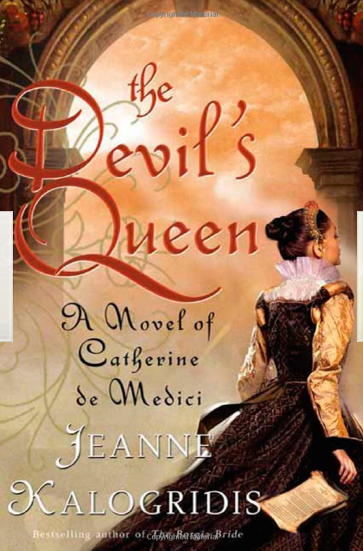
The Devil’s Queen by Jeanne Kalogridis
“I need an ESCAPE!” I shouted to AdventureMan, at the end of my rope. So many things going on in my life that are out of my control, I just don’t want to deal with it any more, and I just want to run away and hide. “I’m going out to buy a BOOK!”
I found just the book, The Devil’s Queen by Jeanne Kalogridis.
I don’t know much about the late 1500’s in Europe, do you? At first, reading about this rich, spoiled little girl growing up in Florence, I felt a little impatient with her. All around her people are starving, and she hasn’t a clue. The plague strikes, and people are dying, but she survives. She starves, she suffers cold and fleas and is tossed by fate like a little cork on the water – all before she is 12 years old. Catherine de Medici learns early in life that she has no control over the forces of history and society swirling around her, over who she will love and who she will marry, even over whether she lives or dies. Surviving an attack on her family compound, held prisoner – alone – in nunneries until she is 12 years old – this girl’s life makes mine look peaceable!
I’m feeling better already.
Kalogridis is no Phillipa Gregory, but she has done her research, and draws us in. By the time Pope Clement betrothes Catherine to Henri of France, we are totally hooked. Thirteen years old, and off to live in a strange country as the bride of a man she has never met. She studies French as quickly as possible, but then again – this is a very bright young woman, who has been trained – by life and by education – to survive.
One of the paragraphs made me laugh out loud – as Catherine enters France, she is aware that her very fashionable Italian clothing is very unfashionable in France. She also notes that all the French women are painfully thin, thin to the point of gauntness, and are whispering behind their hands at her more normal size.
Lack of thinness is the least of her problems. She marries Henri, who is also 14, scared, and not in love with her, and they are expected to consummate their marriage under the eye of the King. Oh aargh! Catherine is on a steep learning curve, mastering French culture, diplomacy, the art of war, court politics and fighting the threat of repudiation the only way she can – with utter humility.
What I like the most about this book is that I feel like I was there with her. She is very human, and also very royal. People who are royal have different ideas than the rest of us, and are entitled in ways we can never imagine. They have obligations we can’t imagine. She makes choices I would never make, and yet the author convinced me that given her circumstances, she does the best she can with the resources at hand.
I also like it that Catherine of Medici was a brilliant and educated woman who held her own in a world where the balance was definitely in favor of being a man, and women were greatly at a disadvantage. While she made some horrifying choices, she had her reasons. This is not a book for the faint hearted; it is very earthy and it feels like an accurate portrayal of the times.
As I read these books, I think, too, how little we appreciate how free women are these days, and how recent that freedom is. Being able to choose our own mates – this is very recent. Being able to inherit and to manage our own money – this is very recent. As I talk with my friends who live in the Arabian Gulf, where marriages can still be based on family alliances, maintaining wealth and power, and where divorce can still equal personal disaster, it no longer seems so alien to me – we have this in our own history. We used to marry by contract, and our husbands had full use of our wealth. We used to be judged by whether we could bear children, how many, how many were sons, and how well we managed our households. We used to die in childbirth, and many of our children didn’t survive their infancy.
If you are looking for a good escape, this is a book that will take you there. It will make your own troubles look small in comparison. This book will keep you engrossed, horrified, and entertained, and, in the end, you might learn something, as I did.
You can find The Devil’s Queen at Amazon.com for a mere $10.40 plus shipping, and yes, I own stock in Amazon.com. LOL, we invest in that which we believe to lasting and important, and books play a large role in our lives. 🙂
HIV Increases Significantly in People over 50
Today, on BBC Health News experts say you are likely at risk if you have had sex without condoms, multiple sex partners, or sex in countries with high HIV rates:
HIV rate rises among over-50s
There has been a big increase in the number of people aged 50 and over catching HIV, latest figures show.
The over-50s infection rate in England, Wales and Northern Ireland more than doubled in under a decade – from 299 new cases in 2000 to 710 in 2007.
In 2008 there were 7,382 new diagnoses – 8% of these were in the over-50s, says the Health Protection Agency.
Experts say the figures are a stark reminder of the importance of practising safe sex, whatever your age.
This highlights the importance of HIV testing – whatever your age”
Other sexually transmitted infections have shown a similar doubling in under a decade among the same age group, and have been rising at a faster rate than in the young.
Promiscuity
Ruth Smith, who led the HPA research, said: “We estimate that nearly half of older adults diagnosed between 2000 and 2007 were infected at age 50 or over. This highlights the importance of HIV testing – whatever your age.
“We must continually reinforce the safe sex message – using a condom with all new or casual partners is the surest way to ensure people do not become infected with a serious sexually transmitted infection such as HIV.”
Bacteria Makes Me Fat!
It’s not my fault! Bacteria makes me fat! I am so relieved! (But I am still fat 😦 )
This is an excerpt from Newsweek Magazine, part of a much longer article which you can read for yourself by clicking on the blue type, above.
The grapefruit diet, the Atkins diet, low-fat diets, low-carb diets, the cabbage-soup diet: they and all the other fad diets make the health establishment roll its collective eyes. The only way to lose weight, says every reputable textbook and medical society, is to burn more calories than you consume. And if you are adding pounds, the reason is, pure and simple, that you are consuming more calories than you expend. Weight gain is a straightforward matter of calories in minus calories out, they maintain.
But while the basic math is right, the meaning of “calories in” isn’t what we’ve been taught, according to a growing pile of studies of chubby mice, obese people, svelte mice, and slim people. The calories that matter are not simply the number printed on grocery items, fast-food menus, and those guilt-inducing signs next to Starbucks’ brownies.
The calories that count are those extracted by your digestive enzymes and—as more and more research is showing—the trillions of bacteria in your intestine. People whose gut bacteria are better at digesting fats and carbs than their neighbor’s will absorb all 1,500 calories in a Friendly’s Ultimate Grilled Cheese BurgerMelt, while the neighbor will absorb fewer. So even in people with identical metabolisms, the effects of eating identical foods can be different.
News and Roosters
“How’d you sleep?” I cheerily greeted my sister, Sparkle, newly arrived from Paris to our small farming village in Germany.
“That #*%@ing ROOSTER!” she exclaimed. “He started crowing around 3:00 a.m. and never stopped! You must have heard him! He was right under our window!”

No. No, there was no rooster under our windows. The nearest rooster was up in the next farm, maybe 100 yards away. But I kind of remembered when we first moved in, I think I remember we heard him. We no longer heard him. You just get used to it, I guess.
What brings this to mind is that KUOW in Seattle has a program today on the Seattle City Council vote – they are about to vote to increase the number of chickens allowed by ‘urban farmers’ but to prohibit the roosters.
You can hear the discussion for yourself by going to KUOW. There are some hilarious comments, one by a man who said “Sure, ban roosters, right after you ban boom boxes, and teenagers, and heavy trucks, and garbage pickups. There are a lot worse sounds in the city than roosters!” (I may have paraphrased that quote, I was laughing too hard to write it all down.)
AdventureMan and I love National Public Radio. We support our local NPR station, WUWF in Pensacola, which I listen to while I am driving, but when I am working on a project, I still stream KUOW, which I started doing while I was living in the Gulf. I love the huge variety of opinions and subjects, and I appreciate that there is more news in the world than what they show on TV, after all, on TV they can only show what they have film footage of. There are books to be discussed, and movies, and music, and social situations in Khandahar and Botswana and Sri Lanka and boy soldiers in Liberia . . . things I haven’t a clue about unless I listen to my national public radio station. I read the paper daily. I watch the news once a day – but it doesn’t meet the depth of coverage of NPR.
I think chickens are pretty cool. They are also pretty stupid, but I am all for a chicken or two, fresh eggs, etc. When I needed fresh eggs in Germany, I just walked up the hill and bought them from the chicken lady. When I asked my landlady about recycling, she just laughed, and we walked our food leftovers, peelings, coffee grounds, etc up the hill and threw them over the fence for the chickens. I don’t even mind roosters. Sorry, Sparkle!
Bionic Cat
You can read this entire story at The NPR Website
No Mouse Is Safe: Cat Gets World’s First Bionic Paws
by THE ASSOCIATED PRESS
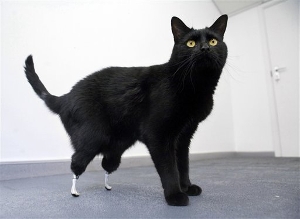
Oscar, the cat with a pair of prosthetic paws, is seen in an undated photo.
June 25, 2010
Oscar the cat may have lost one of his nine lives, but his new prosthetic paws make him the world’s first bionic cat.
After losing his two rear paws in a nasty encounter with a combine harvester last October, the black cat with green eyes was outfitted with metallic pegs that link the ankle to the foot and mimic the way deer antlers grow through skin. Oscar is now back on his feet and hopping over hurdles like tissue paper rolls.
After Oscar’s farming accident, which happened when the 2 1/2-year-old-cat was lazing in the sun in the British Channel Isles, his owners, Kate and Mike Nolan, took him to their local veterinarian. In turn, the vet referred Oscar to Dr. Noel Fitzpatrick, a neuro-orthopedic surgeon in Eashing, 35 miles southwest of London.
Together with biomedical engineering experts, Fitzpatrick gave Oscar two metal prosthetic implants that are a bit wobbly, to imitate a cat’s natural walk. But first, he covered the brown implants with black tape to match Oscar’s fur.
Fitzpatrick said he and biomedical engineers designed the artificial paws so that they would be fused to the bone and skin. “That allows this implant to work as a seesaw on the bottom of the animal’s limbs to give him [an] effectively normal gait,” he said. “Oscar can now run and jump about as cats should do.”
Recent Comments
Kitchen on Isiais: Winding Down intlxpatr on Shampoo Ginger tigerbutterya0c5ff1d… on Shampoo Ginger intlxpatr on British Soldier Kidnapped, Esc… John on British Soldier Kidnapped, Esc… Wikipedia Donate Button

Amazina


Early Voting in Florida


