Pesticide Exposure Cause of ADHD?
This morning on AOL Health News:
By Mary Beth Sammons
In the United States alone, an estimated 4.5 million children ages 5 to 17 have been diagnosed with attention deficit hyperactivity disorder, according to the Centers for Disease Control and Prevention, and rates of diagnosis have risen 3 percent a year between 1997 and 2006. Yet it is unclear what is causing this increase. New research is investigating many avenues. One of them is environmental factors such as pesticides and allergens.
In a study published in the journal Pediatrics, researchers studied 1,139 children ages 8 to 15. All of the children studied had measurable residue of pesticides commonly used on fruits and vegetables. Diet is a major source of pesticide exposure in children, according to the National Academy of Sciences, and much of this exposure comes from the common kid-friendly fruits and vegetables, such as blueberries, strawberries and celery. In a 2008 government report, detectable concentrations of malathion (a pesticide commonly used in agriculture, residential landscaping and mosquito abatement) were found in 28 percent of frozen blueberry samples, 25 percent of fresh strawberry samples and 19 percent of celery samples.
In the Pediatrics study, researchers found that for every tenfold increase in the urinary concentration of pesticide residue, there was a 35 percent increase in the chance that the child would develop ADHD. The effect was seen even in kids who had a very low level of detectable, above-average pesticide residue.
Unlike other studies of pesticidal impact, this one looked at the average exposure to pesticides in the general population of children and not at a specialized group such as children who live on farms, according to lead author Maryse Bouchard of the University of Montreal.
Because certain pesticides leave the body after three to six days, the presence of residue shows that exposure is likely constant, Bouchard said. The study found that children with the kind of metabolites left in the body after malathion exposure were 55 percent more likely to be diagnosed with ADHD. Almost universally, the study found detectable levels: The compounds turned up in the urine of 94 percent of the children. Children may be especially prone to the health risks of pesticides because they’re still growing and may consume more pesticide residue than adults, relative to their body weight.
More research is needed to confirm the findings, says Bouchard. But the take-home message for parents, she says, is to give kids organic produce as much as you can and to wash fresh fruits and vegetables — organic or not — thoroughly.
An unpublished 2008 study out of Emory University found that in children who switched to organically grown fruits and vegetables, urine levels of pesticide compounds dropped to undetectable or close to undetectable levels.
Denver immunologist Dr. Isaac Melamed is studying another effect that may contribute to ADHD: the inflammation caused by all allergies including food, pollen and dust. In his unpublished study, he found that the inflammation caused by an allergic reaction may contribute to ADHD. Therefore, he says, by controlling a child’s exposure to allergens, parents may be able to better control ADHD. Melamed says that although much more study needs to be done on this, in his private practice, he has controlled his patients’ ADHD by limiting allergic triggers.
Remember that all of this research is in the very early stages and needs to be studied more thoroughly before it can be confirmed.
So the parents who conscientiously feed their children fruits and veggies are at most risk for exposing their children to pesticides which may lead to ADHD? And the recommendation is for eating organic vegetables? Or growing your own?
Heartache in Pensacola
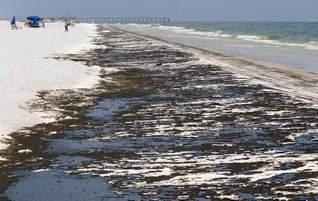
It’s a beautiful full moon over the oil soaked beaches of Pensacola. There is a beach advisory against children on the beach, against pregnant women or people with weak immune systems being on the beach. The surf is contaminated with oil and VOC, which is volatile organic compounds, whatever that means, it is bad.


Checking Out Pensacola Beach
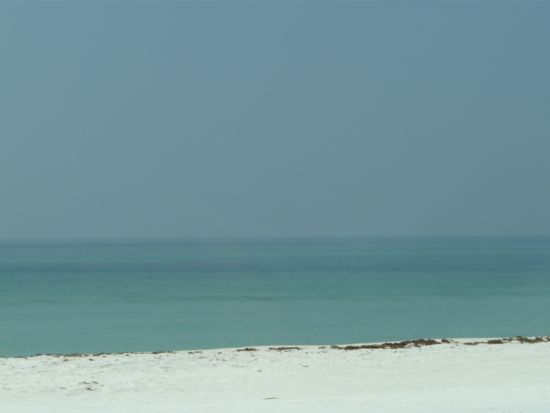
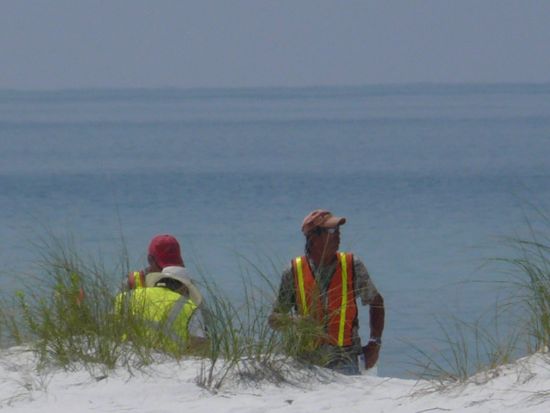
After our water aerobics class this morning, AdventureMan and I drove out to the beautiful sugar-white sandy beaches of Pensacola to check the damage. The clean up crews have been busy, and the beaches look gorgeous. People are sunning, swimming, and sharing the beaches with the clean up crews.
A big huge electronic sign announces that the road to the beach will be closed all day tomorrow. How can you close a major road? Is this Kuwait, or Qatar, where the will of the Amir says “Make it so!” and it is so? Oh. Wait. President Obama is coming, so the road will be his and his alone to go out to the beaches and see what we saw today.
The huge, gigantic glob of oil has only sent tendrils, so far, to the pristine white beaches, but doom impends as storms and winds blow the thick oily sludge toward the shores. God willing, President Obama will find a way to encourage British Petroleum to work with a little more conviction and energy to find a long term solution to this unthinkable TWO MONTHS and hundreds of thousands of gallons spewing into the Gulf.


Save This for a Down Day
Thank you, Kuwait friend, for this wonderful video “Free Hugs.” You can’t help but smile after watching it. 🙂
Skinniest People Shop at Whole Foods
This study is hysterical. It tracked who shopped where, and found that the people who shop at Whole Foods had a far smaller probability of being obese. They concluded that the poorer the consumer, the less healthy the foods.
I found this on AOL Health.
Skinniest People Grocery Shop HERE
By AOL Health Editors Jun 8th 2010 10:56AM
The skinniest people shop at Whole Foods where only 4 percent of the shoppers are obese. Why? It’s all about money–or lack thereof.
People who are poor and have less to spend on food try to get the biggest calorie bang for their food buck. That means they not only shop at cheaper stores, but also buy less healthy food.
The study: A University of Washington research team tracked 2,001 Seattle area shoppers between December 2008 and March 2009. They compared their choice of supermarkets to data they collected on the participants’ education, income and obesity rates. Obesity rates were measured by asking consumers to report their height and weight so their body mass index (BMI) could be calculated. People with a BMI higher than 30 were identified as obese.
The results: The percentage of obese shoppers is almost 10 times higher at low-cost grocery stores, compared with more upscale stores. And poverty is the key reason.
Lead study author Adam Drewnowski, an epidemiology professor who studies obesity and social class, says people who can pay $6 for a pound of radicchio at Whole Foods are obviously better able to afford a healthy diet than those who buy $1.88 packs of pizza rolls at Albertson’s to feed their kids. “If people wanted a diet to be cheap, they went to one supermarket,” Drewnowski told MSNBC. “If they wanted their diet to be healthy, they went to another supermarket and spent more.” He found that only 15 percent of shoppers chose a store based on its proximity to their home. Instead, almost all the shoppers chose a store based on price or quality.
Sticker shock: All the stores offered the same type of food, including fresh fruits and vegetables. But the prices were vastly different. The average price for a market basket of food at Whole Foods was between $370 and $420, compared with the same basket of food at Albertson’s for $225 to $280.
“Deep down, obesity is really an economic issue,” Drewnowski told MSNBC. Eating healthy, low-calorie food costs more money and requires more preparation skills and time than consuming processed, high-calorie foods. MSNBC reports that in a separate study in 2008, Drewnowski estimated that a calorie-dense diet costs $3.52 a day, compared with $36.32 a day for a low-calorie diet. “What this says is your social economic status is clearly associated with how overweight you are,” he told MSNBC.
Grocery stores and percentage of obese shoppers:
• Whole Foods Markets: 4 percent
• Metropolitan Market: 8 percent
• Puget Consumers Cooperative (PCC): 12 percent
• Quality Food Centers (QFC): 17 percent
• Fred Meyer: 22 percent
• Safeway: 24 percent
• Albertsons: 38 percent
— From the Editors at Netscape
Rise in Single Teen Age Mothers in US
Excerpts from new study out from the Center for Disease Control and Prevention found on AOL National News are below. To read the entire article, and for a link to the original report, click on the blue type above.
(June 2) — Attitudes among American teens about birth control, sexual activity and pregnancy have remained largely unchanged since 2002, according to a new federal report.
Stalled progress is bad enough, but some subtle changes also have experts concerned.
Most notably, more teens than ever are using the “rhythm method” to prevent pregnancy, and a growing number of teen girls approve of underage childbirth. . .
After dropping steadily for more than a decade, the teen birth rate in the U.S. rose between 2005 and 2007. Compared with other developed countries, the U.S. posted the remarkably high rate in 2007 of 42 babies per 1,000 teen girls. In Canada, by contrast, only 13 babies are born per 1,000 teen girls. . .
Laura Lindberg, senior research associate at the nonprofit Guttmacher Institute, speculates that the growing number of glamorous celebrities bearing children — especially as single mothers — is having an impact on the attitudes of America’s youth.
(Article contributed to AOL by Katie Drummond)
BBC and the Oil Spill and Ethiopian Elections
You would think that living here on the Gulf Coast within miles of the huge oil spill spewing out to putrefy the beautiful, sparkling gulf waters, that we would have the best, most comprehensive coverage of the local news.
Not so.
“I love BBC!” I called out from my studio to AdventureMan, in his study next door. “Who else is covering the Ethiopian elections in such detail? And they have the best coverage of the oil spill!”
Here is the latest; and excerpt from the Huffington Post:
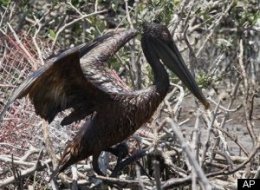
BARATARIA BAY, La. (AP) — As officials approached to survey the damage the Gulf oil spill caused in coastal marshes, some brown pelicans couldn’t fly away Sunday. All they could do was hobble.
Several pelicans were coated in oil on Barataria Bay off Louisiana, their usually brown and white feathers now jet black. Pelican eggs were glazed with rust-colored gunk, and new hatchlings and nests were also coated with crude.
It is unclear if the area can even be cleaned, or if the birds can be saved. It is also unknown how much of the Gulf Coast will end up looking the same way because of a well that has spewed untold millions of gallons of oil since an offshore rig exploded more than a month ago.
“As we talk, a total of more than 65 miles of our shoreline now has been oiled,” said Louisiana Gov. Bobby Jindal, who announced new efforts to keep the spill from spreading.
A mile-long tube operating for about a week has siphoned off more than half a million gallons in the past week, but it began sucking up oil at a slower rate over the weekend. Even at its best the effort did not capture all the oil leaking, and the next attempt to stanch the flow won’t be put into action until at least Tuesday. . . .
In Barataria Bay, orange oil had made its way a good 6 inches onto the shore, coating grasses and the nests of brown pelicans in mangrove trees. Just six months ago, the birds had been removed from the federal endangered species list.
The pelicans struggled to clean the crude from their bodies, splashing in the water and preening themselves. One stood at the edge of the island with its wings lifted slightly, its head drooping — so encrusted in oil it couldn’t fly.
Wildlife officials tried to rescue oil-soaked pelicans Sunday, but they suspended their efforts after spooking the birds. They weren’t sure whether they would try again. U.S. Fish and Wildlife spokeswoman Stacy Shelton said it is sometimes better to leave the animals alone than to disturb their colony.
Pelicans are especially vulnerable to oil. Not only could they eat tainted fish and feed it to their young, but they could die of hypothermia or drowning if they’re soaked in oil.
Globs of oil have soaked through containment booms set up in the area. Plaquemines Parish President Billy Nungesser said BP needed to send more booms. He said it would be up to federal wildlife authorities to decide whether to try to clean the oil that has already washed ashore.
Healing Power of Compassion
From the time we were early-marrieds, we have subscribed, when we could, to Bottom Line and now that we are back in the USA, we have subscribed again. (When we lived overseas, we subscribed, but many of our issues never reached us; now they do!)
I almost didn’t reprint this, but then I saw a message included which said we are welcome to forward this information to friends, family, etc. Well . . . aren’t you my friends? 🙂
This technique is wonderful. Helps others, helps you as you practice it.
May 23, 2010
The Healing Power of Compassion
Charles Raison, MD
Geshe Lobsang Tenzin Negi, PhD
Emory University
Thinking empathetically about other people improves your own health, research shows. Regularly meditating on the well-being of others reduces your body’s inflammatory responses to stress — and that lowers your risk for heart disease, diabetes, dementia and other stress-related health problems.
The goal of compassion meditation is to reshape your responses to other people by concentrating on the interconnectedness of every human being.
It’s easy: Try the following technique for 10 minutes a day, three to four times per week.
WEEK ONE. Sit comfortably, eyes closed, breathing deeply. Think about a time when you were kind to another person — for instance, helping a loved one through a crisis or simply holding a door for a stranger. Recognize your great capacity for goodness. For the last few minutes of your meditation, repeat, “May I be free from suffering… may I find the sources of happiness.”
WEEK TWO. Repeat the same exercise, this time building compassion toward a loved one. Think about someone close to you — your mother, daughter, dear friend — and focus on what a blessing she is in your life. Then think about any suffering she is experiencing… and what you can do to ease her pain. Recite: “May she be free from suffering… may she find the sources of happiness.”
WEEK THREE. Think about someone with whom you have only a minor connection — a bus driver, a waiter at your favorite café. How is he a blessing in your life? How might he be suffering? How can you ease his pain (for instance, with a smile and a sincere word of thanks)? Conclude with the recitation.
WEEK FOUR. Focus on someone you dislike — a whiny neighbor, a critical cousin. Identify blessings, perhaps as lessons you have learned about being patient or not judging others. Consider how the person may suffer… for instance, from being a quitter or having few friends. Finish with the recitation.
MOVING AHEAD. Continue to practice several times weekly, incorporating all four types of compassion into your meditation.
Bottom Line/Women’s Health interviewed Charles Raison, MD, clinical director, Mind-Body Program, Emory University School of Medicine… and former Tibetan Buddhist monk Geshe Lobsang Tenzin Negi, PhD, senior lecturer, Emory University, and spiritual director, Drepung Loseling Monastery, all in Atlanta.
Victory at the Shrimp Basket
This is a moral victory. AdventureMan and I ate at the Shrimp Basket last week and we DID NOT eat fried food! We tried their non-fried platters, AdventureMan had the grilled fish and shrimp, and I had the blackened fish and shrimps. I took the photo before eating! (another victory, woooo HOOOO!)
Yes, I did dip my shrimp in the melted butter. I could not resist. This is one of the best seafood meals I have had in a long time, it was totally delicious.

On the table was this sign:
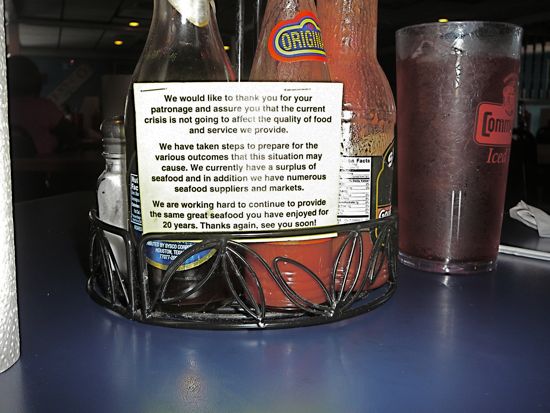
The oil has started coming ashore in Louisiana. It is thick and gooey, and it is sticking to the marshlands, clinging to delicate feathers on birds and suffocating wildlife. This is the beginning of a long, long, ugly process of trying to reclaim what nature never intended the oil to touch. It is devastating.
Garden Gate Nurseries
We’re new, but new-with-a-difference, as we have had so many good people to help us with all the decisions that come with settling in. Today, we spent most of our day exploring health care options. We are so lucky to have a military health plan that will cover most of our needs, but it is a bureaucracy, and our daughter-in-law’s step-father helped guide us through the channels, and introduced us to people who could help explain the benefits and rules. Today we searched out doctors who might work with us. At one point, I told AdventureMan, “the problem is, if they are available, I wonder why? Like maybe all the really good ones are taken?”
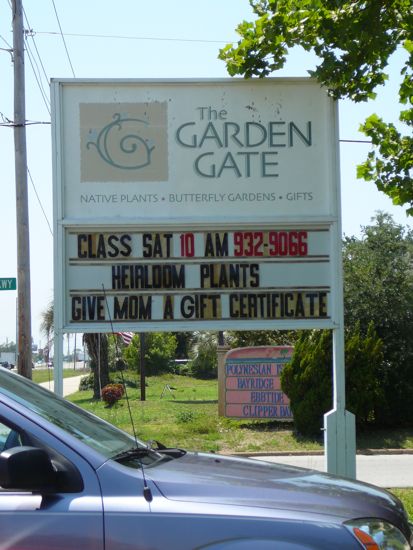
Our therapy is thinking about gardens, working on our gardens, and exploring ideas for how our yard should look in the future. Again, our daughter-in-law knew just the right person to help us out, and introduced us to Garden Gate Nurseries, a little piece of heaven on earth.
Garden Gate Nurseries specializes in educating clients as to what grows well in the Pensacola / Gulf Coast Climate, how to enrich the soil, which plants are particularly drought resistant, salt resistant, which attract butterflies, or hummingbirds, etc. You don’t just plonk things in the garden, you make a plan, and work little by little to accomplish that plan.
A visit to Garden Gate Nurseries is like a foretaste of Paradise:



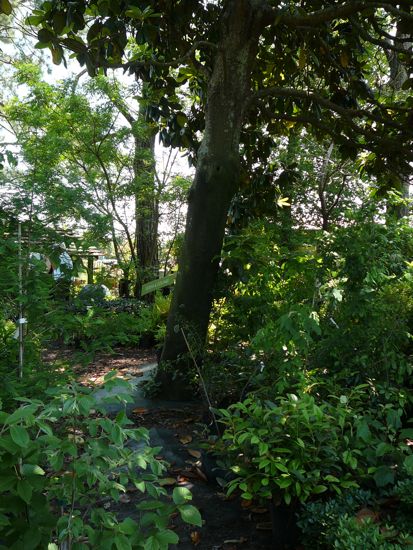
They have herbs and vegetables, plants that love the sun and plants that love the shade, and trees, fruit trees, flowering trees, and some wonderful and unique hand crafted gifts and garden-friendly items in their gift shop.
Best of all, they have a landscape designer, Carole Simpson, who loves gardening, gets her thrills from incorporating your dreams into her designs, is thoroughly knowledgeable about growing things in this climate, and on top of all that, is gracious and kind and generous with her time.
Garden Gate Nurseries / Carole Simpson Landscape Design
3268 Fordham Parkway
Gulf Breeze, FL
850-932-9066
Recent Comments
Kitchen on Isiais: Winding Down intlxpatr on Shampoo Ginger tigerbutterya0c5ff1d… on Shampoo Ginger intlxpatr on British Soldier Kidnapped, Esc… John on British Soldier Kidnapped, Esc… Wikipedia Donate Button

Amazina


Early Voting in Florida


