How Good People Turn Evil
This is a subject that fascinates me – how even “good” people can do very very bad things . . . The article and interview is from Wired.com science/discoveries and you can read the entire article and view a videotape by clicking on the blue type.
TED 2008: How Good People Turn Evil, From Stanford to Abu Ghraib
By Kim Zetter 02.28.08 | 12:00 AM
MONTEREY, California — Psychologist Philip Zimbardo has seen good people turn evil, and he thinks he knows why. Zimbardo will speak Thursday afternoon at the TED conference, where he plans to illustrate his points by showing a three-minute video, obtained by Wired.com, that features many previously unseen photographs from the Abu Ghraib prison in Iraq (disturbing content).
In March 2006, Salon.com published 279 photos and 19 videos from Abu Ghraib, one of the most extensive documentations to date of abuse in the notorious prison. Zimbardo claims, however, that many images in his video — which he obtained while serving as an expert witness for an Abu Ghraib defendant — have never before been published.
The Abu Ghraib prison made international headlines in 2004 when photographs of military personnel abusing Iraqi prisoners were published around the world. Seven soldiers were convicted in courts martial and two, including Specialist Lynndie England, were sentenced to prison.
Zimbardo conducted a now-famous experiment at Stanford University in 1971, involving students who posed as prisoners and guards. Five days into the experiment, Zimbardo halted the study when the student guards began abusing the prisoners, forcing them to strip naked and simulate sex acts.
His book, The Lucifer Effect: Understanding How Good People Turn Evil, explores how a “perfect storm” of conditions can make ordinary people commit horrendous acts.
He spoke with Wired.com about what Abu Ghraib and his prison study can teach us about evil and why heroes are, by nature, social deviants.
Wired: Your work suggests that we all have the capacity for evil, and that it’s simply environmental influences that tip the balance from good to bad. Doesn’t that absolve people from taking responsibility for their choices?
Philip Zimbardo: No. People are always personally accountable for their behavior. If they kill, they are accountable. However, what I’m saying is that if the killing can be shown to be a product of the influence of a powerful situation within a powerful system, then it’s as if they are experiencing diminished capacity and have lost their free will or their full reasoning capacity.
Situations can be sufficiently powerful to undercut empathy, altruism, morality and to get ordinary people, even good people, to be seduced into doing really bad things — but only in that situation.
Understanding the reason for someone’s behavior is not the same as excusing it. Understanding why somebody did something — where that why has to do with situational influences — leads to a totally different way of dealing with evil. It leads to developing prevention strategies to change those evil-generating situations, rather than the current strategy, which is to change the person.
You can read the rest of the article and view the video HERE.
Saudi Men Arrested for Flirting
This is in today’s BBC News.
Saudi men arrested for ‘flirting’
Relations between the sexes outside marriage is against the law
Prosecutors in Saudi Arabia have begun investigating 57 young men who were arrested on Thursday for flirting with girls at shopping centres in Mecca.
The men are accused of wearing indecent clothes, playing loud music and dancing in order to attract the attention of girls, the Saudi Gazette reported.
They were arrested following a request of the Commission for the Promotion of Virtue and Prevention of Vice.
The mutaween enforce Saudi Arabia’s conservative brand of Islam, Wahhabism.
Earlier in the month, the authorities enforced a ban on the sale of red roses and other symbols used in many countries to mark Valentine’s Day.
The ban is partly because of the connection with a “pagan Christian holiday”, and also because the festival itself is seen as encouraging relations between the sexes outside marriage, punishable by law in the kingdom.
You can read the whole article HERE.
I wonder . . . is this what is going to happen in Kuwait? So like they segregate the university. . . then they segregate all the schools, EVEN THE PRIVATE SCHOOLS, so there is no choice. . . then they start patrolling the malls?
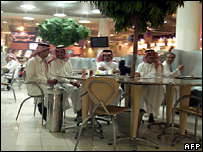
I lived in Saudi Arabia, and I remember the mutawaaeen were NOT police, but sometimes they took on the prerogatives of the police. So I have to wonder, like who made the arrest in the malls? Was it the police? Was it the mutawa hitting the boys with their little sticks? Did they call the boys parents? I have SO many questions!
Founder or Flounder?
“Ummm, errrr. . . .is her campaign foundering or floundering?” I asked my very-intelligent-almost-a-doctor friend and she matter of factly and crisply said that it could be either, her campaign may be gasping and dying like a fish out of water, or approaching failure.
Don’t you wish you knew all those things? I do. I have to look them up all the time.
Founder has a lot of meanings. The one I was looking for is in bold type:
founder
n 1: inflammation of the laminated tissue that attaches the hoof
to the foot of a horse [syn: {laminitis}]
2: a person who founds or establishes some institution; “George
Washington is the father of his country” [syn: {beginner},
{founding father}, {father}]
3: a worker who makes metal castings
v 1: fail utterly; collapse; “The project foundered” [syn: {fall through}, {fall flat}, {flop}]
2: sink below the surface
3: break down, literally or metaphorically; “The wall
collapsed”; “The business collapsed”; “The dam broke”;
“The roof collapsed”; “The wall gave in”; “The roof
finally gave under the weight of the ice” [syn: {collapse},
{fall in}, {cave in}, {give}, {give way}, {break}]
4: stumble and nearly fall; “the horses foundered”
Flounder also has a lot of meanings:
A fish with a flattened body adapted for life on the seafloor.
http://www.reefed.edu.au/glossary/f.html
i) A small edible flatfish, ii)any small flatfish of the family Pleuronectidae or Bothidaes.
http://www.mi.mun.ca/mi-net/terms/nautical.htm
from flounce and founder
encyclopedia.kids.net.au/page/li/List_of_portmanteaus
a flat, bony saltwater fish which lives in bays and coastal waters. They are carnivores eating shrimp, small fish and crabs and are eaten by larger fish. Flounder is considered a popular food fish for people. …
http://www.lakeland.k12.in.us/limabrighton/nctrip07/glossary.html
stagger: walk with great difficulty; “He staggered along in the heavy snow”
any of various European and non-European marine flatfish
behave awkwardly; have difficulties; “She is floundering in college”
wordnet.princeton.edu/perl/webwn
Flounder are flatfish that live in ocean waters ie., Northern Atlantic and waters along the east coast of the United States and Canada, and the Pacific Ocean, as well. The name “flounder” refers to several geographically and taxonomically distinct species. …
en.wikipedia.org/wiki/Flounder
Flounder is an Disney character that appeared in Disney’s The Little Mermaid. He is Ariel’s best friend. Ironically, he is not a flounder, but is more similar in appearance to a Regal Tang or similar fish.
en.wikipedia.org/wiki/Flounder (The Little Mermaid)
I guess I can use either floundering or foundering, but now that I think of it, floundering will always remind me of a big flat fish, so I think I will try to think of founder.
How Decisions are Made in Kuwait
Here is the problem expats have in any country: you don’t know what you don’t know.
If you know you don’t know something, you can learn it. If you don’t know that you don’t know, there is this huge void in your understanding. Many times you can suspect there is a void, and if you ask, people will look at you like you are a little odd, and they will tell you there is no difference.
There IS a difference.
Working together with people of different nationalities, I have learned that some nationalities just forge on ahead and do things. Some nationalities use a more consultative process. Some nationalities expect to be told what to do and don’t do what they are not told to do.
In Friday’s Kuwait Times (February 21) is a column by Shamael Al-Sharikh, called The red, white, green and black. She talks about Kuwait National and Liberation Days, she talks about the shared heritage of all Kuwaitis (honestly, I would love to link you directly to this article but the website is still down) and then – I got a huge “AHA!” She talks about how decisions are made in Kuwait. I will quote a brief section, but I urge you all to find this column and read it in it’s entirety.
“. . . it has become painfully clear that there are nationals of this country who have no sense of belonging to it whatsoever.
However, the storm is about to subside. In a move that shows just how ready Kuwaitis are to mobilize for the sake of their national pride, a few diwaniyas in Kuwait signed a petition and sent it to the Takatul Shaabi political alliance at the National Assembly. It stated that unless MPs Adnan Abdulsamad and Ahmad Lari are asked to withdraw their membership from the Takatul Shaabi, none of it’s members will be welcome in Kuwait’s diwaniyas nor at weddings and funerals.
The move worked: the MPs have been asked to leave. . . the petitions included diwaniyas from all corners of the Kuwaiti society, both Sunni and Shiite, and it covered all sorts of ethnic backgrounds. . . I have never been more proud to support the red, white, green and black than I have now, and I am so proud to be a Kuwaiti.”
Not being welcome in diwaniyas, at weddings or at funerals is not something I would have considered political pressure. It matters here. It mattered enough that when diverse communities within Kuwait made the threat, it was effective. Who knew? Thanks to this column, I learned something I didn’t even know I didn’t know.
Aidan Hartley’s Zanzibar Chest
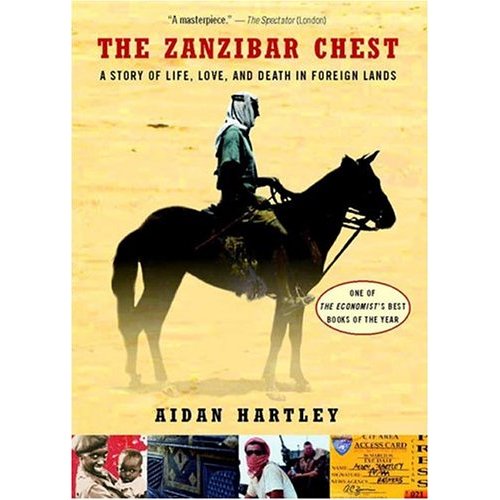
I started Zanzibar Chest in December, and could not get into it. It was interesting, but at first the tone was . . . I don’t know, maybe pompous? Something in the tone put me off, and yet I didn’t put it back on the bookshelves, nor did I give it away. It sat on my bed table while I attacked lesser works, more enjoyable fare. Then, one day, I just knew it was time to try it again, and this time, I could hardly put it down.
Born in Kenya, just before the rebellion, Aidan Hartley spent his life mostly in Africa. He skillfully interweaves three main story lines – the life of his mother and father, the life of his father’s best friend and his own life as a news correspondent.
This is not a joyful book. It is not inspirational. It is a tough, hard look at the people who cover the news, and the toll it takes on their lives. It is a story of drugs and alcohol to numb the pain of what they are observing, the comraderie of gallows humor and surviving the intensity of living through life-threatening moments together.
He covers some truly awful events. He covers the wars in Somalia, and in Rwanda. He covers Kosovo and Serbia. He is sent into some of the most dangerous and awful of places. He pays the price.
In his Zanzibar Chest, he takes us with him.
I will share a couple quotes with you, and if you are sensitive, please stop reading now. This book is not for you. It is almost not for me, except that sometimes I think we need to come face to face with just how awful reality can be to put our own lives right, to set appropriate priorities.
“I can’t put my finger on exactly how death smells. The stench of human putrefecation is different from that of all other animals. It moves us as instinctively as the cry of a newly born baby. It lies at one extreme end of the olfactory register. Blood from the injured and the dying smells coppery. After a cadaver’s a day old, you smell it before you see it. From the odor alone, I could tell how long a body had been dead and even, depending on whether brains or bowels had been opened up, where it had been hacked or shot. A body would quickly balloon up in the tropical heat, eyes and tongue swelling, flesh straining against clothes until the skin bursts and fluids spill from lesions. Flies would get in there and within three days the corpse might stink. It became a yellow mass of pupae cascading out of all orifices and the flesh literally undulated beneath the clothes. The tough bits of skin on the palms of their hands and the soles of their feet were the parts of the body that always rotted away last. As living people, these had been peasants who had walked without shoes and worked hard in the fields. A man who had been dead seven days reeks of boiling beans, guava fruit, glue, blown handkerchiefs, cloves and vinegar. After that he starts to dry out into a skeleton until he’s almost inoffensive . . .
The dead accompanied me long after Rwanda. It was months before I could order a plate of red meat served up in a restaurant. I smelled putrefaction in my mouth, or in my dirty socks, or as sweat on my body. I imagined what people I met would look like when dead. . . “
These guys all suffer from Post traumatic stress syndrome, they deaden themselves with drug and alcohol, and they are totally addicted to the adrenalin rush their job gives them. Living on adrenalin takes a huge toll – on their health, on their mental health, on their relationships, on their belief in goodness. They are the witnesses to the enormity of man’s inhumanity against one another.
In another quote, the author tells us:
“It was impossible for latecomers to comprehend the evil committed here but the British military top brass were still so scared of what their soldiers might see and what it would do to their minds that they sent a psychiatrist to accompany the forces to Rwanda. Bald Sam and I were amazed at that. We laughed about it. A shrink! It seemed extravagant. But the truth is that we stuck close to that man for days. We said it was all for a story, but really it was about us. The psychiatrist, whose name was Ian, told us his special area of interest was the minds of war correspondents. I could see Bald Sam squirming with happiness at all the attention, and I felt quite flattered myself. . . .
. . . for years I did endure some sort of payback. I have to try every day to prevent the poison that sits in my mind to spread outward and hurt the people I love. Sometimes I can’t stop it and I wonder if in some way the corruption will be passed on from me to my children.”
Toward the end of the book, the author tells us how hard it is to give up this adrenalin-news-junky life:
“Whenever I see a news headline to this day I half feel I should board the next flight into the heart of it. I’d love to get all charged up again and I could write the story with my eyes closed. I’m sure the sense that I’m missing out while others get in on a great story will never completely pass. . . The sight of people committing acts of unspeakable brutality against others fills a hole in some of us. The activity is made respectable by being paid a salary to do it, but there is a cost.”
This is not a book I really wanted to read, but it is a book I will never forget. Hartley doesn’t spare himself in the telling of this tale. He takes us with us and shows us all of it, and all of his own warts along with the tale. Would I recommend this book? Not for the sensitive, not for those who don’t want to look at the dark side. Between idyllic sequences on the beaches near Mombasa, in the hills of Kenya and Tanzania, in the dusty deserts of Yemen, there are some very intense and bloody moments. This is non-fiction, it is a documentary, it is a slice of the real life one man has seen, and that to which he has been witness. Read the book, and like him, you pay a price. You carry images in your head that you can’t forget, and a sorrow for our inability to solve our differences peaceably.
(Available in paperback from Amazon.com for $10.88. Disclosure: Yes, I own stock in Amazon.com.)
Dubai Rape Case Update (Two)
In another tiny little article, but high up on page 3 of the Kuwait Times is:
UAE Court Upholds Verdict in Rape Case
Dubai: An appeals court in the United Arab Emirates yesterday upheld 15 year jail terms handed down against two Emiratis convicted of raping a French-Swiss teenager, and AFP journalist said. The judge in Dubai took just a few seconds to announce his ruling after proceedings opened. The defense wanted the sentences pronounced on December 12 to be quashed, and a lawyer for the two men told AFP after Sunday’s ruling that a further appeal would be lodged with the supreme court. Prosecutors had demanded the maximum punishment, which could have meant the death penalty. A third defendant is being tried in a juvenile court. One of the men who raped the European teenager was HIV-positive, but has since been found to be clear of the sexually transmittable disease. The boy’s mother, Veronique Robert, launched a media campaign to publicize the case and gather support for her demand that the UAE recognize homosexual rape in its legal system and set up institutions to treat AIDs sufferers. She protested against the original verdict, saying that “15 years is nothing for someone who knew he had AIDs.”
Comment: Did you read this sentence?:
One of the men who raped the European teenager was HIV-positive, but has since been found to be clear of the sexually transmittable disease.
Can you tell me who has been found to be clear of the disease? One of the men? The teenager?
Comment 2: Bravo, UAE judges!
Corrupt Officials Beware
I don’t usually type out the whole article from the Kuwait Times, but because this one is so small, and buried way down on the page, I am making an exception and typing in the whole thing:
Responding to recent stories published by Al-Rai concerning alleged violations and corruption cases committed by ministers and MPs, HH the Prime Minister Sheikh Nassar Al-Mohammed noted that HH the Amir had instructed them to enforce the law to everybody. “And you can start with enforcing it on me,” the prime minister added.
Sheikh Nassar pointed out that the law would be enforced on everybody, be them (sic) (they) senior or minor officials. He added that he had instructed all concerned law-enforcement authorities to treat everyone equally with no exceptions at all.
Comment: WOOOO HOOOOOOOOO, HH Prime Minister Sheikh Nassar Al-Mohammed and BIG WOOOO HOOOOOOOOOOO to HH the Emir! If I knew how to make red letters, this would be a big RED letter day! WOOOOO HOOOOO law enforcement!
American Unipolarity
One of the top five articles e-mailed to others this week in the New York Times was this fascinating article called Waving Goodbye to Hegemony by PARAG KHANNA, published January 27.
It is 2016, and the Hillary Clinton or John McCain or Barack Obama administration is nearing the end of its second term. America has pulled out of Iraq but has about 20,000 troops in the independent state of Kurdistan, as well as warships anchored at Bahrain and an Air Force presence in Qatar. Afghanistan is stable; Iran is nuclear. China has absorbed Taiwan and is steadily increasing its naval presence around the Pacific Rim and, from the Pakistani port of Gwadar, on the Arabian Sea. The European Union has expanded to well over 30 members and has secure oil and gas flows from North Africa, Russia and the Caspian Sea, as well as substantial nuclear energy. America’s standing in the world remains in steady decline.
Why? Weren’t we supposed to reconnect with the United Nations and reaffirm to the world that America can, and should, lead it to collective security and prosperity? Indeed, improvements to America’s image may or may not occur, but either way, they mean little. Condoleezza Rice has said America has no “permanent enemies,” but it has no permanent friends either. Many saw the invasions of Afghanistan and Iraq as the symbols of a global American imperialism; in fact, they were signs of imperial overstretch. Every expenditure has weakened America’s armed forces, and each assertion of power has awakened resistance in the form of terrorist networks, insurgent groups and “asymmetric” weapons like suicide bombers. America’s unipolar moment has inspired diplomatic and financial countermovements to block American bullying and construct an alternate world order. That new global order has arrived, and there is precious little Clinton or McCain or Obama could do to resist its growth.
Its premise is that during the two terms of George Bush, American power has altered in ways he never anticipated. While he foresaw America leading the world into a peaceful place (like the Pax Romana), he never dreamed American power would unite friend and foe into powerful opposition. The author foresees a future – not that far off – where there are three major powers, the EEC, China, and the US in “a global, multicivilizational, multipolar battle.”
You can read the rest of this fascinating piece by clicking Here: Waving Goodbye to Hegemony
Hegemony
Here is what Wikipedia has to say about Hegemony:
Hegemony (pronounced [hə.ˈdʒe.mə.ni (Amer.), hɪ.ˈɡe.mə.ni (Brit.)])[1] (Greek: ἡγεμονία hēgemonía) is a concept that has been used to describe the existence of dominance of one social group over another, such that the ruling group—referred to as a hegemon—acquires some degree of consent from the subordinate, as opposed to dominance purely by force.[2] It is used broadly to mean any kind of dominance, and narrowly to refer to specifically cultural and non-military dominance, as opposed to the related notions of empire and suzerainty.
The processes by which a dominant culture maintains its dominant position: for example, the use of institutions to formalize power; the employment of a bureaucracy to make power seem abstract (and, therefore, not attached to any one individual); the inculcation of the populace in the ideals of the hegomonic group through education, advertising, publication, etc.; the mobilization of a police force as well as military personnel to subdue opposition.
If you want to learn more, you can read the complete article at Wikipedia on Hegemony.
270,000 KD for What?
I found this in today’s Kuwait Times. I think maybe I am out of touch . . . I haven’t heard of anyone sending or receiving a telegram for a long time. I don’t believe my husband’s office even uses a telex anymore? Am I missing something?
Kuwait Times: 20 January 2008
Telegram, Telex services
Kuwait: The Ministry of Communication is planning to create a new telegram and telex service system. The system will cost KD 270,000 and will be using modern equipment and up to date methods. A contract for creating the system was first given to a Bahraini company, but then the ministry decided to create the system themselves. The ministry will start working on creating the system two weeks from now.
Anyone? Anyone?
Recent Comments
ExpatAlien on What Country am I Living … intlxpatr on Yellowstone: Old Faithful to C… Michelle on Yellowstone: Old Faithful to C… Cathy on No Grown-Ups in Charge intlxpatr on Waiting for Snow Wikipedia Donate Button

Amazina


Early Voting in Florida


 Here There and Everywhere