New Territory: Pensacola Medicine
It’s payback time. Since AdventureMan and I retired, we have been trying to catch up with all the things we have left undone as we lived overseas. One of those things is catching up on medical work, you know, the preventive stuff.
One of the things I avoided in Qatar and Kuwait were any kind of procedures where something alien entered your body. There are good hospitals, and there are good doctors, but you have to know someone who can recommend them, and they they have to accept you as patients. My strategy was simply to stay well. I had a constant concern, about the cleanliness of the hospitals, about the conscientiousness of the people sterilizing medical equipment, about patient care, about credentials of those putting in IV’s – little things like that.
When I came to Pensacola, LOL, I had the same concerns. We have this illusion that everything is better in the USA, but we are only as good as our rules, and the enforcement of the rules, and when budgets are being cut, code enforcement can suffer. Who is checking on the cleanliness of the facility, etc. can be an issue here, too.
We ran into a couple of breaks. We have friends here, and we also have good advisory people. While our advisory people are not allowed to give specific recommendations, we had a long and lively chat with one and we asked, at the end, “if your Mom or Dad needed a good overall internist, who would you send them to?” and she paused and gave us a name.
The name was also on our short list of doctors we had looked up online. There are all kinds of places that comment on doctors, and this doctor has all A’s.
My visit with the doctor got me started on a lot of other appointments. The first visit, however, had a very funny moment. We were talking, generally, I thought, about weight, and he said “what do you think would be a good weight for you at this age” and I thought and said a number and HE WROTE IT DOWN. “Oh no!” I said. “Are you writing it down?”
“Yes.” he responded. “I agree, I think that is a good goal for you.”
GOAL??? I talk a lot about exercise and trying to lose weight, but now I am expected to meet a goal??? Oh, aaaarrrggghh. Me and my big mouth, why did I pick that number???
My Pensacola medical experience grew this week as I had a dreaded colonoscopy, something older people have to do as part of preventive maintenance. I totally hate colonoscopy preparation, and I also know that the same problems that happen in Qatar and Kuwait can happen here in Pensacola, so I was anxious the day of the procedure.
As I was pushed into the operating room by a young guy, I asked “who are you?” and he said he was the doctor. I interviewed him, asking about his certification, etc. and his record. He could see I was anxious.
Finally, I asked, in desperation, “are you Christian?” and he said “yes,” and then added “Would you like us to pray together before we start?” I was shocked. I paused, trying to deal with this new information – you are allowed to pray in the operating room?
“Yes,” I said, “please.”
They put hands on me and prayed for guidance during the procedure, and safety and a positive outcome. That is the last I remember, I felt so secure, and then I woke up and it was over. The outcome was positive.
There is no such thing as not allowing prayer in the schools or public places. People can pray wherever they want. The only thing forbidden is prayers where everyone is forced to pray together, the same words, words that may not express the same faith. We don’t all share the same beliefs, we don’t all pray in the same vocabularies. But we are free to pray, no one can stop the prayers of the heart.
Show Me the Money
Two themes came together, early this Sunday morning in Pensacola, first, as Father Harry spoke to us at Christ Church this morning on stewardship, and giving generously, and then later, as I was reading my Sunday Pensacola News Journal, an article on our elected officials, and their finances, their net worth and where their money is coming from.
Father Harry spoke about the rich man, at whose gate Lazarus begs, covered with sores, and then, at death, how the rich man asks God to send Lazarus to wet his lips, as he burns in the eternal hellfires, and Lazarus sits with God. He also asks God to send Lazarus to warn his rich family members that their choices, their lack of generosity, will have consequences, but God says (I paraphrase here) that Moses already told them, and earlier prophets, and that if the rich didn’t listen to them, they are not going to listen to Lazarus.
To me, it seems a given, that if you are blessed with plenty, then you have an obligation to help those who struggle. It isn’t necessarily money, it can be food, it can be time, it can be expertise, or – in my case – it can even be fabric. 🙂 We learn it in pre-school and kindergarten, don’t we? Share what you have, and everyone gets along.
It totally boggles my mind that many of our good friends, government and military people, have excellent health care under a highly socialized system – that’s what the military health care system is all about, we all have access to the same treatment. Many of the people who have access to medical treatment become rabid about supporting health care for those who don’t. Part of it seems to be “I earned it, and those lazy bums expect it for nothing.”
Most of my life, I’ve worked with ‘those lazy bums’ and have grown to have a lot of understanding and compassion for the circumstances that can make an entire family bone poor. Sometimes, it is poor choices – but how do people learn to make better choices without help? How do people aspire to more when they think that the ‘more’ is inaccessible to them?
The face of our nation changed after World War II when many more Americans gained access to higher education as a veteran’s benefit; prior to the GI Bill, higher education was only available to those comfortable people who could afford it.
Also in today’s Pensacola News Journal is an article about Study: Educating Women Saves Millions of Children which is an Associated Press Story about a study published this month in Lancet. “Educated women tend to use health services more and often make better choices on hygiene, nutrition and parenting,” the study (funded by the Bill and Melinda Gates Foundation) concludes.
And last, in the Pensacola News Journal, is an article that makes my heart sing, that makes me proud to live in a democracy, the article about how much our elected officials are worth, and where there money is coming from. I love it that we hold our leaders accountable, and that their wealth is (theoretically) transparent to us.
I’m a great advocate of wealth. I admire people who create wealth, who invest, who work hard for their money. The best of these people, and I mentioned Bill and Melinda Gates (above) for a reason, give back generously. Many people don’t start out rich, they start from little or nothing and build slowly slowly until they have reached a comfortable level. Sometimes, even in hard times, if you have built a strong foundation, that money just keeps multiplying, especially if it is invested with some diversity.
“It’s called the law of the harvest,” my Mormon friends told me when we were discussing how what you give comes back to you multiplied. It was so graphic, I’ve never forgotten it. There is nothing wrong with money. Money is just another tool, like a computer, or a hammer. It’s what you do with your money (tool) that makes the difference. Money is kind of like a seed, you plant and you harvest, but it is also like fertilizer – you spread it around, and amazing things happen.
Having money is a blessing, and giving it away is even more of a blessing. When you give, good things come back to you, multiplied. It’s the Law of the Harvest.
Guide to Giving to Beggers
I don’t see so many beggers in Pensacola, but I do see a lot of men sleeping rough; the warm temperate climate here attracts a lot of homeless. The churches provide hot breakfasts, sometimes, and there is a homeless shelter and long term transition facility downtown. Giving to beggers was a much bigger issue in Qatar and Kuwait, where the begging woman with the baby in the souks or the guy with the plastic bag full of urine and blood would accost me, and I always had half a feeling I was being scammed.
Today’s reading in Forward Day by Day puts it all in perspective:
THURSDAY, September 23
Luke 4:14-30. The Spirit of the Lord is upon me, because he has anointed me to bring good news to the poor.
Snow fell on me as I waited for a cab. A rumpled homeless man in a stocking cap and fingerless gloves asked me for money.
I like to know that anyone I give money to is worthy (which usually means working or actively looking for work) and I don’t want him spending the money on alcohol or drugs. So I donate through a church or community organization. Pastors usually encourage that kind of giving.
I gave the man twenty dollars because I’d just been to the ATM and had nothing smaller. He stared at me for a moment and stammered, “Ma’am? You meant to give me a dollar, didn’t you?” When I said no, he put his head back and began to yell, “Thaaaank you, Jesus!” over and over. He went to a nearby coffee shop and came out with a huge cookie and a cup of coffee, still singing out, “Thaaaank you, Jesus!”
What if a beggar misuses my money? That isn’t my business. Giving to a beggar is between me and God; what he does with the money is between the beggar and God. (2004)
Thank you, Jesus. 🙂
Why People Give
An urgent message came out today asking us to help the homeless people in Pensacola – and there are a lot of them, thanks to the warm climate. With all the rain recently, sleeping rough has been doubly rough, and it has been made worse by a sudden humidity-moisture related surge in the mosquito population.
As I talked with AdventureMan about our donation, he laughed. I was in fund-raising for a while, and was unexpectedly good at it. One thing I learned, there are a lot of ways to persuade people to donate, and then again, sometimes people will donate and you haven’t a clue as to why they felt this urge to be generous.
AdventureMan laughed; he totally got it. I used to work with a homeless, a long time ago, so I have a soft spot where they are concerned. Mosquitos also love me, and I get these horrid great but huge itchy bumps any time I am anywhere near a mosquito, AdventureMan always says he keeps me nearby because they head straight for me and ignore him.

Of course we donated. Wet homeless people and mosquitos, it was a golden combination. If you would like to donate, too, you can, through the EscaRosa Coalition on the Homeless (Working to Eliminate Homelessness). They will hold an Annual Fundraiser on Saturday September 11th from 7pm – 11pm at The Garden Center.
‘Some Just Like to Hate’
I am receiving hateful e-mails; e-mails claiming Barack Obama is really Muslim, and that Muslims are trying to take over America. Sometimes I wonder how well my friends really know me? Sometimes I wonder how well I know my friends, that they would be so nice and kind as I know them to be, and so rabid in their hate-filled beliefs?
When I found this article today in AOL News it comforted me . . . that this round of Anti-Islam is no where near so mindless and destructive as the hatred of the Catholics, of the Mormons, of the Jews. I can only hope that this too, shall pass.
I work at changing perceptions one person at a time. The most common question I get about living in Jordan, Tunisia, Saudi Arabia, Qatar and Kuwait is “Weren’t you scared?” and I laugh, and point out that the crime rate in Pensacola is much higher, and that the risks of my walking alone in any of those countries was much less than here.
I tell them about my time with women in those countries, the many kindnesses I received, the fun we had working and playing together. They know I am religious. It puzzles them that I can find being around people so different from me comfortable. I tell them how we share values, how being around religious women from Qatar is easier than being around non-believing American women. It’s the stories that make the difference. I can understand why Jesus spoke so often in metaphors. You have to find some way to explain that people can understand, some way they can visualize and connect to what may seem alien and strange.
Andrea Stone
Senior Washington Correspondent
WASHINGTON (Aug. 19) — Are Muslims the new Jews? Or Irish Catholics? Perhaps Mormons? Or are they really the war on terror’s Japanese?
Religious experts and historians say: all of the above.
The still-unfolding controversy over plans to build an Islamic center near ground zero is just the latest chapter in a long saga of religious and ethnic misunderstanding that experts say goes back to the nation’s earliest days.
Fear of foreigners dates to the Alien and Sedition Acts of 1798, which were aimed at French immigrants suspected of disloyalty, said American University historian Allan Lichtman. “Then it was the Irish, the Germans, and the Catholics, and the Jews,” he said. “These waves of xenophobia are as American as apple pie unfortunately.”
Despite the appeal of blaming the overheated rhetoric over the dispute in lower Manhattan on the still raw emotions left over from the Sept. 11 attacks, antipathy toward Muslims predates the furor around the proposed Park51 Islamic center.
A Gallup Poll conducted late last year found 43 percent of Americans admit to feeling some prejudice toward followers of Islam. That’s more than twice the number who feel that way about Christians, Jews or Buddhists.
Acts of vandalism against mosques are rising. Plans to build new ones sprout not-in-my-backyard protests and even calls to outlaw them. Muslim women complain that bans on head scarfs trample their religious rights. In Florida, congressional candidate Allen West, who has been endorsed by Sarah Palin, has said Islam is not a religion but “a totalitarian theocratic political ideology.”
Blogs such as Stop Islamization of America and Creeping Sharia have helped lay the foundation for the controversy. And the culture war promises to grow even hotter. A fundamentalist Christian pastor who describes Islam as “of the devil” has called for an “International Burn a Quran Day” to mark the ninth anniversary of 9/11 next month. A more mainstream minister, Franklin Graham, was booted from a prayer service at the Pentagon, where Muslim prayer is welcome, after he called Islam “evil.”
Yet is any of this new? While nearly one in five believe, incorrectly, that Barack Obama is a Muslim, this is not the first time a president has been suspected of lying about his religion. Anti-Semites and Nazi sympathizers spread false rumors in the 1930s that Franklin Delano Roosevelt, a mainline Episcopalian, was Jewish.
The latest debate reveals “the dark underbelly of the American psyche,” said Boston University religion professor Stephen Prothero, author of “God Is Not One: The Eight Rival Religions That Run the World–and Why Their Differences Matter.” “We keep imagining that we’ve outgrown our religious bigotry and we haven’t. It keeps getting tested for each new religious group.”
Everything old is new again
Scholars liken today’s Muslim bashing to similar episodes in American history. In the 19th century, the nativist Know-Nothing Party wanted to prevent immigrants, especially Irish Catholics, from coming to America. Prejudice against Mormons forced them to flee west to Utah. Anti-Semitism spawned lynchings as, of course, did racism.
In 1924, Congress clamped down on immigration from eastern and southern Europe — home to such “undesirables” as Italians and Jews — as well as all of Asia. And after the attack on Pearl Harbor, more than 110,000 Japanese-Americans living on the West Coast were forced into internment camps for the duration of World War II.
Today’s debate over the mosque “is very mild compared to some of these previous episodes,” said John Green, a University of Akron political scientist who studies religion and politics. He notes that religion, ethnicity and race are often conflated to produce a conflict between new groups and old groups.
“Each of these episodes has its unique circumstances,” he said, “but they appear to be most severe when the unpopular group is linked to national security and the definition of the nation. 9/11 is a good example and many of these episodes were associated with wars. Other were linked to other crises like state rights, civil rights, immigration and communism.”
Louise Cainkar, a Marquette University sociologist, sees similarities to anti-German sentiment during World War I and against the Japanese in World War II but says neither were as “strong or pervasive” as the feelings about Muslims. The only thing that comes close, she said, was the anti-Catholic movement of the 19th century that lingered in a less-virulent form until 1960, when presidential candidate John F. Kennedy had to affirm publicly that he would take no orders from the pope.
Religion and politics have often mixed in America, with uneven results. After 9/11, President George W. Bush rejected the formula that Islam equaled terrorism and spoke out loudly in favor of religious tolerance. In the current debate, political rhetoric has ranged from far right to moderate middle to wishy-washy to impassioned.
But Prothero was struck by two reactions “by politicians who should know better” — Senate Majority Leader Harry Reid and Republican presidential hopeful Mitt Romney. Both men oppose the proposed Islamic center in lower Manhattan and both are Mormons.
“It’s unconscionable and frankly shocking that any Mormon would speak on this issue the way Romney and Reid have spoken. Don’t they remember that the founder of their religion was assassinated by an anti-Mormon mob?” said Prothero, who also wrote “Religious Literacy: What Every American Needs to Know — And Doesn’t.”
Yet he said the men are typical of Americans who live in one of the most religious countries on earth but are “astonishingly ignorant” about religion. He noted that Imam Faisal Abdul Rauf, who heads the Cordoba Initiative behind the proposed Islamic center, is a Sufi. Sufism is a tolerant strain of Islam that Osama bin Laden and al-Qaida consider an infidel religion and whose shrine in Pakistan was recently the target of a double suicide bombing.
“I find the lack of memory frightening,” Prothero said. “This is a classic moment when it helps to remember something about American history – that our freedoms have been hard won.”
Muslims in America
Akbar Ahmed, chairman of the Islamic studies department at American University and a former Pakistani diplomat, visited 100 mosques in 75 cities over the last year for his new book, “Journey Into America: The Challenge of Islam.” What he found in interviews with Muslims and non-Muslims, native-born and immigrant, was a common feeling of being under siege from a faltering economy, natural disasters and two wars at a time when the first non-white president in history “has become a lightening rod for everything that is going on in America.”
But he said the controversy “is not just about one mosque, although that is a very special and sensitive one because of 9/11. It is much more.”
Ahmed said Muslims haven’t had the chance to go through “the process of Americanization that successive waves of immigrants” did before them.
When the Immigration Act of 1965 opened the door for the first time to people from Third World countries — many of them Muslims — the doctors, lawyers and engineers who came “flew straight into the American dream,” Ahmed said. “Nobody challenged them. They didn’t go through the century-long process that Italians and Jews did” to be accepted. But when 9/11 happened, “People said, ‘Who are these Muslims? We don’t know anything about them’ ” and some quickly equated the 19 hijackers with all Muslims in America.
“Some Muslims have been here five generations,” Ahmed said, “but today they are all under a cloud.”
Cainkar, author of “Homeland Insecurity: The Arab American and Muslim American Experience after 9/11,” noted that Arabs have lived in America for more than a century but anti-Arab feelings intensified only after the Six-Day War in 1967 and have since combined to inflame ill will toward Muslims. Today, she said, those speaking out against the proposed mosque are motivated by more than just religious beliefs.
“Some have foreign policy interests. Some think a strong America means controlling Muslim movements and countries. Some support Israel and so understand that to mean opposing Muslims. Some have a conservative view of American society and think it should be Euro-American. Some don’t like people of color. Some believe Jesus is our savior and other religions are false. Some just like to hate,” she said.
“It is not really about Muslims at all — they actually know very little about them.”
That Cheeky Woman at the Well
I love this story. I love all the stories about these women, who just won’t stay in their place. What was Jesus thinking? Why would he start a conversation with this woman, a woman not even married to the man with whom she is living? Listen to her tone, can’t you hear her words, barely bordering on mockery?
It doesn’t take long, and the women to whom Jesus speaks sees the light – that this man is something special, and has something special to offer her, even her, the most humble of the humble.
If I had never lived in the Middle East, I would never have understood the nuances of this story, how men just don’t speak to women, how speaking to this woman, not a Jew, a very unclean woman, could make him unclean, how taking anything from her, much less asking for a drink of water was just unthinkable.
Jesus turned it all upside down. He often did the unthinkable – working on the sabbath, speaking to women as if they were real people, talking about how it is what is in our hearts that matters more than looking good in public . . .
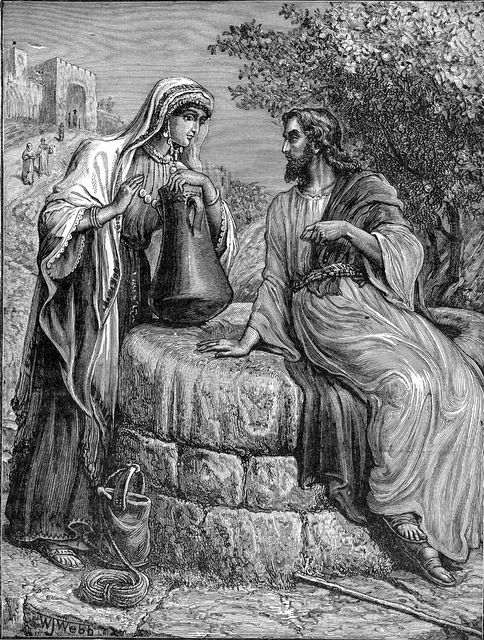
John 4:1-26
4Now when Jesus* learned that the Pharisees had heard, ‘Jesus is making and baptizing more disciples than John’— 2 although it was not Jesus himself but his disciples who baptized— 3he left Judea and started back to Galilee. 4But he had to go through Samaria. 5So he came to a Samaritan city called Sychar, near the plot of ground that Jacob had given to his son Joseph. 6Jacob’s well was there, and Jesus, tired out by his journey, was sitting by the well. It was about noon.
7 A Samaritan woman came to draw water, and Jesus said to her, ‘Give me a drink’. 8 (His disciples had gone to the city to buy food.)
9 The Samaritan woman said to him, ‘How is it that you, a Jew, ask a drink of me, a woman of Samaria?’ (Jews do not share things in common with Samaritans.)*
10 Jesus answered her, ‘If you knew the gift of God, and who it is that is saying to you, “Give me a drink”, you would have asked him, and he would have given you living water.’
11 The woman said to him, ‘Sir, you have no bucket, and the well is deep. Where do you get that living water? 12 Are you greater than our ancestor Jacob, who gave us the well, and with his sons and his flocks drank from it?’
13 Jesus said to her, ‘Everyone who drinks of this water will be thirsty again, 14but those who drink of the water that I will give them will never be thirsty. The water that I will give will become in them a spring of water gushing up to eternal life.’
15 The woman said to him, ‘Sir, give me this water, so that I may never be thirsty or have to keep coming here to draw water.’
16 Jesus said to her, ‘Go, call your husband, and come back.’
17 The woman answered him, ‘I have no husband.’ Jesus said to her, ‘You are right in saying, “I have no husband”; 18for you have had five husbands, and the one you have now is not your husband. What you have said is true!’
19 The woman said to him, ‘Sir, I see that you are a prophet. 20 Our ancestors worshipped on this mountain, but you* say that the place where people must worship is in Jerusalem.’
21 Jesus said to her, ‘Woman, believe me, the hour is coming when you will worship the Father neither on this mountain nor in Jerusalem. 22 You worship what you do not know; we worship what we know, for salvation is from the Jews. 23 But the hour is coming, and is now here, when the true worshippers will worship the Father in spirit and truth, for the Father seeks such as these to worship him. 24 God is spirit, and those who worship him must worship in spirit and truth.’
25 The woman said to him, ‘I know that Messiah is coming’ (who is called Christ). ‘When he comes, he will proclaim all things to us.’ 26 Jesus said to her, ‘I am he,* the one who is speaking to you.’
God Loves a Cheerful Giver
“So let each one give as he purposes in his heart, not grudgingly or of necessity; for God loves a cheerful giver” (2 Corinthians 9:7)
I’ve always thought of this verse as the secret to a wealthy life. Whatever you give, with open hands and open hearts, comes back to you multiplied. When you give cheerfully, gladly, you see the riches in your life, and you have the gift of a grateful heart.
Warren Buffett and Bill Gates know that money doesn’t buy happiness – but giving it away does. 🙂
From AOL Business Roundup
Billionaires To Donate Fortunes: The Sage of Omaha, Warren Buffett, said Wednesday he and 39 other of America’s wealthiest people have agreed to donate a bulk of their wealth to charity either during their lifetimes or upon their deaths. As DailyFinance’s Carrie Coolidge reports, the initiative, known as Giving Pledge, is a moral commitment to give, not a legal contract. “At its core, the Giving Pledge is about asking wealthy families to have important conversations about their wealth and how it will be used,” says Buffett, chairman and CEO of Berkshire Hathaway (BRK.A).
See full article from DailyFinance: http://srph.it/dxRFZx
God Puts Women in Responsible Positions
I like the discipline of reading the Lectionary every day, because there are some stories we all know, familiar stories, but reading every day, we learn the less familiar stories. The book of Judges is not a book I would turn to saying “Oh good! Today we are reading Judges!” but now that I am into it, I am coming across some gems.
Here, we have Deborah, a prophetess and judge, and Jael, a courageous and determined women, and oh, what a difference their faithfulness makes:
Judges 4:4-23
4 At that time Deborah, a prophetess, wife of Lappidoth, was judging Israel. 5She used to sit under the palm of Deborah between Ramah and Bethel in the hill country of Ephraim; and the Israelites came up to her for judgement. 6 She sent and summoned Barak son of Abinoam from Kedesh in Naphtali, and said to him, ‘The Lord, the God of Israel, commands you, “Go, take position at Mount Tabor, bringing ten thousand from the tribe of Naphtali and the tribe of Zebulun. 7 I will draw out Sisera, the general of Jabin’s army, to meet you by the Wadi Kishon with his chariots and his troops; and I will give him into your hand.” ’
8 Barak said to her, ‘If you will go with me, I will go; but if you will not go with me, I will not go.’
9 And she said, ‘I will surely go with you; nevertheless, the road on which you are going will not lead to your glory, for the Lord will sell Sisera into the hand of a woman.’ Then Deborah got up and went with Barak to Kedesh. 10 Barak summoned Zebulun and Naphtali to Kedesh; and ten thousand warriors went up behind him; and Deborah went up with him.
11 Now Heber the Kenite had separated from the other Kenites,* that is, the descendants of Hobab the father-in-law of Moses, and had encamped as far away as Elon-bezaanannim, which is near Kedesh.
12 When Sisera was told that Barak son of Abinoam had gone up to Mount Tabor, 13 Sisera called out all his chariots, nine hundred chariots of iron, and all the troops who were with him, from Harosheth-ha-goiim to the Wadi Kishon. 14 Then Deborah said to Barak, ‘Up! For this is the day on which the Lord has given Sisera into your hand. The Lord is indeed going out before you.’ So Barak went down from Mount Tabor with ten thousand warriors following him. 15 And the Lord threw Sisera and all his chariots and all his army into a panic* before Barak; Sisera got down from his chariot and fled away on foot, 16 while Barak pursued the chariots and the army to Harosheth-ha-goiim. All the army of Sisera fell by the sword; no one was left.
17 Now Sisera had fled away on foot to the tent of Jael wife of Heber the Kenite; for there was peace between King Jabin of Hazor and the clan of Heber the Kenite. 18 Jael came out to meet Sisera, and said to him, ‘Turn aside, my lord, turn aside to me; have no fear.’ So he turned aside to her into the tent, and she covered him with a rug. 19 Then he said to her, ‘Please give me a little water to drink; for I am thirsty.’ So she opened a skin of milk and gave him a drink and covered him. 20 He said to her, ‘Stand at the entrance of the tent, and if anybody comes and asks you, “Is anyone here?” say, “No.” ’
21 But Jael wife of Heber took a tent-peg, and took a hammer in her hand, and went softly to him and drove the peg into his temple, until it went down into the ground—he was lying fast asleep from weariness—and he died. 22 Then, as Barak came in pursuit of Sisera, Jael went out to meet him, and said to him, ‘Come, and I will show you the man whom you are seeking.’ So he went into her tent; and there was Sisera lying dead, with the tent-peg in his temple.
23 So on that day God subdued King Jabin of Canaan before the Israelites.
Christ-Church-in-the-Gym
Today, with ample notification, the congregation met over in the Episcopal Day School Gym, while the air conditioning in the main cathedral and office buildings is being replaced. We sat on folding chairs, shoulder to shoulder, and we didn’t have kneelers.
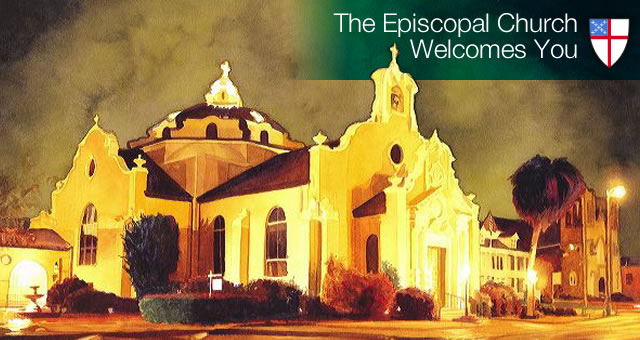
Except for the congregation not being 1/3 Indian and 1/3 African and 1/3 all-the-rest-of-us, I would have thought I was back in Doha. 🙂 We sing the same music, follow the same liturgy – it is such a comfort, just about anywhere in the world we go, most of what we do follows the same pattern. Fellowship was held in the back of the gym, just like Doha. I’m beginning to know a few faces, and we nod a little (after all, we are Episcopalians) and I am happy our son and his wife also know a few people so worship feels more like family. Our little grandson loves the baby-care; they take such good care of him.
We have learned to live with – even adapt to – the differences wherever we might go. Some places, it’s all “smells and bells” i.e. incense, bells, high church formality. Some places it’s more evangelical, “new” music and hands in the air. Christ Church in Pensacola is old school, liturgical, but without the smells and bells. The sermons are down to earth and applicable.
The sermon today was on just that – keeping our mind on the substance of what we believe, and letting the stylistic differences go. Amen to that.
The Not-to-Do List
I love this meditation from Rick Warren, who sends these out daily from his Purpose Driven Life connection. I was at dinner last night with three well-connected (2 i-Phones, one something else) family members, and I remember thinking (with a grin) that we spent the entire dinner in conversation, and no one was occupied with their phone.
Choosing a simpler life
by Rick Warren
. . . a time to embrace and a time to refrain. Ecclesiastes 3:5 (NIV)
You’d think that living in Southern California means I’m surrounded by people who live a laid-back lifestyle. The truth is just the opposite: Most of the people I know are trying to cram more and more into each day.
For instance, a couple of years ago, I was with a group of friends driving down the interstate. At one point, I looked around and realized most of us were engaged in some activity other than talking to each other. Two people were on their cell phones; another was working on his BlackBerry; and a fourth was focused on his laptop computer.
As a joke, I declared I felt left out. I called the driver, who was sitting right next to me, and we chatted together on our cell phones for a few minutes! The point of our traveling together in the van was so we could grab time to talk face-to-face! Yet we felt pressed to get it all done.
That’s when I realized the truth – we couldn’t get it all done, and God never intended for us to make completing a to-do list the purpose of our lives.
The fact is, there are many things we think we must do that really are not worth doing. My point is this: You won’t simplify your life by getting an electronic organizer. You won’t even find it by convincing your neighbor, who makes Martha Stewart look like a sloth, to give you tips about coordinating your activities while still wearing a perfect dress and pearls like Beaver Cleaver’s mom.
Simplifying is really about choices – prioritizing what is important – and then sticking to those choices no matter how tempting it is to add more to your to-do list. In fact, take those tempting activities and put them on a list of things not to do.
You are the only one who can assume responsibility for your time and clarify what’s really important to you.
Now maybe you’re thinking, “But I have to take care of the kids,” or “I have to get this report done by Friday.” I’m not naïve about the pressures many people feel today, but it may be that those things – your children, your work – are the priorities you keep on your to-do list, and you move other things to the not-to-do list.
Recent Comments
intlxpatr on Shampoo Ginger tigerbutterya0c5ff1d… on Shampoo Ginger intlxpatr on British Soldier Kidnapped, Esc… John on British Soldier Kidnapped, Esc… intlxpatr on British Soldier Kidnapped, Esc… Wikipedia Donate Button

Amazina


Early Voting in Florida


