January 6 The Feast of Epiphany
I have always loved Epiphany. The vision of the three wise men riding on camels, following a star to find a baby in a manger delights my soul. There is a flip side, of course, as the wicked King Herod sends his soldiers to kill all the male children under two years old, and the Christ child, whose parents Mary and Joseph are warned by an angel, have miraculously escaped to hide in Egypt.
Friday, in church, I learned something I had never known before: The Feast of the Epiphany was traditionally the second most important celebration in the church year, just after Easter. I had always assumed it was Christmas. I was wrong!
Not only is Christmas not the second most important, it is also not the third most important – that is, if I remember what Father Andy said, the Assumption. He said that we didn’t begin to celebrate the birth of the child in Bethleham, as a church, until around the 4th century.
Here is the story, in one of our readings for today:
Matthew 2:1-12
2In the time of King Herod, after Jesus was born in Bethlehem of Judea, wise men* from the East came to Jerusalem, 2asking, ‘Where is the child who has been born king of the Jews? For we observed his star at its rising,* and have come to pay him homage.’ 3When King Herod heard this, he was frightened, and all Jerusalem with him; 4and calling together all the chief priests and scribes of the people, he inquired of them where the Messiah* was to be born. 5They told him, ‘In Bethlehem of Judea; for so it has been written by the prophet:
6“And you, Bethlehem, in the land of Judah,
are by no means least among the rulers of Judah;
for from you shall come a ruler
who is to shepherd* my people Israel.” ’
7 Then Herod secretly called for the wise men* and learned from them the exact time when the star had appeared. 8Then he sent them to Bethlehem, saying, ‘Go and search diligently for the child; and when you have found him, bring me word so that I may also go and pay him homage.’ 9When they had heard the king, they set out; and there, ahead of them, went the star that they had seen at its rising,* until it stopped over the place where the child was. 10When they saw that the star had stopped,* they were overwhelmed with joy. 11On entering the house, they saw the child with Mary his mother; and they knelt down and paid him homage. Then, opening their treasure-chests, they offered him gifts of gold, frankincense, and myrrh. 12And having been warned in a dream not to return to Herod, they left for their own country by another road.

Wait Five Minutes
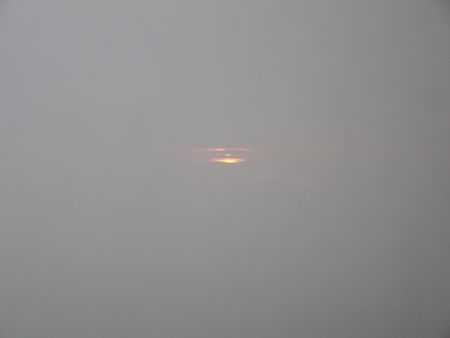
When I first looked out the window this morning, you couldn’t see a thing. Looking closely, you could see a tiny glow where the streetlights are, but nothing else. The fog had rolled in.
Five minutes later, you could see the shoreline.
Now, there is still a thick fog, but you can see through it.
I didn’t have any hope for a good sunrise this morning, but I was pleasantly surprised. I had a gleam of sunshine about 7:30:
Five minutes later:
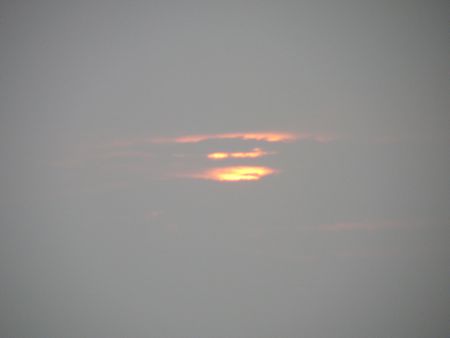
And five minutes later:
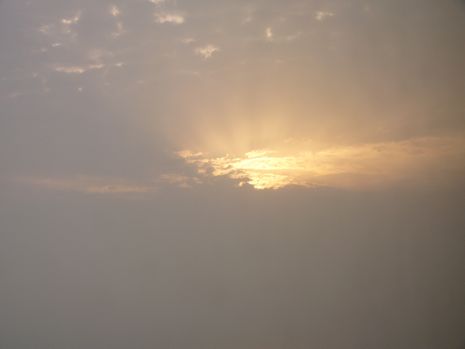
And in my head, I hear the ineffable strains of Break Forth, Oh Beauteous Heavenly Light, which when I went to U-Tube, I found this wonderful version by the Florida Agricultural and Mining University, beautifully done with another appropriate hymn, Deo Gratias, or, as we say in Arabic, Thanks Be to God!
The Great Migration (3)
Our trip started at the Grumeti River Camp and continued on the the Serengeti Tent Camps. We have filled our eyes and ears with the sights and sounds of the Great Migration, and have had the thrills of elephants, giraffes, lions, hyenas, alligators and vultures in addition. Now it is time to head north, to the Klein’s Wilderness Camp, located near Klein’s Wilderness Lodge.
The “airport” at Serengeti, from where we are flying, is a busy little place with one open-to-the-air little cafe and a toilet down a path with two stalls. It’s the bring-your-own paper kind of place, but it’s nice there is that convenience. The landing strip itself is just a cleared piece of ground where the little two engine planes land and take off.

Our flight is larger than most we have taken, maybe 20-something people, most on the way home or to Zanzibar. First, they are dropping us off at Kleins, a short flight away. The landing field at Klein’s has a little antelope running across it when we get there, so the pilot circles and lands on the lush green landing strip. There is no one there. We wait, it is inevitable that a car come roaring around the curve any moment now, but no car comes. The pilot comes on the microphone and asks who the passengers are for Klein’s, and we raise our hands.
“I can’t leave you here,” he says.
We totally understand. There are lions around. This is a wild country.
“I have to take you to Arusha with us,” he says, “and I will bring you back on the next flight.”
I am not entirely unhappy. In the tiny little airport in Arusha, I found a vendor who is selling Masai textiles and raw gems at very good prices. He is Moslem, and astounded that I speak some Arabic. When I come back to his shop, he is delighted to see me again. (or maybe I paid too much the first time, ya think?)
I pick up a few more momentos, and head back for the airline departure desk, where there is a very loud argument going on over the telephone about who is to blame about our not being picked up at Klein’s Wilderness Camp. The Camp says the airlines never told them. The airlines say they did. It’s on our itinerary, which we have had for months, and we landed exactly when they said we would, but in Africa, you have to stay flexible, flight schedules change depending on where customers need to be dropped off. It doesn’t pay to get angry or aggressive, you learn to just go with the flow. Things will work out.
A short time later, the pilot takes us to the plane for the flight back, and whoa! We fly right over an active volcano!

This time, when we get to Klein’s, a car is waiting and the arguement between Klein’s and the airlines continues. On the way to Klein’s, we are told that they were never told when we would be arriving.
Don’t you hate it when people refuse to take any responsibility? The airlines treated us so well, the pilot said he didn’t think it was their fault but he went out of his way to make sure we felt well taken care of. This is the only time at CCAfrica that we felt the camp was not well managed, and part of that feeling came from this continual message of “it’s not our fault.” We later learned that the previous camp manager had just been fired and a new manager was starting, and there was a lot of work going on to try to get the camp back on track.
This was another beautiful location, we were high up and could see forever.
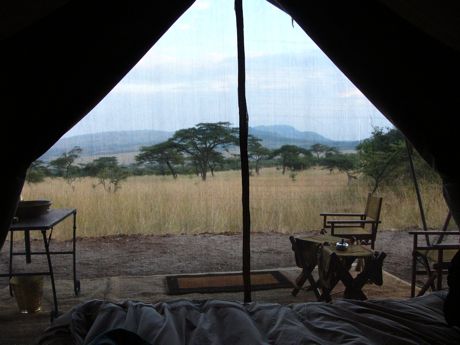
Sometimes, in the mornings, or in the late afternoon, the migrating antelope came through the camp. We could sit outside and just watch them file past.
Most of our days in this camp, we would leave early in the morning, have lunch with us so we would stop somewhere in the park, and not get back until late at night. These are the vehicles we travelled in, stopped for a break
 :
:
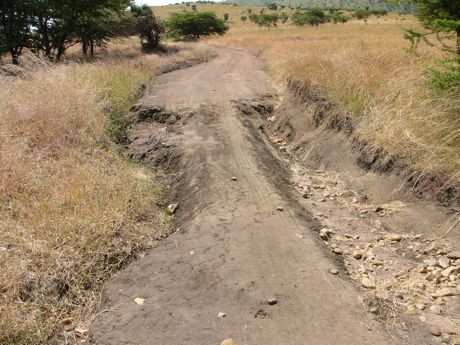
Some of the roads were barely there, were pitted, or rutted, or were raw rock:
We spent hours watching the zebra herds, and the shy antelope:
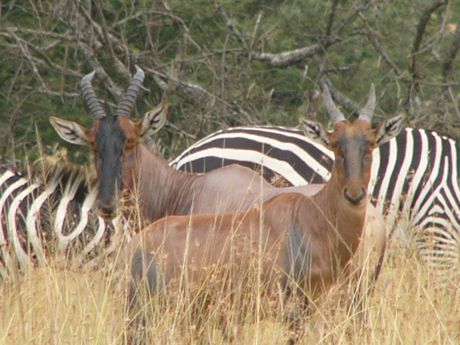
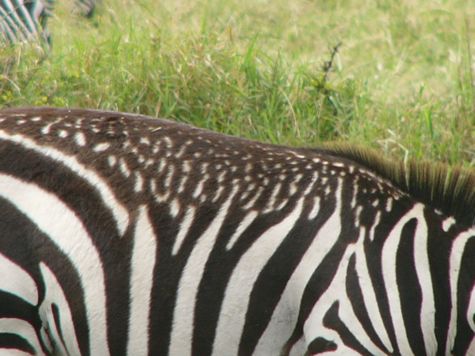
“How can you spend hours watching zebra?” you might ask. Every zebra is different. It’s particularly fun watching female zebra with their young. When they are born, the momma zebra insures that her little baby zebra sees only her coat for the first important hours of it’s life, so that the baby can recognize the momma zebra’s own unique markings:
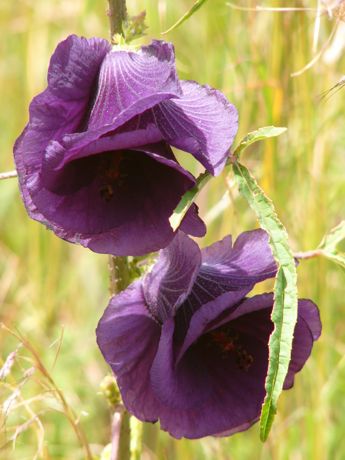
But there were other thrills as well. The nice thing about travelling in a very small group (most of the time just AdventureMan and I and the guide) was that you can ask them to stop while you photograph a beautiful purple flower:
And if you see a leopard, you can just sit and watch him as long as you like:
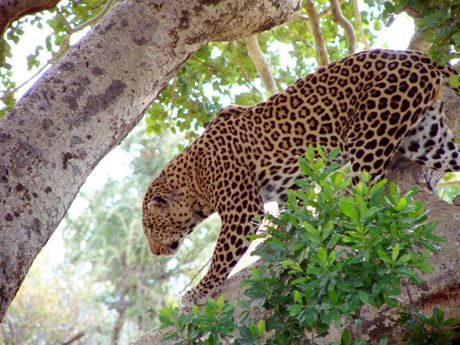
We rarely ran into others from the camps, but this Masai was accompanying another group:

Among the thrills in this more northern camp were also the glorious birds. This is one of our favorites, a Lilac Breasted Roller:
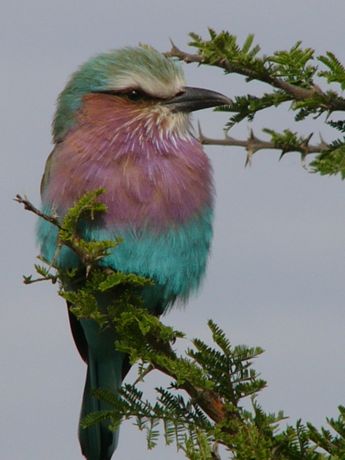
I’m not sure what this bird is, probably a common starling. His fluorescent coloring attracted my eye. AdventureMan says that the fluorescent coloring happens a lot in birds which eat excrement, but he is not sure that is true, just what he thinks he remembers:

We love travelling with CCAfrica. They specialize in eco-tourism, like the Robin Pope Safari Camps we travel with in Zambia. Our all time favorite safari with them was The Hemingway, a 14 day safari through Botswana, starting in Zimbabwe at Victoria Falls, heading south to Chobe and Moremi, Savute, the Okavango and then flying into the Kalahari. It was an all-time thrill. If January is a little slow for you and you want to read about the Hemingway Safari you can click on that blue type and it will take you to the first entry – of thirteen! I wrote it up back when I was first blogging, sort of as a discipline for myself to get it all down in writing. There aren’t a lot of photos – I wasn’t digital then – but it is a very thorough description of a trip-of-a-lifetime safari.
Even though they don’t seem to offer this particular safari anymore, CCAfrica will tailor any safari you want to your specifications. What we loved about the Hemingway was that so much of it was under canvas, so we would be sleeping right out among the animals – and listening all night.
A warning – none of these safaris are for people who HATE getting up early. The game is active in early early morning and late afternoon, so most camps get you up at 5:30 – 6:00 so you can grab a quick cup of coffee and bite to eat and then run for the jeeps/vehicles that will take you out to see the game. It can be very cold on an early morning game run, but oh – the thrills! It is SO worth it! You come back late morning, have your mid-day meal, which in these camps is always amazing, and then you have quiet time in the heat of the afternoon, when you can catch up on those zzZZZZZZZzzzzz’s you missed out on in the early morning. You wake up refreshed, ready for afternoon tea and your afternoon/evening game drive. They feed you and feed you – but we never gain weight on these trips, maybe because you are rocking around over the rough roads all day.
And, when the trip is over, and you are ready for a few days of sloth and luxury before you return to the real world, there is no better spot for transitioning than the CCAfrica private island hideaway of Mnemba, a place we dream about on a cloudy dark day in Kuwait:

That is Mnemba island in the background, viewed from the beach in Zanzibar. You take a boat to get there, and when you land, you land barefoot. You never put your shoes on the entire time you are there. It is beautiful, secluded, luxurious and infinitely private. You can have all your meals in your own banda, if you wish. They have their own marine reserve, a dive shop, snorkeling equipment and it is all included. They even have internet. 🙂
View from our Mnemba banda:

Christmas in Kuwait
There are Christmas trees in Kuwait, in the malls, in the stores, and Santa and his reindeer are everywhere. I can remember other Christmases – in Saudi Arabia, in Jordan, in Tunisia, in Qatar – when you never knew if this was a year when Christmas would be allowed or not.
For my family and friends not in Kuwait, you would be amazed what you can find here. I am just showing a tiny bit of what you can find these days in Kuwait:


Mom’s Rosemary Tree
One of my philosophies – no, no, don’t run away, this isn’t all that deep – is that things have a way of working out. No matter how too horrible everything can get, things work out, this passes, and in today’s hurried, bustling, transitory world, even the worst events fall into oblivion much of the time.
Mom phoned with a request – Lowe’s was having a sale on Rosemary trees, only $8.97, could we get one for her? She likes to have a sweet smelling Rosemary tree outside on her balcony. We went to Lowe’s immediately, first thing in the morning, and . . . they were already gone! There were more expensive ones – like double the price – but all the on-sale ones were already gone. Honestly, there must not have been very many to start with.
(You are probably asking why I didn’t just go ahead and buy it for her anyway. It’s not allowed. She gives her daughters envelopes of money and when we buy things for her that she has asked for, we have to pay from out of that envelope, or she won’t ask us anymore; it’s a matter of pride.)
From that day on, I kept an eye out for Rosemary trees (just maybe 16″ high), Home Depot, Fred Meyer, some of the larger local floral shops – nothing, or double what she wanted to pay.
Then, on my very last day in Seattle, I took Mom to Trader Joe’s. We all like Trader Joe’s, who carried foods and candies and cookies and wines that other more conventional grocers don’t carry. Mom needed to stock up for all her Christmas guests and Christmas entertaining. And there – for only $8.64, not even on sale, was the perfect Rosemary tree. It smelled divine. Here it is, safe in Mom’s basket:

Candle Lights
One last photo from my trip to Seattle. I love Christmas light, and this one was SO creative! They must have used several hundred lights to create this candle, the full size of their house:
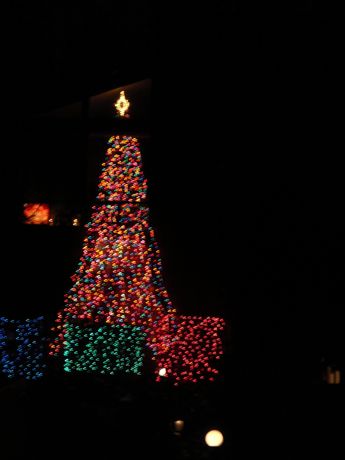
Magnificent Concert
There isn’t much I ask of AdventureMan, he is busy supporting us and feathering our nest for retirement. When I ask, he is such a sweetie. I had asked about last night – there was a very special concert I wanted to hear. He took me, even though he had an early flight out this morning and hadn’t packed, hadn’t even picked up his shirts from the cleaners.
It was so totally worth it.
The Al Ahmadi singers did their “Holiday” concert at the SAS/ Al Hashemi Ballroom. It was wonderul, and moving, and a great way to get into the spirit of the Christmas season. I love that ballroom, it has so much character, even though the outer reception area smells a little moldy – what can you expect, right on the sea like that? The place is clean, and has an amazingly elegant feel, with it’s fabulously intricate wood parquet floors, it’s ship-light inspired chandeliers, it’s coffered ceilings, it’s heavy wood staircases to the upper deck/balcony. It has a great ambience.
Thanks be to God, in Kuwait, the Al Ahmadi singers can even sing excerpts from The Messiah, have readings about the meaning of Christmas, and celebrate the birth of the tiny baby Jesus. Can you see my great big grin? Even the memory makes me happy.
The orchestra supporting the chorus, under the direction of Joanna Kowalla, was also amazing. Very very good. Lucky Al Ahmadi singers, with such a great director, Richard L. Bushman. The soprano soloist, Vernica Grmusa, took our breath away with her excellence. The alto soloist, Jessica Olson, had a couple of really fun numbers, composed by the concert conductor’s wife, Harriet Petherick Bushman.
It was just the evening I needed, exquisite music, performed with spirit and excellence, in an atmosphere of joy. It was a total wow.
Just a couple reminders to people who may not have a lot of experience with attending concerts:
1) Turn off your cell phone. It is selfish and rude for you to be talking on your phone. I don’t care if your friend is lost, I don’t care. The conductor is making the SECOND announcement now about turning off cell phones; he means YOU. Everyone around you is glaring – can’t you see? Turn off your cell phone.
2) If you are late, and if they allow you in anyway (in most places you have to wait until an intermission or pause) enter discretely and find seats quickly and SIT DOWN. The key word here is discrete. Most of us are excited about the concert and eager to hear the music. Your grand entrance is lost on us. We don’t care how good you look, we just want you to sit down. Waving to all your friends, attracting attention to yourself makes us want to kill something – watch out. It might be YOU.
In spite of my complaints, above, the concert was so overwhelmingly good that even these minor rudenesses didn’t spoil the overall joy of an evening particularly well spent. Bravo, Brava, Al Ahmadi Singers, orchestra and soloists!
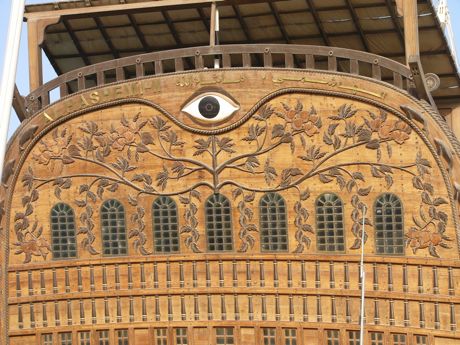
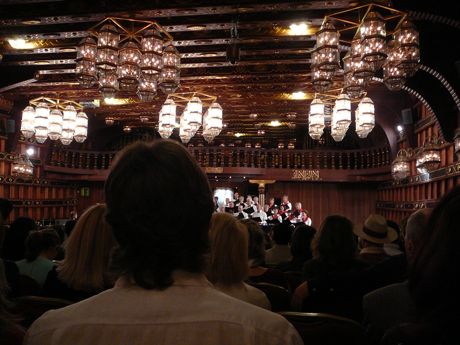
Band of Boats
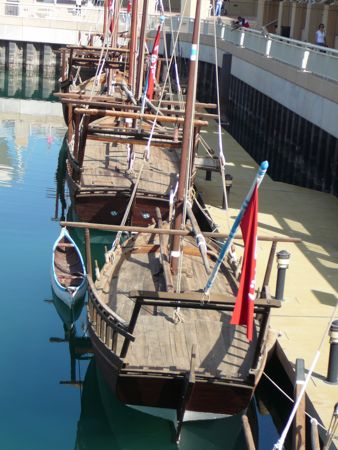
It must depend on when the fish are running; there is a band of boats a few hundred yards off shore, the shuw’i , the old fashioned kind of fishing boats. Late in the afternoon, they are easier to see than in the morning, where the haze obscures them. Best of all, early in the morning, before the sun rises, they form a necklace of bobbing, flickering lights, and, for some reason, it makes me feel warm and secure to see them out there.
(Some things don’t have to be rational, they just are what they are.)
The description of the shuw’i at the Science Museum along the Corniche:
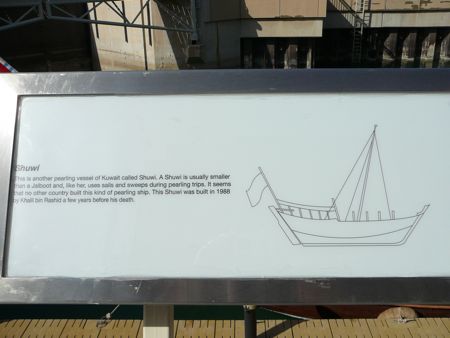
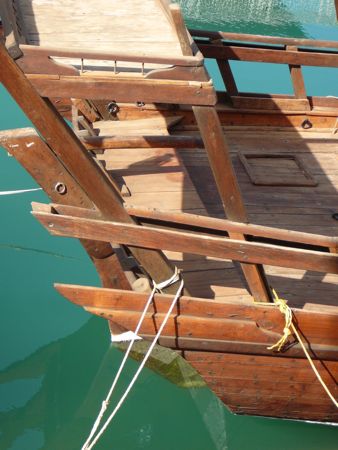
While the weather is so perfect for walking, and for being outdoors, visit the Science museum on the Corniche. The old boat exhibit outside is totally FREE, and a fabulous peek into Kuwait’s past, which, every morning and night, I am reminded, carries on to the future – the historic shuw’i are still in use, as are the larger jalboot.
Big Diamond’s Bat-about
Oh Big Diamond, you can’t imagine. You have an eye for the very best gifts.

I’m sorry the shot is not clear. We can’t get the Qatteri Cat to stay still when he has the bat-about toy. This was the best of all the photos – most, the bat-about disappeared just as I was shooting. *dying laughing* He loved it from the minute it came out of the suitcase.
When we all woke up – around 3 this morning, it was the first thing the Qatteri Cat went for, even before his food. He loves the bat-about, and AdventureMan and I are rolling with laughter, watching him play with it. It is great exercise, and such fun for him – and for us.
It is one of the BEST Christmas gifts ever. Thank you!
Starbuck’s Holiday
Waiting in line to order some coffee, I saw these on a bottom shelf. I haven’t seen these in any of the other Starbuck’s. I think they need to do an Eid Mubarak mug and special coffee, don’t you?

Recent Comments
Kitchen on Isiais: Winding Down intlxpatr on Shampoo Ginger tigerbutterya0c5ff1d… on Shampoo Ginger intlxpatr on British Soldier Kidnapped, Esc… John on British Soldier Kidnapped, Esc… Wikipedia Donate Button

Amazina


Early Voting in Florida


