“Arab Education Falling Behind”
In a study recently released, the World Bank reports that education in the Arab World is falling behind. You can read the entire article HERE at BBC Middle East News:
The World Bank has said the quality of education in the Arab World is falling behind other regions and needs urgent reform if it is to tackle unemployment.
In a report, Bank officials said Arab states had to make improving education their top priority, because it went hand-in-hand with economic development.
The region had not seen the increasing literacy and school enrolment witnessed in Asia and Latin America, they said.
Djibouti, Yemen, Iraq and Morocco were ranked the worst educational reformers.
The bright spot? Here is one of the concluding paragraphs:
The report concluded that Jordan and Kuwait were the top educational reformers in the region, while Djibouti, Yemen, Iraq and Morocco ranked lowest in terms of access, efficiency and quality of education.
(An editorial Wooooo Hooooooo to Kuwait!)
New Fatwa; Sabeeh set to survive
In today’s Friday Kuwait Times (it’s not online today, so I can’t reference it directly) is an article by B Izzak stating Sabeeh set to survive vote.
It’s a very interesting article, telling how some of the key players are lining up.
In paragraph five, we find this:
In a related development, MP Duaij Al-Shimmari, a member of the Islamic Constitutional Movement (ICM), or Muslim Brotherhood, yesterday distributed a Fatwa (or religious edict) which clearly supports women being appointed as ministers.
Duaij said he received te Fatwa from Sheikh Ajeel Al-Nashmi, a highly respected cleric, which said that a minister’s post is allowed by Islam for women and thus supporting the no-confidence vote against Sabeeh or opposing it should entirely depend on her replies and not on her being a woman.
Wooo Hooooooooo! Equality means just that – judge women, as men, on the issues and their performance. Hold them accountable – just as you would a man.
Favoring Co-ed Schools
Fascinating defense of integrated classrooms in today’s Arab Times, entitled Students Will Be Made More Comfortable under Co-ed written by Kuwait University student Dalal Nasser Al-Otaibi.
I learned how American Universities became co-ed, and why. (I had no idea; you grow up thinking these things are a given.) This article must have been used as a paper for a class, as it is well documented, cites sources, etc.
Walking Old Damascus (3)
I can never get enough of Old Damascus, but for those of you who are bored already, I will only do one more after this one. And my friends, I am only skimming the surface – Damascus can keep you busy and happy for a long time. Along one of our favorite streets, Al Qamariyya, we saw a sign that said Calligraphy and Lute instruction, and we looked at each other with a grin – we could be happy for weeks learning lute and calligraphy!
We had met up with an old friend who loves Damascus as we do, and he suggested a walk OUTSIDE the walls, from Bab Thouma (Thomas’ gate) to the Bab Es Salaam, which we did. The Bab Thouma is only a five minute walk from our hotel, straight up al Hijari, crossing Street Called Straight where it becomes Sharia Bab Thouma – how easy can it be?
The walk along the northern outside walls in this section is spectacular. For one thing, look at the differing levels of construction in this, one of the remaining walls of Old Damascus:


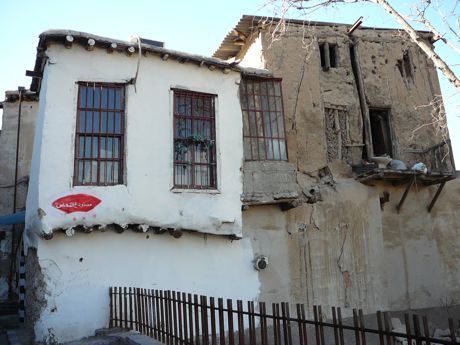
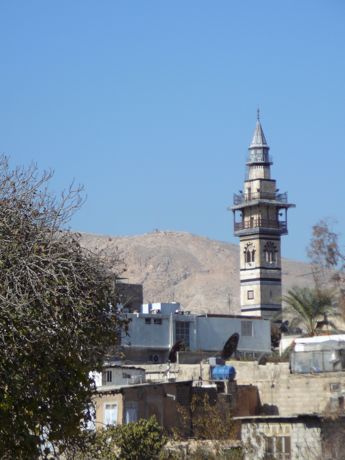
From outside the northern wall, looking north toward the mountains:
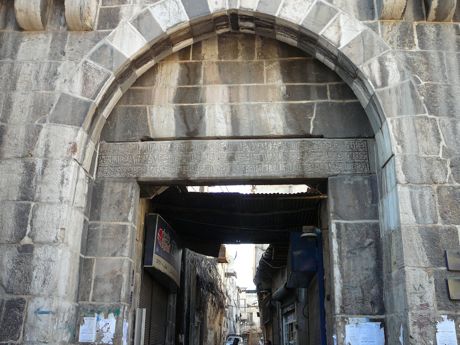
Then you come to the Gate of Peace/ Bab es Salaam:
There is a whirl of reconstruction going on in the old city. Some fear modernizations which will change the character of the old town, but others say that the restrictions won’t allow that to happen – we shall see:


Here is what we love – in every country, you will find volunteer supervisors where construction or reconstruction are going on:

One of the highlights of our trip was a visit to Ananias’ chapel. This is not the actual spot where Ananias baptized Paul, a mosque has been built over that site (It is called the Jakmak Mosque and you can see it in the long covered souk at the beginning of the Street Called Straight) but this is the church/chapel which commemorates that baptism, and it is very beautiful.
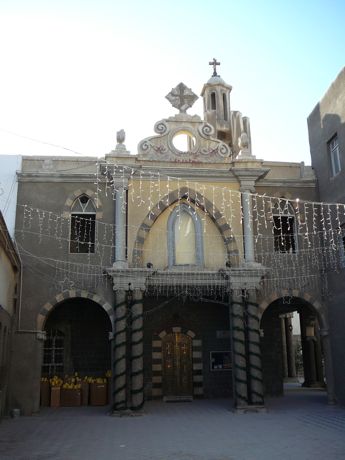

Time for a cup of coffee, and to plan the next walking expedition, and we find this wonderful cafe next to the church at Bab Sharqi:

We think there is a museum for the Hijaz Railway, which fascinates AdventureMan, but this is all we can find:

At our friend’s recommendation, we also try the Old Town restaurant, and we like it so much we go there twice:
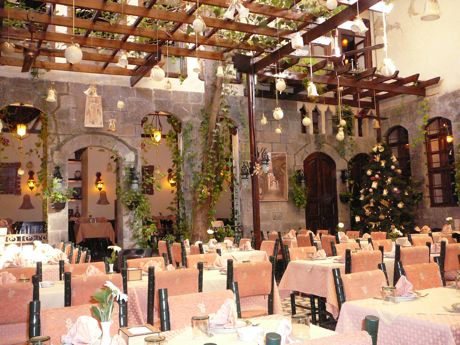
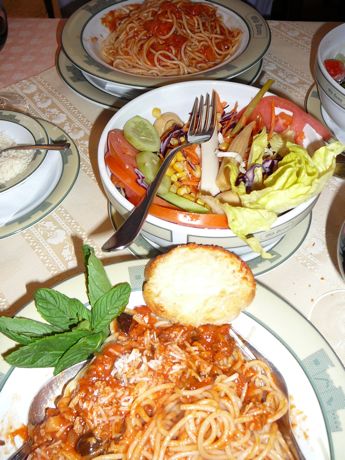
Nice to have some pasta for a change, and the pasta here is really good!
Interesting old balcony:

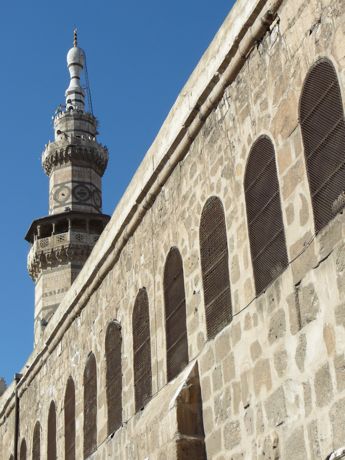
I keep looking for the Issa/Jesus spire of the Umayyad mosque, and I think this might be it, but I am not sure. Legend has it that this is where Jesus will prevail over the forces of darkness and evil on the Last Day.
We are told you MUST make a stop at Leila’s, near the Ummayad Mosque, near the Hamadiyya Souks, and so we do. It is very conveniently located when you are shopping for visiting the mosque:
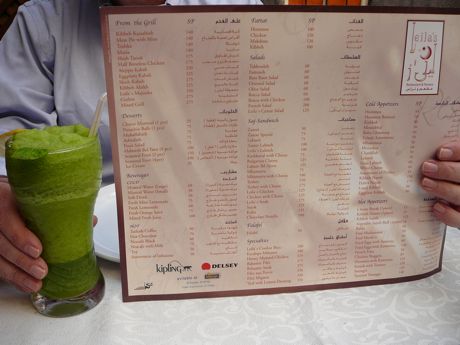
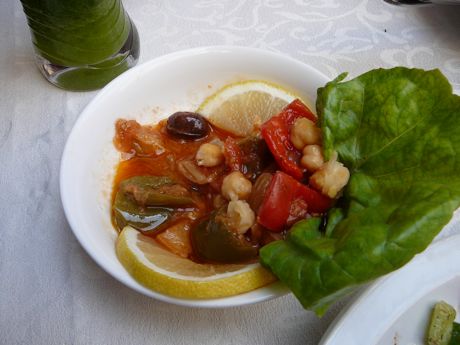
They had a Baba Ghannoush there unlike any I have had before, but very much like something we used to eat in Tunisia, called mechoia – grilled eggplant and peppers and garlic, with a very smokey taste. Yummmmy!
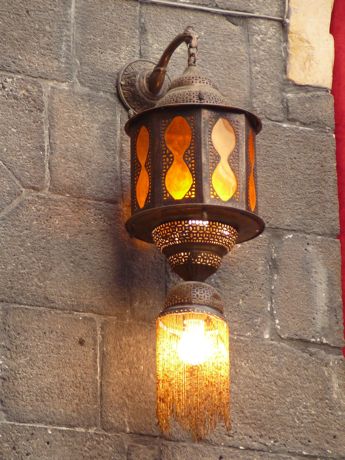
You know me and light fixtures – this is one of the Leila lamps:
Tomorrow I will take you to our absolute favorite restaurant in Damascus, and finish up the trip, I promise, as much as I hate to leave!
(Happy Islamic New Year!)
Salary Belongs to Husband?
Muna al-Fuzai had a column yesterday in the Kuwait Times entitled Kuwaiti Women Accept Discrimination. (You can read the whole article by clicking on the blue type.)
In this article is one small paragraph that sends shivers down my spine:
A religious Islamic ruling was made recently to approve the husband’s right to take his wife’s salary because the time she spent outside was his own and thus he is entitled to take her salary, which she has worked so hard to earn.
It doesn’t sound to me as if it has the weight of law – like the first question I ask is:
• “do all Islamic religious rulers believe this to be true, or is this one guy’s opinion?”
• is it possible for this ruling to receive enough support to make it law?
• if it becomes law in Kuwait, does this law apply to all people living in Kuwait, or just to Kuwaitis?
This, to me, is a very scary ruling.
I’ve been married to AdventureMan for a long time. We’ve always discussed finances together, and we’ve both agreed on how to allocate our money and salaries. Sharing is very different from my earnings being controlled by someone else, no discussion. Or maybe discussion, but not necessarily.
But I am not Kuwaiti. If you are working, have ever worked, or intend to work, how does this ruling strike you?
Congress Overturns Bush Veto
From BBC News.
The United States Congress has for the first time overturned President George W Bush’s veto, on a bill authorising spending on water projects.

The Senate voted 79-14 to overturn the veto, after the House of Representatives voted 361-54, well over the two-thirds majority required.
The last time a veto was overridden was in 1998, under President Bill Clinton.
The bill authorises billions of dollars-worth of local projects, many of which Mr Bush says are unnecessary.
It includes funding for coastal restoration in Louisiana after Hurricane Katrina, improving the Florida Everglades and fisheries in the Great Lakes.
Many local projects, such as dams, sewage plants and beach restoration, are considered important to local communities and therefore to politicians’ electors.
My comment: It’s about time. I only wish it had happened before, when Congress approved a child healthcare plan, Bush vetoed it, and Congress didn’t have the votes to override the veto.
In the US system, there are two houses in the legislature; the Senate, with two representatives from each state, and the House of Representatives, with representations allocated according to population. When a bill is passed, it has to be passed by both houses, by a simple majority, more voting for than against. Then the bill goes to the President for his signature. If he vetos the bill (says no) then the bill can still become a law if 2/3 of the members of the Senate and 2/3 members of the House vote for it.
Several members of Bush’s party, the Republicans, had to vote with the Democrats in order to overcome the veto.
You can read the rest of the story HERE.
In addition to national laws, there are state laws. In my state, Washington state, there is a really cool way a bill may be introduced by the people, called an initiative. If you can gather enough genuine signatures – and they will be sampled and verified, so you really have to have more than enough real signatures – you can put an issue on the ballot. It usually takes a lot of signatures, and most of the time the initiatives can be a little bit crack-pot, but it puts a lot of power in the hands of the people to have this instrument for making laws.
On the other hand, there are also referendums, in which the elected legislators will send a bill to the people to vote on.
These are both forms of direct democracy, where the people vote for themselves, instead of trusting elected representatives make the decisions for them.
You would think it would be an ideal form of democracy, but to work, it requires that people educate themselves on the issues, and people often aren’t willing to do that.
“I’ve Never Seen a Diabetic Cat Before”
I arrived in Qatar with my diabetic cat, and quickly had to find a vet who could help me keep her blood sugar stable. I had been working for a year with a German vet who had all the latest equipment, but we were never able to fully stabilize my little kitty.
I was told there was a vet in Qatar, and fortunately, his office wasn’t too far away. We made an appointment and went for a visit.
“I’ve never seen a diabetic cat before,” he said. “I’ve seen one diabetic dog, and I will go on the internet and find out what to do.”
Diabetes in animals is relatively new, and most of the vets think it is a combination of more people having housepets, the pets living long enough to develop these illnesses, and the poor quality of the processed kibble we buy them. My little cat had been put on special foods, those expensive cat foods which have a guaranteed formula.
He was a very friendly and open vet – always had lots of customers. When my cat would have a diabetic crisis, he would take a blood sample and run it to the lab across the street himself, even with a waiting room full of people and their pets. He loved his job and he was very open.
On yet another visit when my cat was in crisis (it’s not easy to give enough insulin and not too much insulin, and that can vary even day by day) he took her into his surgery, and the floor was littered with dead cats in nylon net bags. Dead cats everywhere! All over the floor! I was horrified!
“It’s spaying day,” he explained briefly. The cats were not dead, just anaesthetized, and kept in nylon string bags to keep them contained if they started to come out of anaesthesia. Believe me, there are sights you don’t want to see. That is one of them.
Eventually, my little sweetie gave up the fight. She died in the car on our way, one more time, to the vet. Diabetes is a terrible disease, and when the body fails, it just fails utterly. It can only manage so much destruction.
The vet suggested another cat – he always had cats that needed homes – but we weren’t ready yet. We needed some time to grieve our little sweetie. Adventure Man said “NO MORE CATS” because his heart breaks every time we lose one.
And this was the same vet who, when we were ready, gave us the Qatteri Cat. He said he thought the Qatteri Cat looked like me!
If you have a cat who develops diabetes, it is not a death notice. First, go online and gather all the information you can. Thousands of people have diabetic cats who are living fine, normal lives, they have formed an online community, and they can give you support and information. There is special animal insulin made for cats, and special small syringes. Some diabetes can be controlled with diet alone, other cases require one, two or three shots a day. The cats mostly don’t mind. (Mine did.)
My sister has a diabetic cat, too, and she tells me that he KNOWS when he needs another shot and comes to her at his injection time. He doesn’t resist, he seems to know the insulin helps him. You will think at first that you can’t give injections, but you can. It’s amazing what you can do when you have to.
Science Exam Answers
When my son was in school and we would talk about school and grades and tests, I told him “tell the teachers what you know, even if you don’t know the answer to the question, sometimes you get partial points. Don’t leave a question blank, especially on written exams.” Rarely are you penalized for guessing, or for wrong answers.
Here are some delightful answers children came up with on science exams. (Thank you, KitKat, for passing these along to me.)
Subject: Science Exam Answers
If you need a laugh, read through these
Children’s Science Exam Answers.
These are real answers given by children.
Q: Name the four seasons.
A: Salt, pepper, mustard and vinegar.
Q: Explain one of the processes by which
water can be made safe to drink.
A: Flirtation makes water safe to drink
because it removes large pollutants like grit, sand,
dead sheep and canoeists.
Q: How is dew formed?
A: The sun shines down on the leaves and makes
them perspire.
Q: How can you delay milk turning sour?
A: Keep it in the cow.
Q: What causes the tides in the oceans?
A: The tides are a fight between the Earth and
the Moon. All water tends to flow towards the moon,
because there is no water on the moon, and nature
hates a vacuum. I forget where the sun joins in this
fight.
Q: What are steroids?
A: Things for keeping carpets still on
the stairs.
Q: What happens to your body as you age?
A: When you get old, so do your bowels and you
get intercontinental.
Q: What happens to a boy when he reaches
puberty?
A: He says good-bye to his boyhood and looks
forward to his adultery.
Q: Name a major disease associated with
cigarettes.
A: Premature death.
Q: How are the main parts of the body
categorized? (e.g., abdomen).
A: The body is consisted into three parts –
the brainium, the borax and the abdominal cavity.
The brainium contains the brain; the borax contains
the heart and lungs, and the abdominal cavity
contains the five bowels, A, E, I, O, and U.
Q: What is the fibula?
A: A small lie.
Q: What does “varicose” mean?
A: Nearby. (I do love this one…)
Q: Give the meaning of the term “Caesarean
Section”
A: The Caesarean Section is a district in
Rome.
Q: What does the word “benign” mean?’
A: Benign is what you will be after you be
eight.
Be Thin, Cut Cancer Risk
Be thin to cut cancer, study says
This is from today’s BBC Health News
Even those who are not overweight should slim down if they want to cut their risk of cancer, a major international study has claimed.
The World Cancer Research Fund carried out the largest ever inquiry into lifestyle and cancer, and issued several stark recommendations.
They include not gaining weight as an adult, avoiding sugary drinks and alcohol, and not eating bacon or ham.
Everyone must also aim to be as thin as possible without becoming underweight.
People with a Body Mass Index (BMI), a calculation which takes into account height and weight, of between 18.5 and 25, are deemed to be within a “healthy” weight range.
But the study says their risk increases as they head towards the 25 mark, and that everyone should try to be as close to the lower end as possible.
Recommendations include:
Limit red meat
Limit alcohol
Avoid bacon, ham, and other processed meats
No sugary drinks
No weight gain after 21
Exercise every day
Breastfeed children
Do not take dietary supplements to cut cancer
Comment: This is not a new study, but a compilation based on the committee looking at hundreds of studies done on correlations of weight, diet and cancer risk. The troublesome issue to me is that these are things we have been told, things that we KNOW, and things we aren’t doing anything about.
Hey! The weather is great! Let’s go for a walk!
(You can read the rest of the BBC article here.
Why Skidboot?
On November 18 of last year, I published a short item, very short, four lines, on Skidboot. At the time, I was so new to blogging, I didn’t even know how to embed a YouTube video in the blog, so I just referred readers to the YouTube site.
For the last two weeks, it has been my top stat getter. I have Googled, I have tried everything I can think of to figure out why Skidboot? Why now, almost a year later?
If anyone coming here to read the Skidboot article will take a minute to tell me why, I would sure appreciate it. It’s not going to kill me not to know, but it is a mystery to me!
Here is the original video:
Recent Comments
intlxpatr on Shampoo Ginger tigerbutterya0c5ff1d… on Shampoo Ginger intlxpatr on British Soldier Kidnapped, Esc… John on British Soldier Kidnapped, Esc… intlxpatr on British Soldier Kidnapped, Esc… Wikipedia Donate Button

Amazina


Early Voting in Florida


