He’s on the Roads Again
This also from today’s Gulf Times. This 25 year old was convicted of killing an Asian driver, due to his reckless driving, and the court fined him the equivalent of $1370. He also had to pay the family of the man he killed about $41,000. Oh. Wait. He “and his insurance company” will pay the fine.
And they didn’t take his driver’s license away, they suspended it. Oh. His jail sentence is also suspended.
Do you think because his license is suspended, that he isn’t driving?
What do you think he has learned about the value of a human life?
What do you think he has learned about equality before the law?
What do you think he has learned about accountability?
Do you believe he will be a better driver now that he has learned the consequences of reckless driving?
You will note that I did not use the tags “Doha” or “Qatar” on this post. That is because these are not situations unique to Qatar, unique to the Gulf countries, unique to the Middle East . . . in every country, including my own, there are pockets where justice depends on who is on trial. I would venture a guess that no country is exempt, that it is always a question of degree. So the question for us, as parent,s is how do we raise children who respect the value of life? Who respect the law? Who see themselves as equal to every other person before God and before the law?
Jail term suspended
A Doha appeals court has suspended the three-month imprisonment given by a lower court to a local motorist for reckless driving that caused the death of an Asian driver on June 27, 2007.
According to sources, the fatal accident took place in Shahaniya soon after midnight, “when the accused swerved left suddenly, for unknown reasons, colliding with a pickup driven by the deceased in the opposite direction.”
According to the court papers, there was no median separating the two lanes that ran in the opposite directions and the pickup was damaged in the crash.
The Qatari motorist was 25 at the time of the incident.
The appeals court ordered him to pay, jointly with the insurance company, QR150,000 as blood money to the family of the Bangladeshi victim (32).
The Doha court of first instance ordered to cancel the driving licence of the convict, but the upper court suspended it. A fine of QR5000 was upheld.
Health Services Providers Closed in Doha
Also from today’s Gulf Times . . . . It would be nice if we knew what those institutions were, so we could avoid them in the future, and what the specific complaints were.
For example, it doesn’t bother me for men and women to be in the same waiting room, like when my husband was really sick and needed a procedure done, he really needed me by his side. It would have been agony to have to wait in separate rooms, and, in fact, I have never seen separate waiting rooms in the modern Doha facilities I have visited, except for the hospital where they process all the people trying to obtain residence visas.
But I really want to know who is carrying expired or adulterated medications in their pharmacies, and who is using unauthorized or unqualified medical personnel! Please! In the interest of public safety, name the names.
22 health institutions shut for flouting rules
The Medical Licensing department at the Supreme Council of Health closed down a total of 22 health institutions, which did not comply with the health standards and rules, between November 2008 and September 2009, the department’s report states.
According to the report, which was the first published by the department, the health institutions include private clinics, medical centres, herbs selling outlets, dental clinics and eye-glasses shops.
They were found violating the standards during surprise visits by medical licensing inspectors.
Among the violations listed against the institutions were employment of unlicensed general practitioners and persons banned from practising or blacklisted, shortage of medical staff, selling of drugs that contain internationally banned substances or drugs not registered with the government pharmacy department and improper collation of patients’ data.
While some centres were found operating without proper licences, some were said to be in possession of expired drugs.
The report added that a number of them failed to separate men and women in waiting rooms and that they lack proper hygiene.
Halloween and Your Pet
I got these reminders today from Pet Food Direct who sends the Qatteri Cat’s special diet food every month or so. These are great things to keep in mind, especially shutting your pet away when a thousand strangely dressed creatures are coming to the door!

Keep your pet in a safe, secure, and quiet area of your home during trick-or-treating. Many pets can be scared of kids dressed in costume, the constant ringing of the doorbell, or traffic in and out of the house. Keeping your pet in a secure area away from all of the action will help keep your pet relaxed and will help prevent escape. Be sure all pets are wearing collars and ID tags just in case!
Keep your pets indoors during Halloween eve and leading up to Halloween. Cats – black ones in particular – often fall victim to pranksters. Keep cats safely indoors. Visit humanesociety.org/safecats for more information.
Try to avoid taking your dog trick-or-treating because this can be very stressful to your pet. If you do decide to take your pet out on Halloween eve, make sure they are properly restrained with a reflective collar and leash and make sure they are well supervised.
When decorating your home for Halloween, keep loose wires, open flames, decorations, and Jack-o-lanterns out of your pets’ reach. Pets are curious creatures by nature so these materials can attract their attention and potentially cause harm to them.
Keeping candy out of reach from your pet is very important, too. Chocolate can be poisonous to a dog or cat and candy wrappers can cause choking or intestinal obstruction if ingested. If you think your pet has ingested candy, call your veterinarian immediately and/or contact ASPCA poison control. Poison control charges a $60 fee, but it is well spent should your pet get into trouble. Instead of chocolate, have your pets’ favorite treats handy for them to enjoy!!!
I hope all your family members – including your pets — have a fun, safe, and happy Halloween!
Internet Use Changes Older Brains
I love this story – using the internet is good for aging brains!
Internet Use Changes Older Brains
LiveScience
posted: 14 HOURS 46 MINUTES AGOcomments: 10filed under: SCIENCE NEWS
(Oct. 19) — Adults with little internet experience show changes in their brain activity after just one week online, a new study finds.
The results suggest Internet training can stimulate neural activation patterns and could potentially enhance brain function and cognition in older adults.
As the brain ages, a number of structural and functional changes occur, including atrophy, or decay, reductions in cell activity and increases in complex things like deposits of amyloid plaques and tau tangles, which can impact cognitive function.
UCLA/LiveScience
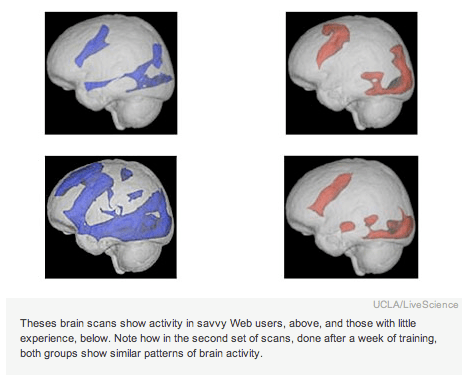
Research has shown that mental stimulation similar to the stimulation that occurs in individuals who frequently use the Internet may affect the efficiency of cognitive processing and alter the way the brain encodes new information.
“We found that for older people with minimal experience, performing Internet searches for even a relatively short period of time can change brain activity patterns and enhance function,” Dr. Gary Small, study author and professor of psychiatry at the Semel Institute for Neuroscience and Human Behavior at UCLA, said in a statement.
The UCLA team worked with 24 neurologically normal volunteers between the ages of 55 and 78. Prior to the study, half the participants used the Internet daily, while the other half had very little experience. Age, educational level and gender were similar between the two groups.
The participants performed Web searches while undergoing functional magnetic resonance imaging (fMRI) scans, which recorded the subtle brain-circuitry changes experienced during this activity. This type of scan tracks brain activity by measuring the level of blood flow in the brain during cognitive tasks. While the study involves a small number of people and more research on this topic is needed, small study sizes are typical of fMRI-based research.
After the initial brain scan, subjects went home and conducted Internet searches for one hour a day for a total of seven days over a two-week period. These practice searches involved using the web to answer questions about various topics by exploring different websites and reading information. Participants then received a second brain scan using the same Internet simulation task, but with different topics.
The first scan of participants with little Internet experience showed brain activity in the regions controlling language, reading, memory and visual abilities. The second brain scan of these participants, conducted after the home practice searches, demonstrated activation of these same regions, but there was also activity in the middle frontal gyrus and inferior frontal gyrus – areas of the brain known to be important in working memory and decision-making.
Thus, after Internet training at home, participants with minimal online experience displayed brain activation patterns very similar to those seen in the group of savvy Internet users.
“The results suggest that searching online may be a simple form of brain exercise that might be employed to enhance cognition in older adults,” Teena D. Moody, the study’s first author and UCLA researcher, said in a statement.
You can read the rest of this article from Live Science on AOL News by clicking here.
Farewell Dar al Thaqafa
We were sitting in a meeting when two friends rushed in, full of news of the fire down at the Souk al Diraa / Souk al Asseiri, familiarly known as The Fabric Souks. Our friend’s car had been near where the blaze broke out and they had been stuck while the firemen refused to allow her near her car, and finally they moved it out of the way for her, covered with ash and dirty water, but otherwise unharmed.
We all waited breathlessly to hear if the fabric souks were harmed. They weren’t. For such a big blaze, such a long-lasting fire, no lives were lost, no one was hurt, as far as anyone knows.
But in this morning’s paper, I see that while the fire started out a small fire, somehow, it was not contained, and in the clutter and chaos of the older souks, it grew, fed by stacks of stored goods and rubbish.
One of the victims was an old friend of mine – the Dar al Thaqafa. Little Diamond and I would often find treasures there, books you couldn’t find anywhere else. There are other bookstores in this chain, but this one, this Dar al Thaqafa was THE oldest bookstore in Doha, stocking school supplies, children and adult fiction and non-fiction, textbooks and obscure Islamic scholarly works. It was a quiet place, an old fashioned book-store, tucked behind the very tacky toy vender where I once bought both a dancing Osama bin Laden and a dancing Saddam Hussein.
We are sorry to see this old friend go. (They gave me permission to take these photos)

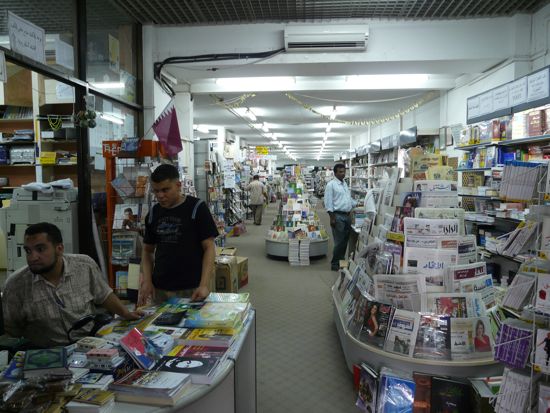
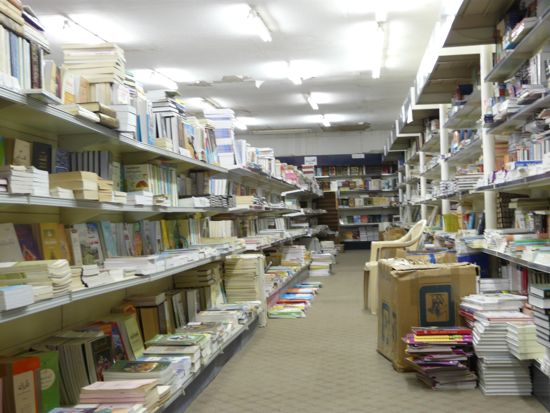
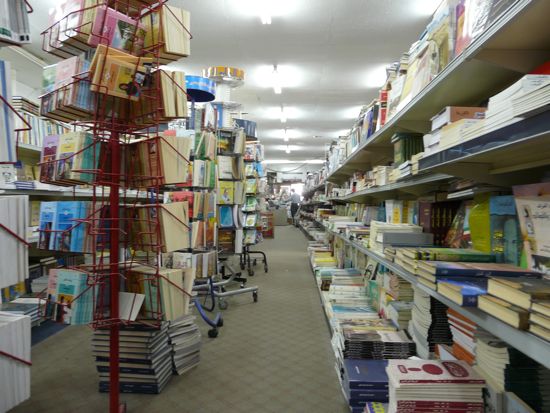
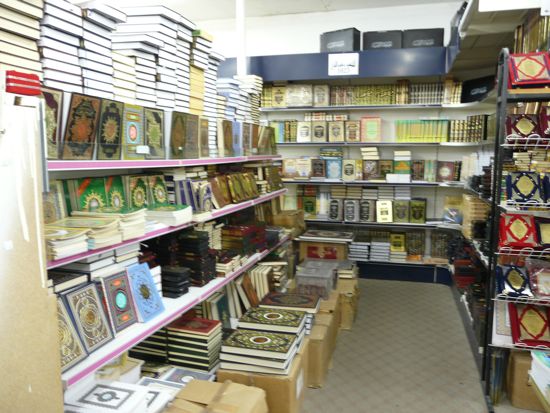

The area was full of small merchants, most of whom I suspect could ill-afford this loss of merchandise and income. I took a photo of an alleyway in the area of the fire (taken in July)

10 Riskiest Foods to Eat
Found this on AOL Wallet Pop where you can find amazing research and ideas on how to make your money go a little further. Although this study was conducted in the US, it seems to me that these would be the hardest foods to manage anywhere in the world.
Aimee Picchi
Think you’re safe eating foods regulated by the Food and Drug Administration? Think again, according to the Center for Science in the Public Interest, a non-profit health advocacy group.
What many consumers consider healthy foods — including eggs and leafy greens — are implicated in 40% of food-related outbreaks linked to FDA-regulated food, the Washington, D.C.-based CSPI says in a new study.
The watchdog group, which based its findings on outbreak data collected by the Centers for Disease Control and Prevention between 1990 to 2006, says the list of the 10 foods should sound an alarm to consumers and legislators because of the presence of so many healthy foods, ranging from tomatoes to sprouts.
“Many of the foods that made the list are a part of a healthy and balanced diet,” said CSPI staff attorney Sarah Klein on a conference call to discuss the findings. “Leafy greens are unfortunately no stranger to food-borne illness. The most common path are Norovirus, E. coli and Salmonella.”
The report from the CSPI, known for bringing the public’s attention to food issues such as the health dangers of trans fats, comes days after the New York Times highlighted the dangers of hamburger meat and the flaws in beef inspection. Some readers decided to swear off hamburgers for good after seeing the piece, writes WalletPop sister publication Daily Finance.
More than 1,500 separate outbreaks were linked to the foods on the CSPI’s list, which has led to almost 50,000 reported illnesses. The top 10 riskiest foods regulated by the FDA are, in order of the most outbreaks:
• leafy greens
• eggs
• tuna
• oysters
• potatoes
• cheese
• ice cream
• tomatoes
• sprouts
• berries
The report doesn’t differentiate between organic and non-organic foods, although the CSPI believes the risks are fairly similar, said Caroline Smith DeWaal, the director of the group’s food safety program, on the call. It also didn’t include meat, because the FDA doesn’t regulate the meat industry, she said.
So what should consumers do? Proper food handling and safety measures are important in home kitchens, ranging from cooking eggs thoroughly to taking care potatoes aren’t contaminated by other food. Because potatoes are always cooked, which would eliminate any pathogen, the reason why potatoes are linked to food-borne illnesses is likely from cross-contamination, DeWaal said.
And the report underscores the need for the passage of the Food Safety Enhancement Act, the CSPI said. The Senate should take the lead of the House and pass the legislation, which would give the FDA authority to require food processors to implement food safety plans and increase frequency of inspections.
Despite the call for change, food system in the U.S. remains relatively safe, said Dr. Craig Hedberg, a professor of environmental and occupational health at the University of Minnesota School of Public Health, on the call. Still, food-borne illness is “a major health concern,” he added.
Mediterranean Diet Can Help Fight the Blues
From BBC Health News comes a study that says not only is the Mediterranean diet good for your heart healt – it is also good for your mental health. If you are fighting the seasonal blues, fight back with olives, olive oil and a diet high in veggies and legumes.
The Mediterranean diet, already thought to protect against heart disease and cancer, may also help to prevent depression, Spanish researchers say.
They found depression was more than 30% less likely to develop in people who followed a diet high in vegetables, fruit and cereals, and low in red meat.
They studied 10,094 healthy adults over four years, the Journal of the American Medical Association reports.
However, the team stressed additional, larger-scale studies were required.
Researchers at the Universities of Las Palmas and Navarra recruited university graduates to take part.
Dietary patterns
They completed questionnaires and the researchers calculated their adherence to the Mediterranean dietary pattern (MDP) for an average of four-and-a-half years.
MEDITERRANEAN DIET FEATURES
• A high intake of monounsaturated fatty acids like olive oil
• A moderate intake of alcohol and dairy products
• A low intake of meat
• A high intake of legumes, fruit and nuts, cereals, vegetables and fish
Participants who had a strong adherence to the MDP tended to be male, ex-smokers, married and older individuals.
They were more active physically and showed a higher total energy intake.
The researchers identified 480 new cases of depression during the follow-up period – 156 in men and 324 in women.
They found that those with the highest adherence to the MDP were more than 30% less likely to develop depression.
They took into account marital status, the number of children and factors associated with a healthy lifestyle and found the relationship did not change.
Even taking account of personality traits, such as competitiveness and anxiety, had no effect on the results.
‘More research needed’
Professor Miguel Martinez-Gonzalez, of the University of Navarra, said the results would have to be confirmed in longer trials with more participants but they had found a strong inverse association between the Mediterranean diet and depression.
“Thirty per cent is a large reduction in the risk and this could be very important considering the large burden of disease represented by depression.
“We know how important the Mediterranean diet is in reducing cardiovascular risk factors and the same inflammatory proteins are also raised in patients with depression.”
He said it was likely that the overall dietary pattern was more important than the effect of single components and “may exert a fair degree of protection against depression”.
Dr Cecilia D’Felice, a clinical psychologist, said there was mounting evidence for the importance of diet in treating depression.
She said: “What we do know is that a diet high in olive oil will enhance the amount of serotonin or brain transmitter available to you.
“Most anti-depression drugs work to keep more serotonin available in the brain.”
Jaidah Flyover roadworks finish in five days
From today’s Gulf Times comes news that one of the worst current traffic snarls in town will be history in five days.
Do you believe it?
And now – how is the work on D-ring going? Any news on how soon it will be completed?
By Sarmad Qazi
The road works under the Jaidah flyover are expected to be completed in five days, an official said yesterday.
The busy junction leading to the Corniche and the densely-populated Musheireb area in one direction and to Ramada junction and the Salwa highway on the other was dug up towards the end of September for expansion work.
Read the whole article HERE
Live Longer: Marry an Educated Woman
From today’s BBC Health News comes an important discovery for Men’s health – men who marry educated women live longer. Educated women live longer. Who a man marries matters more than his own education. You can read the entire article by clicking on the blue type, above.
This study does not say you need to marry a Swedish woman. . . you need to marry an educated woman!
Educated women ‘aid long life’
A university education is important to longevity, the study suggests
A well-educated woman positively influences both her own and her partner’s chances of a long life, Swedish research suggests.
A man whose partner had only a school education has a 25% greater risk of dying early than if she had had a university education, it suggests.
The authors say educated women may be more likely to understand the various health messages their families needed.
The findings are based on a study of 1.5m working Swedes, aged 30 to 59.
The study, in the journal of Epidemiology and Community Healthcare, says that in the case of men, it is their income and social status that affect women’s lifespan.
The researchers looked at data from the 1990 Swedish census and followed up information on causes of death, including cancer and circulatory diseases like heart disease and stroke from the cause of death registers up to 2003.
University education
A woman’s education and social status were more important for a man’s life chances than his own education, the findings indicate.
Read the entire article HERE
Maid Builds Mansion with Elderly Employer’s ‘Gift’
This is a sticky situation – not a new situation, it is timeless, and not unique to Kuwait – it is everywhere. People with elderly parents need to pay attention; the elderly can be so vulnerable. He may well have given his caretaker the money. His poor 108 year old mother!
Maid coaxes elderly sponsor to sell home, buys villa with cash
KUWAIT CITY, Oct 3: Police have arrested a Sri Lankan housemaid who allegedly duped a Kuwaiti man in his 70s, and lured him into selling his home, reports Al-Watan Arabic daily.
It is reported the woman, who was working for the old man, induced him to sell his home, and then took the money from him. She is said to be worth about KD 120,000. She has also built a mansion in her home country.
A security source said the man’s mother, who is about 108 years old, and his family have lodged a complaint at the police station. However, the maid claims the man had given the money to her of his own free will.
Recent Comments
Kitchen on Isiais: Winding Down intlxpatr on Shampoo Ginger tigerbutterya0c5ff1d… on Shampoo Ginger intlxpatr on British Soldier Kidnapped, Esc… John on British Soldier Kidnapped, Esc… Wikipedia Donate Button

Amazina


Early Voting in Florida


