Spotting Infections in Your Elderly Parents
I am printing this entire article because few of you will be reading the Military Officers Association of America newsletter, and this is one of the best articles I have seen on the subject. It is SO easy to dismiss a parent’s complaints as just being a normal part of aging – and it is important to catch these things early.
Role Reversal — How to Spot Infections
2008/08/22 00:00:00
By Nanette Lavoie-Vaughan
The next time your parent complains of feeling “out of sorts” or gives you a vague list of minor problems, don’t dismiss it as normal grumpiness. There’s a good chance your parent could have an infection.
Diagnosing the elderly with an infection can be difficult. Seniors are less likely to have classic symptoms such as fever, chills, and vomiting. Instead they might have atypical symptoms such as subnormal temperature, confusion, fatigue, and decreased appetite. In many cases, these subtle signs can be attributed to the normal aging process — or ignored until the late stages of the infection.
Let’s take a brief look at how the infection process works. When the human body is under stress or exposed to bacteria and viruses, it triggers a healing chain of events that, in most cases, results in the prevention of infection or illness. However, when the amount of bacteria is too great an infection occurs. At that point, the immune system kicks in doubly hard, releasing a flood of chemicals to attack the infection and promote recovery.
Seniors are more susceptible to infection because multiple chronic illnesses that occur with age put extra stress on the body, and the medications for these conditions can block the immune system. In addition, the immune system naturally weakens as we grow older.
The most common sites for infections in older adults are the urinary tract, the respiratory tract, and the skin. It also is common for seniors to develop an infection prior to an acute deterioration of their chronic medical condition or in combination with other acute medical problems. A typical example is the person with congestive heart failure who develops pneumonia. The symptoms of cough, congestion, and shortness of breath are similar and might occur simultaneously, or the onset of pneumonia might precipitate an acute attack of congestive heart failure.
So how do you know if your parent is developing an infection? Look for:
an acute change in his or her ability to perform day to day activities;
subnormal temperature;
increased pulse rate;
unexplained dehydration;
confusion;
poor appetite; and
fatigue with increased aches and pains.
For specific infections you might want to look for the following signs:
Respiratory infections
Cough
Increased mucus
Abdominal pain
Headache
Chest pain
Generalized weakness
Loss of appetite
Urinary infection
New onset of incontinence
Pain with urination
More frequent urination
Flank pain
Weakness
Blood in the urine
Skin infection
Redness
Warmth
Pain or tenderness
If you note any of these symptoms, due diligence requires a complete medical evaluation to determine the source of the infection and any other acute medical problems.
Why is this so important? The risk of sepsis, an overwhelming infection that enters the bloodstream, is higher in the elderly. The longer these types of symptoms go untreated, the more likely the bacteria will find its way into the bloodstream.
Another concern is the prevalence of antibiotic-resistant infections. The overuse of antibiotics for viral illnesses and the common cold have caused bacteria to mutate and become resistant to antibiotics that once treated most infections. The three super infections that pose a threat are Methicillin-resistant Staphylococcus aureus (MRSA), Clostridium difficile (C diff), and Vancomycin-resistant enterocolitis (VRE).
MRSA is diagnosed by obtaining a culture of the body fluid (sputum, urine, blood) where the infection is present. MRSA infections can occur anywhere in the body, and even though treatment with Vancomycin appears successful, a small amount of the bacteria can remain — a phenomenon medical professionals refer to as colonization. The remaining bacteria can cause infections to reoccur at any time.
C diff and VRE both cause diarrhea and are the result of antibiotics killing the normal, beneficial bacteria that reside in the intestinal tract and allowing infection-producing bacteria to proliferate. C diff can occur after the prolonged use of any antibiotic; VRE is specific to the use of Vancomycin. Treatment includes preventing dehydration associated with diarrhea, a bland diet, and bulking agents to decrease the amount of diarrhea, and administration of Flagyl to treat the condition and allow the normal bacteria to return to appropriate levels.
The good news is that most infections are isolated and can be treated with short-term antibiotics. Basic preventative measures — such as assuring that your parents have a pneumonia vaccination, receive the flu vaccine yearly, avoid others with acute infections, and stay well-hydrated — can decrease the likelihood of serious infections.
In addition, keeping the skin well moisturized can prevent skin infections. Dry skin is more likely to crack and tear, providing an opening for bacteria to enter. Urinary tract infections are prevented by good hygiene and adequate fluid intake.
Infection in the elderly is a serious concern, but a few simple measures and a diligent eye are all it takes to keep your parents healthy.
(For more information about infections in the elderly, super infections, and vaccinations go to http://www.health.nih.gov/topics. )
Nanette Lavoie-Vaughan is an adult nurse practitioner and professional consultant. She is a featured speaker at national professional conferences and writes about geriatrics for multiple publications. If you’d like to send Nanette a comment, question, or suggestion for a future column, please e-mail rolereversal@moaa.org.
“We Didn’t Have a Refrigerator”
We were eating breakfast together, my Mom and I, when she dropped a bomb. I had no idea she could catch me by surprise that way. We’d been talking about fresh peaches, and preserves.
“When your Dad and I got married, we didn’t even have a refrigerator,” she said.
Not have a refrigerator? You can get married and not have a refrigerator?
“How did you get one?” I asked, still reeling from astonishment.
“Your Dad inherited $100 from some very distant relative,” she related, “he got like 1/32nd, which came to $100. We used it to buy a refrigerator.”

“What did you do before you had it?” I asked, still a little disoriented.
“Well, it was Alaska,” she said. “We had these sort of pantries that had shelves with little holes opening to the outside, covered with screen to keep out insects and mosquitos, but it would let in the cool air. It didn’t get that hot, even in the summer. In the winter, we had shelves on the outside porches, too.”
Holy smokes, I thought to myself. How would I function without a refrigerator? We would have to go back to shopping every day. If there weren’t refrigerators, maybe stores wouldn’t have frozen sections, too? Maybe we would have to be buying meat just as it was slaughtered, only vegetables that could travel from not too far without refrigeration, we would be using a lot more grains and things that didn’t need refrigeration to preserve them.
Maybe we would be drying more foods? We would probably, in Kuwait, be eating more dates and rice, eating more locally raised foods – what, sheep? camel meat? We would probably be eating a lot more fish. We would probably go back to canning foods while they were abundant – tomatoes, fruit jams, maybe we would even pickle some fish and/or shrimp for out-of-season eating. Our food might be saltier, as salt is also a preservative. Maybe we would eat more rice, more pomegranate . . . maybe occasionally a boat would come in from Ethiopia or Kenya bringing rare coffee beans, and only very special, very lucky people would have access to the little luxury we all take for granted.
Ooops. Well, I am getting carried away. I was so amazed to hear my mother had initially kept house without a refrigerator that I sort of spaced out.
She went on to tell me that as she was growing up, her family had an ice box, and they would put out a special piece of paper when they needed ice from the ice man, who would drive by every day to provide ice for the cool-boxes. The ice came in different sizes, depending on the size of the ice box.
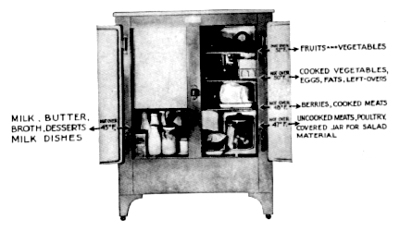
(I found this picture and a fairly clear explanation of ice boxes on on Wikipedia.)
It gets better. As I was reading the Wikipedia information, I came across the Pot in Pot refrigerator , known in Arabic as a “zeer” for which Mohammed Bah Abba was awarded a Rolex Laureate (Rolex Awards for Enterprise) in 2000. You can read about Mohammed Bah Abba, the Nigerian teacher who developed this simple, but effective refrigeration technique, by clicking on the blue type above. You can read more about the Zeer pot, and see a photo of how they work, by clicking here: Science in Africa.
Riots and Internet Offenders
From today’s Arab Times:
Kuwait preparing law to punish ‘Internet offenders’: Al-Othman
KUWAIT CITY (AP): Kuwait’s prosecutor general says Internet offenders will no longer be able to escape punishment in this country. Hamed Al-Othman says in an interview with Al-Qabas daily published Sunday he has prepared a bill that criminalizes promoting vice, incitement against the country’s leadership, divulging state secrets, or insulting Islam on the Web. If convicted, offenders would be sentenced to up to one year in jail and/or a fine, but face seven years in prison if their victims are minors. Al-Othman’s office confirmed that he made the comments to Al-Qabas.
The draft Internet crime and data information law recently passed by the Public Prosecution Department will be forwarded to the Council of Ministers for their consideration, adds Al-Othman.
Al-Othman explained the importance of passing such a law at this time, saying “it’s obvious to all who care about protecting our customs and the future generations that such a law is needed to combat the increasing electronic crimes associated with the ever-improving electronic technology. “The law will include 37 articles and punishment for those who fall foul of the law will be either jail sentence or financial fine,” he added.
Protest turns violent in fight over pay
KUWAIT CITY : A riot by about 2,000 workers of Al-Jawhara Company for Stevedor-ing and Cleaning in their camp in Hassawi led to the destruction of six vehicles and injuries to five camp officials, says K. John, the company’s Operations Manager. The manager was speaking to the Arab Times Sunday after the riot was brought under control by policemen. The riot, which began Saturday night, reached its peak by Sunday morning and continued till noon. The workers, John said, were disgruntled over their wages and were demanding a hike, talks over which have been going on for the last couple of weeks. “The recent outbursts in other cleaning companies stoked the angry workers to violence Saturday,” he added.
Meanwhile, late Sunday evening, the Ministry of Social Affairs agreed to almost all demands of workers of cleaning companies who had threatened to go on strike, besides setting a minimum wage of KD 40 for cleaning workers – without any deductions an embassy official said on condition of anonymity. The embassy official added that the ministry has also asked the cleaning companies to pay for health and residency fees of their workers and that companies which violate the rights of workers will face “full force of the law.” The official also said that Bangladeshi officials, who maltreat or exploit their workers, will be referred to the concerned authorities.
A mob of hundreds of Bangladeshi cleaners had attacked their company’s office in Jleeb Al-Shyoukh Saturday evening, and beat up five supervisors who were reportedly exploiting the workers, some cleaners told the Arab Times.
The workers were protesting about their unpaid wages and poor working conditions. All five supervisors are Bangladeshis and are currently being treated at the Farwaniya hospital.
A cleaner said the condition of the two injured officials was critical. However, this could not be independently confirmed.
The cleaners reportedly damaged furniture, computers, printers and other office equipment in the attack that lasted for a few minutes.
According to the workers, no arrests were made and a large police force was deployed at the camp from Saturday evening until late Sunday afternoon.
The timely arrival of police and embassy officials prevented the situation from spiraling out of control, added the cleaners. The workers said that they embarked on indefinite strike from Sunday and that they will not return to work unless all their problems are redressed by the company.
This is the first violent demonstration to grip Kuwait since the strikes of Bangladeshi cleaners began last Sunday.
Some of the problems facing the workers include: underpayment; company is making them pay for the health and residency fees; some cleaners are made to work for more than eight hours without any overtime benefits; company is not allowing workers to take vacation every two years; company is not granting sick leave, among other problems.
About 5,000 Bangladeshi cleaners are employed with this local company and are placed at various government establishments.
Jleeb Al-Shyoukh is home to thousands of Bangladeshi cleaners, who live in squalid camps and a majority of them are paid as low as KD 18 salary.
Another worker told the Arab Times that the problem had been simmering for a long a time and that the five supervisors were warned by them not work against workers’ interests.
He added that the trouble began when some of the workers confronted the supervisors as to why they were deducting their pay and that two supervisors reportedly threatened some cleaners, thereby leading to the showdown.
He said that the officials of the ministry of social affairs and labour rushed to the camp Saturday evening and urged the workers not to resort to violence and that they would put an end to their grievances as soon as possible.
Expressing his views on the company’s alleged apathy, another worker said: “We tried to resolve our problems with the company in an amicable manner, but our appeals fell on deaf ears. The supervisors in question are hand in glove with the company’s managers and used to report every development that took place at the camp.”
“When we decided to go on strike a few days ago, the supervisors quickly informed the company. The company then scuttled our plans by turning up the heat on our representatives. We know it is wrong to take the law in our hands but our situation was worsening by the day.”
The ministry of social affairs and labour has taken tough measures against cleaning companies that violate rights of workers, even as the ministry recently said that it had cancelled the contract of a company whose workers went on strike last Sunday.
On Saturday, senior officials of the ministry managed to convince some 7,000 Bangladeshi cleaners to drop their strike, who had threatened to stop work on Sunday if their demands were not met.
According to the workers, the ministry has agreed to all their demands and that they would be paid KD 40 salary, up from KD 8. It was also reported earlier that the ministry will soon send inspectors to labour camps to take a stock of workers’ living conditions and also to address their grievances.
When asked why the workers were unhappy over the wages, John said the issue is very complex, and the government is partly to be blamed for the current state of affairs. “The workers demand health insurance, which is KD 50 per person, while it is only KD 10 for domestic maids. This makes it very difficult for companies to provide health insurance of its workers.
“The municipality pays just about KD 23 per cleaning worker, and the government can’t expect us to pay more than that. Our workers receive anywhere between KD 20 and KD 70 depending upon their rank and job.
“Tendering rules also need to be reformed by the government. There are many small players who make abysmally low quotes to win tenders and bring down the quality of this sector. This despite the fact that we need to show bank guarantees of very huge sums to win tenders,” John explained.
Stressing the cleaning companies are an asset to the nation and should be treated with due importance, John said “the government has to provide us lands at subsidized rates to help sustain the industry.
“The workers ransacked the rooms in the camp and destroyed some computers. We also suspect that workers from neighboring camps joined in the riot, adding to the ferocity of the violence. The project manager had to be rescued from the camp by the police from the marauding rioters,” he revealed.
When asked what future course of action the company is planning to take, John said a meeting of the Cleaning Companies Association was called Sunday evening, “and the issue was to be discussed to find a solution to this problem that’s getting out of hand.”
“The demands of the workers are not wholly over the board given the inflation rates in the state. If the issue is not resolved many government institutions and private companies will be hit,” John added.
“The workers at Al Jawhara Company do not have any unpaid dues and all their salaries are paid in time,” he concluded.
Also:
KUWAIT: Acting Assistant Undersecretary of the Ministry of Social Affairs and Labour for labour sector Hamad Al-Me’dhadi revealed Sunday that the main reason behind the majority of recent strikes was the demand for salary increase.
He said that the Ministry of Social Affairs and Labour will report to the Cabinet on these strikes coinciding with another report to be submitted by the Ministry of Interior in this regard.
He added that ministry officials met with a representative of the Bangladeshi embassy and informed him that the strike of laborers must be expressed in an orderly manner and according to official channels.
He pointed out that it had been agreed with the Bangladeshi embassy that there should be representatives for all those laborers so that the ministry’s legal researchers and inspectors can listen to the workers demands.
Meanwhile, the issue of continuous strikes by expatriate workers and their rights are on top of the agenda for the Council of Ministers’ meeting on Monday. The meeting will be presided by the Acting Prime Minister and the Defense Minister Sheikh Jaber Al-Mubarak Al-Sabah.
“The Cabinet is ready to sanction erring companies and they may request the National Assembly to pass the new labor law at the beginning of the next parliamentary term,” Source added.
By Francis A. Clifford Cardozo and Valiya Sajjad
Arab Times Staff
Down the Drain
As I was wandering through the Co-op (Jamiya) the other day, picking up a few basics, I came across something not-so-basic – a bottle of alcohol-free Merlot.
I was making spaghetti sauce – and here is the truth as I see it – almost any sauce is improved by the addition of a little wine. And this is alcohol-free! I can serve it to my Islamic dinner guests.
The sauce was superb, even if it is me saying it about myself. Just a basic meat sauce, but with the fresh basil from our friend’s prolific garden, and the cup of Merlot – sublime.
That was a week ago. Today, I went to use the Merlot in another sauce and HORRORS! Look at that!

Can you see that? That great big spot of MOLD growing on the Merlot-drink-that-does-not-contain-alcohol???
I had to throw it all out. I don’t take chances on making people sick from food bourn illnesses, not even myself. And while AdventureMan and I are generous in our nature, we are frugal in our private lives, and throwing nearly $16 literally down the drain horrifies me! Maybe it was the humidity – my bread also went green very quickly – or maybe it is the non-alcohol that allowed it to mold so quickly. I don’t know. I don’t think I will be buying another bottle of Merlot here in Kuwait any time soon.
Strange Bird

It’s the strangest bird. He settles on the balcony off my kitchen around dusk. It doesn’t bother him that I am inside moving around, preparing dinner. It doesn’t bother him in the least that the Qatteri Cat is jumping at the window and miow-ing wildly. When I bribe the Qatteri Cat to leave the kitchen, and I shut the door and take some bread pieces out to the bird, he doesn’t fly away.
He’s still there when I go to bed. He is there at 4 in the morning, when I can’t stand not knowing if he is there or not. When I get up – after dawn – he is gone.
I am glad he felt safe enough to spend the night on the balcony. I am also glad he was able to fly away the next morning – I was afraid he wasn’t well. Maybe stunned from flying into a window or something. Maybe (gasp) bird flu. It was a relief to know he flew away on his own power, and that he he was just spending the night on my balcony.
Fresh Orange Souffle
This recipe is a little more complicated than most, because of the collar, but once you’ve done it – and it isn’t that hard – it is a piece of cake. You can leave out the Grand Marnier and it still tastes just fine. Delicious and cooling, light on a hot hot hot summer’s eve in Kuwait – or anywhere else. 🙂
Fresh Orange Souffle
This is another recipe from our time in Tunis, where oranges are so good and so sweet!
2 small naval oranges
2 envelopes unflavored gelatine
6 eggs
1 cup sugar
1 can frozen concentrate for orange juice, thawed
2 Tablespoons lemon juice
1 pint heavy cream
1/4 cup Grand Marnier or other orange flavored liquer
1. Prepare six cup clear souffle dish, or other clear straight sided glass dish with a collar – here’s how. Fold a 24” length of waxed paper in half lengthwise, wrap around dish to make a 3 “ extension of dish. Tape or use string to hold in place. (You use a clear glass dish so that the sliced oranges show around the sides)
2. Cut one orange into thin slices, arrange slices against side of souffle dish, chill.
3. Grate rind from remaining orange, measure 4 teaspoons.
Squeeze the juice of the oranges; measure into 1 cup measure adding water, if necessary, to equal 1/2 cup. Sprinkle gelatin over the orange juice, let stand 5 minutes to soften.
Set cup in a saucepan of simmering water, stirring until gelatin is completely dissolved. Remove from heat.
4. Beat eggs and sugar in a large bowl with electric mixer at high speed until thick and light. (10 – 20 minutes)
5. While eggs are beating, whip 1 1/2 cups of the cream in a small bowl until soft peaks form, refrigerate.
6. Combine orange rind, orange juice concentrate, lemon juice, orange liquer and dissolved gelatin; pour into egg mixture. Continue beating the mixture until it is well blended. Remove bowl from mixer, chill about 5 minutes by placing in larger bowl lined with ice cubes. Stir often, just until mixture mounds slightly when spooned.
Fold whipped cream into chilled mixture until no streaks of white remain. Pour into prepared dish, taking care not to disturb the orange slices. Refrigerate until firm, about 4 hours.
9. To serve, gently remove collar. Beat remaining cream in a small bowl until stiff. Garnish with chopped pistachio nuts.
Warning: Ummm, I just remembered, this is an old fashioned recipe that uses raw eggs. People with immune system difficulties, pregnant women, anyone worried about raw egg issues should not eat this souffle.
Ministry Conducts Demographics Study
This is from today’s Kuwait Times. I LOVE demographics. I love tagging factors, loading them all into a data base and seeing where the stats fall. You learn so much.
The Ministry of Social Affairs and Labor is studying effective means to rectify the country’s demographic imbalance. The ministry has reportedly reached the conclusion that the blend of different nationalities in Kuwait has proved detrimental to its societal fabric. One Arab nation’s expatriate population in the country has exceeded 300,000, sources say, which puts the states economic and political stability at great risk. Sources said that the matter is complicated and needs all the ministries’ undivided support.
Expatriates, it is felt, bring with them their own modern culture and customs which are alien to the local citizens, most of whom follow archaic customs deeply rooted in tribal practices. Expatriates are also accused of taking the law into their own hands without approaching the concerned authorities whenever they are confronted with a problem. It has also been observed that expatriates belonging to a certain nationality inhabit certain areas in droves, leaving security officials at a loss to change the situation.
As a move towards controlling the situation, the ministry is to form a permanent committee comprising officials from different ministries to scrutinize all the expatriates who arrive at Kuwait.
It will issue a fitness certificate to eligible expatriates on the lines of medical fitness test. Employers will then be able to decide whether to appoint those workers or repatriate them. The ministry also plans to come down heavily on expats who obtain jobs using illegal residence permits.
Hmmm. Rectifying the population imbalance might require giving up expatriate labor. What laborers do you want to give up? The largest number are probably doing low-skill level work – cleaning houses, cleaning the streets . . .Or do you want to give up those who are managing your stores, taking your orders in all the restaurants, cooking, taking care of the office chores?
I can guess which expatriates are bringing in alien modern customs and practices, but unless you are going to give up television, cable, the internet and travel . . . that train has probably left the station.
So which nationality has over 300,000 expats in Kuwait? And which nationalities “inhabit certain areas in droves?”
Who takes the law into their own hands?
Weight Loss: Fat Burning Beads
I could not believe my eyes. Would you buy these beads? You can read the entire story at BBC Health News.
‘Fat-burning’ bead marketing ends
A company that said its “fat-burning” beads triggered “automatic weight loss” has agreed to stop marketing in the UK.
One claim suggested that Accu-Slim Beads worked “faster than total starvation” by placing one bead behind each ear.
The Office of Fair Trading (OFT) sought assurances from Global DM Licensing, based in Hong Kong, that it would stop mailings being sent to UK consumers.
The OFT says thousands fall victim to claims about weight loss products.
Misleading claims
The company, using the name The AccuSlim Centre, claimed the beads were “fat burning acupuncture without needles, diets, exercise or effort”.
It claimed that users could eat as much as they liked but still lose 30lbs in 30 days, as the bead stimulated acupressure points that led to automatic weight loss.
The company claimed guaranteed results and charged £65 for a package of up to 120 beads.
OOps – I just noticed that they only have to stop marketing these beads in the UK. So if someone approaches you on the streets of Kuwait offering to sell you fat-burning beads (wouldn’t you feel like punching someone who thought you needed fat burning beads?) DON’T BUY THEM! THEY DON’T WORK!
More Three Cups of Tea
The timing couldn’t be better. Thank you, Phantom Man, for sending a link to this New York Times article on Three Cups of Tea, from the July 13th New York Times.
By NICHOLAS D. KRISTOF
Published: July 13, 2008
Since 9/11, Westerners have tried two approaches to fight terrorism in Pakistan, President Bush’s and Greg Mortenson’s.
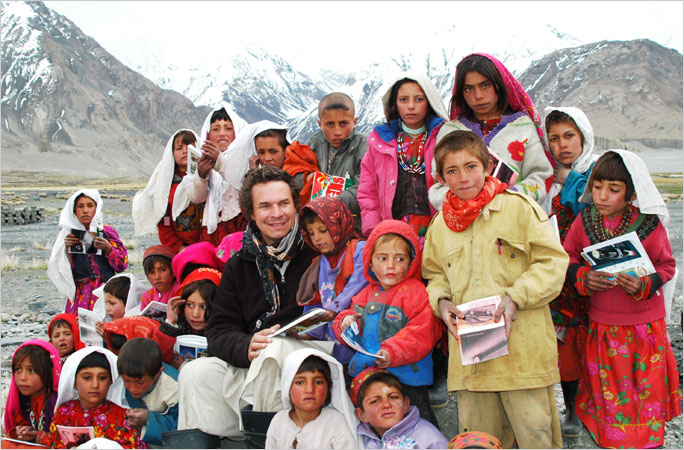
Greg Mortenson with Sitara “Star” schoolchildren. Photo: Fred R. Conrad/The New York Times
Mr. Bush has focused on military force and provided more than $10 billion — an extraordinary sum in the foreign-aid world — to the highly unpopular government of President Pervez Musharraf. This approach has failed: the backlash has radicalized Pakistan’s tribal areas so that they now nurture terrorists in ways that they never did before 9/11.
Mr. Mortenson, a frumpy, genial man from Montana, takes a diametrically opposite approach, and he has spent less than one-ten-thousandth as much as the Bush administration. He builds schools in isolated parts of Pakistan and Afghanistan, working closely with Muslim clerics and even praying with them at times.
The only thing that Mr. Mortenson blows up are boulders that fall onto remote roads and block access to his schools.
Mr. Mortenson has become a legend in the region, his picture sometimes dangling like a talisman from rearview mirrors, and his work has struck a chord in America as well. His superb book about his schools, “Three Cups of Tea,” came out in 2006 and initially wasn’t reviewed by most major newspapers. Yet propelled by word of mouth, the book became a publishing sensation: it has spent the last 74 weeks on the paperback best-seller list, regularly in the No. 1 spot.
Now Mr. Mortenson is fending off several dozen film offers. “My concern is that a movie might endanger the well-being of our students,” he explains.
Mr. Mortenson found his calling in 1993 after he failed in an attempt to climb K2, a Himalayan peak, and stumbled weakly into a poor Muslim village. The peasants nursed him back to health, and he promised to repay them by building the village a school.
Scrounging the money was a nightmare — his 580 fund-raising letters to prominent people generated one check, from Tom Brokaw — and Mr. Mortenson ended up selling his beloved climbing equipment and car. But when the school was built, he kept going. Now his aid group, the Central Asia Institute, has 74 schools in operation. His focus is educating girls.
To get a school, villagers must provide the land and the labor to assure a local “buy-in,” and so far the Taliban have not bothered his schools. One anti-American mob rampaged through Baharak, Afghanistan, attacking aid groups — but stopped at the school that local people had just built with Mr. Mortenson. “This is our school,” the mob leaders decided, and they left it intact.
You can read the entire article in the New York Times by clicking on the blue type.
Three Cups of Tea
My best-friend-from-college and I were chatting the other day and I asked her “what are you reading?” because we have always exchanged book recommendations back and forth.
“I’m reading a biography of Teddy Roosevelt,” she started, and I groaned, because most of the time biographies don’t interest me that much. “And I am reading Three Cups of Tea . . . “ and I interrupted her (rudely) to exclaim “so am I!”

Three Cups of Tea is a must-read in the US. It was actually published in 2006, and has sold more and more books every month, and has been on the New York Times best seller list almost since it was published.
The book begins with a failure. A mountaineer, attempting a climb on K2 runs into problems, including evacuating two severely injured fellow climbers from the mountain. Exhausted, and devastated by his failure to capture the summit, he gets lost on his way back to the base camp, and ends up in a village where the people are very kind to him. He is treated as an honored guest, he regains his strength, and on his last day in the village, learns the children have no school. He rashly promises to come back and build a school for them.
One of the great redeeming features in this book is Greg Mortenson’s endless humility. He has a co-author, to whom he gave a long list of people he could talk with, including all his enemies and people who thought he was crazy. He’s that kind of guy. He talks about his life’s personal failures and his toughest moments, and he moves on.
He doesn’t take credit for the dogged persistence with which he keeps his promise, in spite of daunting obstacles. He doesn’t take any credit for the good will he builds.
Several years ago, I read another book which has changed my life, The Purpose Driven Life (which, by the way, the hardcover is $9.99 and the paperback is $10.19, go figure) in which the basic premise of the book is that we are each created uniquely, individually, by a loving creator, for a purpose. As I read Three Cups of Tea, I thought this man is greatly blessed; he discovered his purpose and nothing kept him from fulfilling it!
The book deserves every single one of it’s Amazon Five Star ratings.
I had a hard time putting the book down. Even though my life is full of other demands, once I had the chance, I spent an entire afternoon finishing this great book.
Greg Mortenson isn’t discouraged that his first school takes three years, and first he has to build a bridge. His second, third and fourth schools take just . . . three months! He has a gift for inspiring others, and people give what they can. The villagers give their time and their efforts, and western supporters donate funds.
By the end of the book, 24 school have been built, in the very poorest mountain villages in Pakistan, where money from the government for education doesn’t trickle at all, until near the end of the book. He doesn’t build the schools himself – he meets with the villagers, they donate a plot. He buys the materials, and together, they all build a school. These villagers are hungry for their children to become educated, to have a chance for a better life. Mortenson learns to focus on the girls.
He learns that as the boys become educated, they leave the villages for the city, but as the girls become educated, they come back, and like yeast, they raise the standard of living for the entire village, providing health care services and information, providing education for the newest crop of children, learning new skills, bringing them back and sharing them.
One of Mortenson’s gifts is that he isn’t interested in changing these mountain people into westerners. He likes them, and he learns from them, just the way they are. He dresses like them, he prays with them, he learns their language, and he has no western agenda for the curriculum in these schools. He also helps the government schools – building an additional room here for an overflowing school, paying a teacher’s salary there – his goal is to educate children. That’s it. No political agenda. The people of the villages love him for it, and give him their full support.
You cannot undertake a project like this without a lot of help. Mortenson had some extraordinary experiences, experiences that to me look like the grace of God, that drew together teams of people to help build and supply his schools.
“I looked at a sign in front of the school and saw that it had been donated by Jean Hoerni, my cousin Jennifer’s husband,” Bergman says. “Jennifer told me Jean had been trying to build a school somewhere in the Himalaya, but to land in that exact spot in a range that stretches thousands of miles felt like more than coincidence. I’m not a religious person,” Bergman says, “but I felt I’d been brought there for a reason and I couldn’t stop crying.”
A few months later, at Hoerni’s memorial service, Bergman introduced herself to Mortenson. “I was there!” she said, wrapping the startled man she’d just met in a bruising hug. “I saw the school!”
“You’re the blonde in the helicopter,” Mortenson said, shaking his head in amazement. “I heard a foreign woman had been in the village, but I didn’t believe it.”
“There’s a message here. This is meant to be,” Julia Bergman said. “I want to help. Is there anything I can do?”
“Well, I want to collect books and create a library for the Korphe School,” Mortenson said.
Bergman felt the same sense of predestination she’d encountered that day at the school. “I’m a librarian,” she said.
After struggling for many years, seeking donors who would help to build a school, Mortenson now has a foundation eagerly supported by many Americans, and especially the mountaineers, who continue to build schools. At the end of the book, the foundation is moving into the poorest sectors in Afghanistan, and building schools there. They have children’s programs in many of the schools in the United States, where children donate pennies to help pay for books for the schools, and for the teacher’s monthly salaries, where salaries are not reaching the teachers. You can donate to the school building fund, teacher’s salaries and books using your credit card, online, at the website Three Cups of Tea. You can order this book there, too, as well as music CD/s and learn more about the work being done.
Recent Comments
Kitchen on Isiais: Winding Down intlxpatr on Shampoo Ginger tigerbutterya0c5ff1d… on Shampoo Ginger intlxpatr on British Soldier Kidnapped, Esc… John on British Soldier Kidnapped, Esc… Wikipedia Donate Button

Amazina


Early Voting in Florida


